Tuesday, July 19, 2011

Lazy Hazy Dayz of Summer

Here in the Midwest we are stuck under a "heat bubble."  Texas to Michigan, we are all suffering together in ridiculously hot and humid weather.  Bleh.  

So, what's a girl to do?  Why, go paddling, of course!

On Sunday, GREAT (The Grand River Environmental Action Team) was hosting a paddle on the northern branch of the Kalamazoo River.  I had my doubts at first, for it was in the 90s, with humidity in the 90s, and the paddle would go through the hottest part of the day (it began at noon).  But, I loaded the Spitfire anyway and drove an hour to the put-in spot.  They had a shuttle service set up, so after dropping off our boats, we drove to the take-out up in Albion and caught a ride back to Kings Road.

I was one of the last boats in the water, and because I was being a naturalist, I soon was the last boat.


How wonderful to see some old friends, like pickerel weed.


It was a day for damselflies.  If I saw one, I must've seen a thousand this day, mostly ebony jewelwings and these little tiny bluets.


Most of the river passed through open land...no shade to be had.


There were plenty of wild roses blooming along the banks.


Another old friend, arrowhead, was blooming in fair profusion.  Some were submerged, which was odd since we haven't really had any rain to speak of in a long while.


This damselfly led me on a merry chase.  It's an American rubyspot, and when it flies, it flashes a brilliant red from its wings, as if the sun was glaring off a ruby.  It is a very nervous insect and just wouldn't sit still for a photograph.  I must've chased about a dozen of these before I finally got one decent shot.


There were quite a number of these blinds along the river.  Somehow, I doubt they are bird blinds...unless they are for duck hunters.  Maybe they are deer blinds?


Parts of the Kalamazoo were quite shallow.  Twice I got hung up on a sand bar.  According to Gary, this is a good river for brown trout, which apparently can reach some prodigious sizes.


By this time I was well behind the rest of the paddlers, so I had high hopes of seeing some wildlife.  As I was drifting along (the current was pretty good), I started to hear this splashing and sucking noise.  Off to my left, a tributary entered the main waterway.  I saw some ripples on the water's surface and thought that perhaps one of the other paddlers had taken a detour to see what was up the channel.  As I passed and turned around to look upstream, this is what I saw:


When she saw me, she froze.  Then she decided that I was just too scarey and she took off - behind her was a second deer, who bolted around the bend before I could capture its image.


A short while later I also saw a sandhill crane's head peeking above the tall vegetation, but it ducked before I could get a photo.

I was now entering some farm lands.


The presence of electric fence on posts in the river was not reassuring.  This must mean that cattle are allowed in the river. While on the one hand this seems to make sense, for the animals can drink and wallow to stay cool to their bovine hearts' content, but from a river health point of view, it is not so good.  Cattle cause a great deal of erosion along riverbanks, and we won't even mention the "pollution" they add to the water.

Now, I've paddled down rivers when I've had to go around cattle (I'm thinking of the Raritan in New Jersey).  It's interesting.  But I was glad to not see any cows today.  However, one of the trip leaders later asked me if I'd seen the cows in the water - apparently they were bathing when she went by.


It's milkweed season.  I'm thinking this is swamp milkweed, with the narrower leaves.  


Here we are at our first obstacle.  One of the trip leaders was stationed here to guide boats to the left side of the river, so they could line up for a shot under the bridge and through the rapids.


Here's the line-up...


 ...and here we go!  Woo-hoo!


Bank beavers!  I guess this was the biggest surprise of the trip for me.  I don't expect to see beavers down here in farm country.  To me, beavers are animals of the northern wilderness.  But, according to Gary, they are definitely here in the Kalamazoo.


Vervain.  A very tall vervain.  My wildflower book is at home (I looked at it before I left the house at 6:15 this morning), so I can't tell you which vervain this is right now.  I'll come back to that.

More farms.


And another damselfly.  This one is a river jewelwing.  Like the ebony jewelwings, these damsels have beautiful metallic blue or green bodies, but only the tips of their wings are black.  Just for the record, photographing damselflies who won't sit still from a boat that is drifting on a swift current is not easily done.  I'm lucky this is as clear as it is!


Halfway there, Kenny, GREAT's president, was on the bridge to document each paddler's journey.  Here's my photo of Kenny taking of a photo of me taking a photo of him.


Shrubby cinquefoil was in bloom in a few places along the river. HM...it seems like a good number of the plants I saw this day were species I saw every summer in the Adirondacks.  I guess they do just as well in warm, alkaline areas (southern Michigan) as they do in cooler, more acidic habitats (Adirondacks). 


My attention was grabbed by a bird flitting around this tree.  Then I spied the hole.  It was a bird with a nest in a cavity.  I crashed into the bank, had to extricate myself and reposition the boat so I could get a photo.  The sun, of course, was behind the bird, so everything is in silhouette, but I'm pretty sure it was a bluebird in its natural habitat!  No nestboxes for this bluebird - it was nesting in a cavity in a tree.  Huzzah!


Obstacle number two:  the culverts.


For those who were unsure of their skills, Kathy, another member of the GREAT crew, was on hand to maneuver boats into position.


Some paddlers guided their own boats through.


I was among the latter group and got myself lined up to shoot through.  Actually, the water wasn't moving too swiftly at this point. so it was a slow shoot.

 
Woo-hoo!  And out the other end!


Everyone made it through safe and sound.


Farming has a long history in this part of the state, and evidence of older claims still dot the landscape.


Shade!  This was the only bit of shade the whole seven miles of the trip (not counting the three bridges and the culvert).  Ahhhhh.


I was quite taken with this bridge.  Something about its architecture just appealed to me.


And here I just couldn't believe my eyes - bat houses!  Not one, but two, side-by-side, and of good size!  Someone here likes bats and knows the proper way to build and erect bat houses!  The river was moving right along here and I was well past them before I was able to get the camera up for a shot.  I wonder if any bats are using them.  It's certainly a good location, right here along the river.


We were definitely nearing civilization now, for some lovely homes were perched right along the river banks, we could hear traffic, and we saw construction.  Still, at this spot the river entered a bit of a marsh.


I'm thinking it's probably quite buggy along here at night.


And suddenly, we were at the take out!  How quickly the trip went by.  I didn't think I'd been paddling all that fast, but the current moved us right along, so seven miles passed in only a couple hours or so.
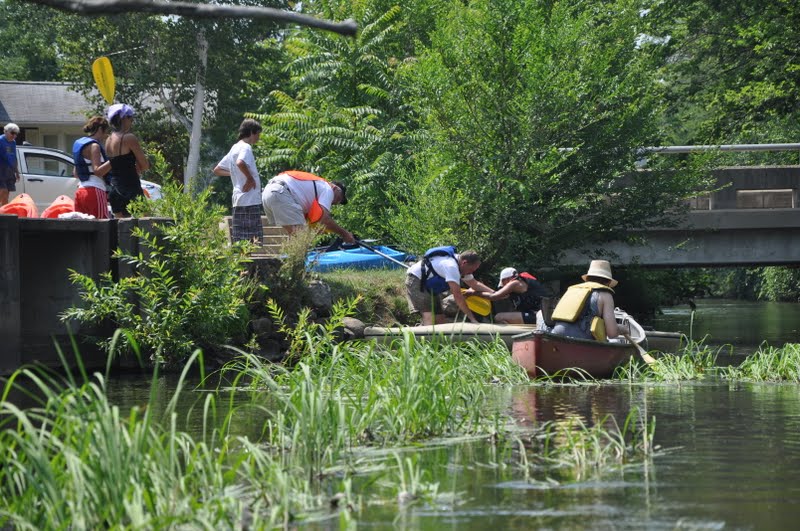

I highly recommend this trip.  It was a very pleasant paddle, and even with the heat and humidity, it wasn't too bad on the water.  Sure, the sweat was dripping off my chin when we took out and began loading boats and gear, but on the river there was just enough of a breeze to keep it tolerable, and with a big floppy hat and my three-liter camelbak hydration system, I was quite comfortable.

Thank you, GREAT, for a terrific trip!  For more information about GREAT, visit their website.  These are good folks who have done a LOT to clean up the Grand River, and who sponsor paddling trips around much of the greater Jackson area.

Monday, July 11, 2011

A Morning En Route to the Fen

Friday I decided it was high time I went out on the trails, especially since I had heard of some good finds out in our little fen.  So, camera in hand, I hit the trails.  

My first stop was the native plant gardens around the end of our building.  These gardens have been established to show visitors a) what our native plants look like and b) how they can be just as lovely in our gardens as any horticultural plant from overseas.

The showstopper right now is Queen of the Prairie, which is blooming beautifully! I had one of these show up in the "wild area" of my yard back in Newcomb - no one knew what it was, for it isn't a native plant for the Adirondacks.  How it got there, we will never know.


In the woods and along the ways pokeweed is just starting to bloom.  This is a plant I learned a year or two ago from my friend Jackie, who introduced it to me along a canal near Schuylerville, after we stopped at a cider mill for apples, cider and homemade donuts.


We have quite a healthy population of pokeweed here.  In fact, here is a shot of me in front of our most robust population of this plant.  I am just under 5.5' tall, and these plants, as you can see, are well above my head.  They are a native plant, which produces purple berries later in the season.  These berries are hugely important to  our birds, so this is a great plant to have on your property if you want to attract wildlife!


The small pond out along the trail is carpeted in green.  The hot weather and lack of rain seem to have done the pond plants well.


 My goal, however, was the prairie and the fen.  What was blooming?  I was wasn't surprised to find butterflyweed flowering, since it is in bloom all over the place.  This member of the milkweed family does very very well out here in southern Michigan.


The spiderworts are starting to fade, so soon there will be seeds to collect.  This fella, though, wasn't after the seeds.  When I tried to look this caterpillar up, I came across two possibilities:  salt marsh moth and yellow bear.  I sent the image off to BugGuide and it immediately came back identified as the salt marsh moth.  Really?  But there are no salt marshes around here.  Turns out, we have to look at the history of this critter to understand how it got its name.  It was named in the 1770s, when it was "discovered" by early settlers, who first found it along the eastern coast, in the salt marshes.  This moth, however, lives in other habitats, but the name stuck.


Bee Balm!  Monarda!  Here we have our native monarda, which is such a lovely lavender color.  I had some of this in my gardens in Newcomb, but it is so nice to see it growing in the wild, where it belongs.  A favorite of butterflies, bees and hummingbirds, it is a native plant we should all encourage. 


I was a bit surprised to see a lobelia in the prairie.  This is spiked lobelia, and while it is a native prairie plant, in my mind I still see lobelias as wetland species.


Another new plant for me was blooming out on the prairie:  flowering spurge.  Like so many of the plants here, it had a difficult time identifying this, but one of our staff sat right down with me and worked it out.  "I'm pretty sure its a spurge," he said, and sure enough, with some intense thumbing through books, we found it.  Apparently once we reach mid- to late summer, these plants will make the prairie look like it is covered with baby's breath.


Black/brown-eyed Susans are just coming out now, too.  Nothing says summer quite like these lovely sunny flowers.  


Here we are at the fen, my target.  I was surprised by just how much water was out here.  We haven't really had any rain of any significance for about a month (writes she, as a humdinger of a thunderstorm rolls overhead), and yet there were channels of water still out in the fen.


This was my target:  sticky tofieldia.  It was "discovered" out here last week by a fen specialist from The Nature Conservancy, making it a new plant for our native plant list.  I know this plant from the Ice Meadows along the Hudson River in the Adirondacks, so I was delighted to find it here.


Now, this plant really threw me for a loop.  I thought "loosestrife" when I saw it, but it wasn't swamp candles and it wasn't fringed.  Nothing else matched it in my Newcomb's Field Guide.  I was frustrated.  When I came back to the office, Mark took one look at it and said "Oh, that's prairie loosestrife."  Which, just for the record, is NOT in Newcomb's!  Whew!  I was beginning to lose all faith in my favorite flower book and in my skills at keying out plants!


It was definitely a dragonfly sort of day.  This lovely twelve-spotted dragonfly obliged me with a perfect pose on a twig in its territory along the edge of the trail.


My favorite, however, was this one.  When I saw it, what caught my eye was a flash of copper - metallic copper.  The flash washed across the wings and body alike.  I tried to sneak up on it to snap a photo, but the flighty thing just wouldn't stay still in one place long enough.  It was frustrating.  But, then I discovered that there were quite a number of them darting about the prairie.  With extreme patience, I was finally able to get a couple shots good enough for ID:  it is an immature male widow skimmer.


Finally, when I was back in the woods, I ran across a couple populations of these small, woolly insects.  I thought they were some kind of woolly aphid, but when I sent the photo off to BugGuide, it turned out to be a juvenile flatid planthopper - Anormenis chloris.


So, it turned out to be a great day of discovery.  Several new plants, some new insects - what more could a girl want?!

Odds and Ends

Thursday, while cutting food for our caterpillars at work, I found this egg case.  It was difficult to photograph because the outside was hard and shiny.  It turns out that it is the egg case of the eastern tent caterpillar.  HM...now what to do?  Tent caterpillars are certainly destructive, but I believe they are a native insect, so it's hard to be totally against them.


Meanwhile, our search continues for monarch eggs and larvae.  It's been a poor year so far for monarchs.  These things tend to go in cycles, but down years are always so sad.  The wee caterpillar I brought in perished, and so did one of the two older ones we had.  The survivor, however has become a crysalis, so we are very happy about that.

We were even happier when Carrie (one of our naturalists) found these three monarch eggs out in the Children's garden.


Monarch eggs are very small - it takes a good eye to find them.


My walks along the roadside have turned up another new plant!  This one is a wild four o'clock, which took us quite some time to ID.  It's another native (whoo-hoo!) and is rather lovely.  In some areas this plant can become a weed, probably because it does so well in dry, sandy soils.


It's gotta be summer, for the chickory is blooming!


All around this area we have wild grapes.  Dare I compare it to kudzu?  Wild grape vines are draped over almost every surface:  trees, shrubs, and even just the ground.  They are native, so that's a plus, and it means the fruits are good for our native birds.  And, it turns out there is more than one variety of wild grape out there.  This one, I think, is summer grape, but I need to go and take a closer look at it to be sure.


I finally found some saint johnswort!  I was looking for this plant last month to use for my summer solstice walk, but could I find even one?  Nooooo.  Now, however, it seems to be blooming everywhere.  Apparently no one told the plants here in Michigan that they are supposed to bloom for the summer solstice.


Friday, July 8, 2011

Where to Start?

It's been a while since I've posted, and my thoughts are all scattered.  I'm sitting at the Toyota dealer, car getting a full checkup, and I have plenty of time to post.  I just can't decide what to do.  So, I suppose we'll just start going through photos.

Okay, here we go.  

First, I want to start with a very special thank you, going out to the wonderful ladies of Newcomb's Mountain Quilters.  I came home from work the other day to find a package on my porch.  When I opened it, it was this lovely friendship quilt made (and signed) by my quilting friends back "home." How sweet is that?!?

.

Some new flowers are blooming along the roads where Toby and I walk.  Here is night-flowering catchfly, a non-native plant, but one that is blooming quite profusely right now.

 There are a couple plants blooming right now that to the casual eye look a lot like bladder campion, and this catchfly is one of them.  The flowers, however are a bit smaller, and the "bladder" (the green pouch behind the petals, made from the sepals) is long and slender, whereas on bladder campion it is a bulging bladder (hence the name).


Meanwhile, back at work, the leaf-legged bug eggs hatched!  


Unfortunately, no one was there to feed, water or release them, so they perished in the jar.  Still, I was able to photograph them.  What lovely babies they are.


And this,


is a fossilized mollusk I found while putting in the veg gardens at home.  I'm not sure what species it is/was, so I am hoping some fossil enthusiast out there might have a lead for me.  This part of the country was all underwater a few thousand years ago - Lake Michigan, which preceeded the current Lake Michigan and was larger than all the Great Lakes combined.  


Yellow goatsbeard is going to seed.  These seedheads are about the size of a baseball.


And they make amazing subjects for a nature photographer!


Just down the road from me, in any direction, actually, is state land.  In this particular direction (north), we have some great habitat.  Indigo buntings nest here, and at night the air is filled with the calls of whip-poor-wills.  This particular evening, though, the light hitting this tree caught my eye.  The golden glowing is the sun lighting up the flowers.


And what is it?  Basswood!  I've seen the tree plenty of times before, but I've never seen it in bloom, so this was a pleasant surprise.  I've heard stories of how the bees love it, how it fills the air with its sweet scent, and that it makes great honey.  I'm not a connoisseur of honey, and only use it for baking, so I'm the wrong one to make declarations on the virtues of basswood honey.


Here's another bladder campion look-alike for those not in the know:  bouncing bet.  This is a fun plant , even though not a native one.  Bouncing bet is also called soapwort, and the name is well-earned, for this plant, when its leaves are crushed and mixed with water, forms a very gentle soap, which was terrifically valued in the middle ages by those in the fabric business.


And "bouncing bet" as a name?  Well, Bet was a popular nickname for Beth, Betsy, Elizabeth, and one that might've been common.  Picture a washing woman  named Bet, bending over the wash tub, scrubbing away at a load of laundry, and her skirts and underskirts bouncing away as she scrubbed, scrubbed, scrubbed.  It's said that this flower looks like her bouncing skirts.