As someone who grew up with a nearly paralytic fear of bees and all stinging insects in general, I find myself oddly drawn to these insects here in the latter part of my life.
At least as long as my associations with them are on my own terms.
Over the last few years I've become quite interested in native bees, and in fact next weekend I am attending a workshop on native bee ID (a program I've been trying to get someone to lead here at work).
Yesterday I received a postcard in the mail from Icarus Films, a company that is currently promoting one of its newest flicks: The Strange Disappearance of the Bees, by Mark Daniels.
Here's a teaser clip from the documentary:
Then, while looking for more information about this movie, I came across THIS video clip about how it is bumble bees can fly (an on-going factoid among children and adults alike: bumblebees shouldn't be able to fly):
The more I learn about bees, the more fascinating they become. I wonder, if honey bee colonies continue to decline, will native pollinators be able to fill in the gaping chasm they leave behind?
Bees and bats...rapid declines. Causes coming to light. And just in case you are wondering about the bats, WNS has just been confirmed in Alabama - the 18th and most southerly state to have its bats fall victim to this ravaging fungus.
Dark days ahead.
Showing posts with label bees. Show all posts
Showing posts with label bees. Show all posts
Friday, March 16, 2012

Wednesday, June 8, 2011
Questionable Neighbors
So, as I was sitting there last night, waiting for my caterpillar to uncurl, I watched several large bees investigating the sides of the house. Suddenly, one came in to the porch railing where I was sitting. She flew along, apparently checking it out, and then poof! disappeared.
Uh-oh.
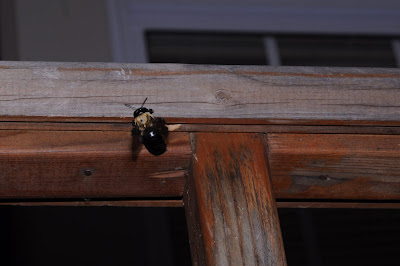
I looked underneath the railing, and there it was - a neat hole, about half an inch across. Carpenter bee.

As I watched, she flew back out. I sat down to wait - I wanted to get a good photo of her coming in, legs laden with pollen, so I could identify her species and determine if I had a potentially serious problem here.
On the one hand, I want to encourage our native pollinators, because a) they are native and b) honey bees are in the decline. However, on the other hand, I just spent a lot of money buying this house, and while I accept old farm houses need some work, entering a battle with carpenter bees and carpenter ants (I found about a half dozen gigantic black ants in the bathtub this morning) is not my idea of a good time.

The bee's arrivals, though, while well announced by loud buzzing when she was in-bound, did not lend themselves well to photography - she was just too fast and the camera was too slow.
Reading through my copy of Attracting Native Pollinators this morning, I think I know which bee this is, more or less. I think it is Xylocopa, the large carpenter bee (subfamily Xylocopinae). These bees can reach lengths of 1.25 inches - sure seems to fit! And, as a robust bee, it can chew its way into soft woods, excavating tunnels for laying eggs, which, apparently, are some of the largest insect eggs in the world, topping out at about a half-inch in length. Some species of Xylocopa also chew their way into flowers to get food because they are too heavy for the flower to otherwise support them while feeding.
As I sat there last night, waiting for this particular bee to return, I noticed quite a number of other individuals making forays to and from various nooks and crannies along the house. These are solitary nesters, not bees that form colonies, but if one's house is riddled with them, does that make it a colony of solitary nests? Apparently vinyl siding isn't a deterrent to these bees. Hm...looks like another research project - do I need to be concerned about the structural integrity of the house with these bees in residence (and those very suspect ants)?
Uh-oh.
I looked underneath the railing, and there it was - a neat hole, about half an inch across. Carpenter bee.

As I watched, she flew back out. I sat down to wait - I wanted to get a good photo of her coming in, legs laden with pollen, so I could identify her species and determine if I had a potentially serious problem here.

On the one hand, I want to encourage our native pollinators, because a) they are native and b) honey bees are in the decline. However, on the other hand, I just spent a lot of money buying this house, and while I accept old farm houses need some work, entering a battle with carpenter bees and carpenter ants (I found about a half dozen gigantic black ants in the bathtub this morning) is not my idea of a good time.

The bee's arrivals, though, while well announced by loud buzzing when she was in-bound, did not lend themselves well to photography - she was just too fast and the camera was too slow.
Reading through my copy of Attracting Native Pollinators this morning, I think I know which bee this is, more or less. I think it is Xylocopa, the large carpenter bee (subfamily Xylocopinae). These bees can reach lengths of 1.25 inches - sure seems to fit! And, as a robust bee, it can chew its way into soft woods, excavating tunnels for laying eggs, which, apparently, are some of the largest insect eggs in the world, topping out at about a half-inch in length. Some species of Xylocopa also chew their way into flowers to get food because they are too heavy for the flower to otherwise support them while feeding.
As I sat there last night, waiting for this particular bee to return, I noticed quite a number of other individuals making forays to and from various nooks and crannies along the house. These are solitary nesters, not bees that form colonies, but if one's house is riddled with them, does that make it a colony of solitary nests? Apparently vinyl siding isn't a deterrent to these bees. Hm...looks like another research project - do I need to be concerned about the structural integrity of the house with these bees in residence (and those very suspect ants)?
Monday, September 6, 2010
Around the 'hood
Friday afternoon the monarchs were in fine form in my yard. The New York Ironweed is in full bloom and the butterflies were all over it. Despite this, they refused to sit still for a photo session. As soon as I snuck up on one, it would flit to the other side of the plant, or to a plant in a different bed. At one point I watched three (!) drift in together, silhouetted against the blue sky - what an image it would've made!

Aren't these delicate pink flowers delightful? They look like tissue paper creations. They are the greatly enlarged (via photo magic) blossoms of one of my heathers.
 It seems to be the time of year for shades of purple. Here is our native monarda, a lovely lavender flower. The bees were very happy to have these around, since most of the season's flowers have already called it quits thanks to the excessive heat and lack of rain this summer. Goldenrods prevail, and in my gardens, the native bee balm is still doing well.
 I really got quite a kick out of watching the bees as they scrambled around the circle of flowers, shoving their heads inside each one in hopes of finding a little nectar. I have a video of it, but it refuses to post today. I'll try again later in the week.
Toby and I walked down to the pump house in the evening. I can't help but chuckle and shake my head in amazement every time I pass over this latest addition to the town:
 Yes, Newcomb now has a speed bump! And don't you love that the warning signs are about three feet in front of it?
Apparently a local resident was complaining about the speed of the cars going to and from the golf course. So, now we have a speed bump, on a dead end side road.
As we came around a bend in the road, a flash of white caught my eye - a red-tailed hawk flying up to rest on a utility pole.

The neighborhood blue jays were none to pleased and were calling out in near hysteria. Eventually the hawk became uncomfortable. You can see it crouching here, getting ready for take off.

And away we go!


Aren't these delicate pink flowers delightful? They look like tissue paper creations. They are the greatly enlarged (via photo magic) blossoms of one of my heathers.
 It seems to be the time of year for shades of purple. Here is our native monarda, a lovely lavender flower. The bees were very happy to have these around, since most of the season's flowers have already called it quits thanks to the excessive heat and lack of rain this summer. Goldenrods prevail, and in my gardens, the native bee balm is still doing well.
 I really got quite a kick out of watching the bees as they scrambled around the circle of flowers, shoving their heads inside each one in hopes of finding a little nectar. I have a video of it, but it refuses to post today. I'll try again later in the week.
Toby and I walked down to the pump house in the evening. I can't help but chuckle and shake my head in amazement every time I pass over this latest addition to the town:
 Yes, Newcomb now has a speed bump! And don't you love that the warning signs are about three feet in front of it?
 Apparently a local resident was complaining about the speed of the cars going to and from the golf course. So, now we have a speed bump, on a dead end side road.
As we came around a bend in the road, a flash of white caught my eye - a red-tailed hawk flying up to rest on a utility pole.

The neighborhood blue jays were none to pleased and were calling out in near hysteria. Eventually the hawk became uncomfortable. You can see it crouching here, getting ready for take off.

And away we go!


Monday, August 2, 2010
The Gentians and the Bees
The narrow-leaved gentians were blooming is such profusion along the river that it was stunning. I've never seen carpets of this flower before. But even more amazing was watching the industrious bumblebees diving into the "closed" blossoms in search of pollen and nectar.
I took several series of photos, hoping to capture the entire event. Here we have Madam Bumblebee diving into the flower:

...and then backing out:

When she emerged, she used her middle legs, which are equipped with pollen combs, to rake the pollen off her hair and transfer it to the pollen sacs on her hind legs (for more information on this, read the piece I just wrote for the Adirondack Almanack).

And then off she goes to dive into another flower:

Here we go again. Into the flower:

...within the flower (sometimes buzzing, sometimes silent):

...and backing back out:

And then it dawned on me: I have a video option on the camera! So, take your Dramamine and sit back - you can watch LIVE ACTION of the bumblebee visiting the gentians! If you turn the volume up, you can hear the vibration buzzing when the bee is deep within the flower.
[Okay - I couldn't upload it onto the blog, but you can see it here.]
I took several series of photos, hoping to capture the entire event. Here we have Madam Bumblebee diving into the flower:

...and then backing out:

When she emerged, she used her middle legs, which are equipped with pollen combs, to rake the pollen off her hair and transfer it to the pollen sacs on her hind legs (for more information on this, read the piece I just wrote for the Adirondack Almanack).

And then off she goes to dive into another flower:

Here we go again. Into the flower:

...within the flower (sometimes buzzing, sometimes silent):

...and backing back out:

And then it dawned on me: I have a video option on the camera! So, take your Dramamine and sit back - you can watch LIVE ACTION of the bumblebee visiting the gentians! If you turn the volume up, you can hear the vibration buzzing when the bee is deep within the flower.
[Okay - I couldn't upload it onto the blog, but you can see it here.]
Tuesday, April 6, 2010
More Insects of Early Spring
After spending a couple hours weeding four more beds of the veg garden on Sunday, I grabbed the camera and headed for the willow shrub, which was just swirling with insects. By now, thanks to three days of temps in the 80s, most of the catkins were "open" and the insects were in buggy heaven.
This little yellow dude was one of the first to catch my eye. I think it is a fly of some sort, but again, I have an ID request in at BugGuide. Will keep you posted. Update: Ken Wolgemuth at BugGuide suggested Scathophaga sp., so I looked it up in Kaufman's and found Scathophaga stercoraria, which seems like a pretty good match. This is a dung fly, which prompts the question "so why is it on the willow?". Well, it turns out that as adults, dung flies are predators; it's the larvae that feed on animal droppings. So, this adult was probably scoping out the scene for tasty morsels that were so focused on finding their own food that they weren't watching for predators. Still, it certainly looks like this one is snacking on the catkin. According to Stephen Marshall's Insects, this is also called the Pilose Yellow Dung Fly, and it usually breeds in fresh ungulate (eg: cattle) dung, where the male is known to guard the female while she lays her eggs.


This little yellow dude was one of the first to catch my eye. I think it is a fly of some sort, but again, I have an ID request in at BugGuide. Will keep you posted. Update: Ken Wolgemuth at BugGuide suggested Scathophaga sp., so I looked it up in Kaufman's and found Scathophaga stercoraria, which seems like a pretty good match. This is a dung fly, which prompts the question "so why is it on the willow?". Well, it turns out that as adults, dung flies are predators; it's the larvae that feed on animal droppings. So, this adult was probably scoping out the scene for tasty morsels that were so focused on finding their own food that they weren't watching for predators. Still, it certainly looks like this one is snacking on the catkin. According to Stephen Marshall's Insects, this is also called the Pilose Yellow Dung Fly, and it usually breeds in fresh ungulate (eg: cattle) dung, where the male is known to guard the female while she lays her eggs.

I was watching the larger of this pair, contemplating whether to take a photo of it or not, when the smaller one flew it and latched on. Turns out, the big one is female and the male decided it was his job to sire her offspring. His front legs were scrabbling the entire time, while his abdomen pumped away. I took some video footage of it, but I'm having a difficult time trying to load videos on this post. It's probably just as well, because between the wind blowing the branches and my legs shaking (I was kneeling upright - not a stable position), the video needs to warn viewers to take dramamine before watching.

This enormous, and rather fierce-looking, fly came in and dominated the scene a bit. Isn't it the most bristley thing you've seen?


The daphne are all is full bloom. Amazingly, it is only this year that I've noticed how cloyingly sweet their scent is. It's got a kind of soapy quality about it. Ick. Still, up close the flowers are rather attractive.

Zipping about the stem of the daphne was this sweet little jumping spider. It was so fast that every time it jumped, it reminded me of Jeannie in "I Dream of Jeannie" - a blink of the eyes and she vanished from here and reappeared there. Update: this is probably the zebra jumping spider (Salticus scenicus). Jumping spiders are delightful creatures. See those big black eyes? They have fantastic vision and will actually look up at you and watch you. The males are noted for their elaborate courtship dances - make the most of that good vision, eh? And when it comes to jumping, well, these guys can out-distance even our best long-jumpers, for they can jump up to 50 times their body length! Let's see, for me that would be something like 275 feet. But they've got rather scrawny legs, so how is that possible? They use a system kind of like hydrolics. Quick contractions of the muscles in the front of the body cause an increase in blood pressure, which in turn makes the legs extend rapidly. Zooooommm! Blink and it is gone!


Here it is again, this time as seen from behind. I figure that white butt has got to be diagnostic. We'll see what BugGuide has to say. Update: Andy Calderwood over at BugGuide says it is a Tachinid fly of the genus Epalpus - the white patch diagnostic, as I suspected. Looking up Epalpus in my Kaufman's field guide, I see E. signifer as the illustrated specimen. This fly has a whitish face and thorax, which you can sort of make out in the first photo. According to the field guide, there are three species of Epalpus found in North America (the other two species are not found in the East). It's a parasitoid, laying its eggs on the caterpillars of a species of owlet moth. Reading up on this fly in my new weighty tome Insects, Their Natural History and Diversity, the very first sentence reads "We are surrounded by killer flies." The family Tachinidae is made up almost entirely of parasitoids. AND, just in case you are wondering, a parasitoid kills its host, where as a parasite does not. Anyway, the whole page about Tachinids is fascinating and gruesome. I won't violate copyrights by typing it up here, but if you really want to know some of the reproductive strategies of these flies, you'll want to find a copy of this book and turn to page 408. I don't recommend it as late night reading.

I checked out the black pussy willow, too, to see if anyone besides the flies were visiting. This small wasp was having a busy time getting a meal.

The daphne are all is full bloom. Amazingly, it is only this year that I've noticed how cloyingly sweet their scent is. It's got a kind of soapy quality about it. Ick. Still, up close the flowers are rather attractive.

Zipping about the stem of the daphne was this sweet little jumping spider. It was so fast that every time it jumped, it reminded me of Jeannie in "I Dream of Jeannie" - a blink of the eyes and she vanished from here and reappeared there. Update: this is probably the zebra jumping spider (Salticus scenicus). Jumping spiders are delightful creatures. See those big black eyes? They have fantastic vision and will actually look up at you and watch you. The males are noted for their elaborate courtship dances - make the most of that good vision, eh? And when it comes to jumping, well, these guys can out-distance even our best long-jumpers, for they can jump up to 50 times their body length! Let's see, for me that would be something like 275 feet. But they've got rather scrawny legs, so how is that possible? They use a system kind of like hydrolics. Quick contractions of the muscles in the front of the body cause an increase in blood pressure, which in turn makes the legs extend rapidly. Zooooommm! Blink and it is gone!

The place was hopping down at the vernal pool Sunday evening as Toby and I strolled by. Spring peepers and woodfrogs alike were busily singing their hearts out. I tried to get photos, I tried to call in the woodfrogs, but my efforts usually resulted in silence. So we finished our trip to the river and on the way back I gave the pond one more try. This time I just shot some video. Most of the action is behind the grasses (you can see the water roiling a bit), but at the beginning you can just make out a couple frogs as they bob near the surface. The high-pitched peeps are the peepers, and the quacking sounds are the wood frogs.
And here's what all the fuss was about - eggs!

Our final find of the evening was this bizarre-looking thing. It's like someone crossed a caddisfly larva with a pangolin. It was creeping across the road, tucking its little tush underneath as it moved, much like a crayfish does. The head, stretched out here, was moving back and forth, sometimes extended way out, other times pulled back in under its protective armor. I collected it in a vial and brought it to work today, where my boss immediately said "OH! A firefly larva!" Well, who knew!
These guys are out at night hunting for things like snails. Like their parents, the larvae have glow-in-the-dark capabilities, but it was still light enough that this fellow wasn't lit up. You will be happy to know that he's been released back into the woods.
Saturday, April 3, 2010
First Flowers & Their Friends
Would you believe we hit 80*F yesterday! In the Central Adirondacks! In Early April! Unheard of. Must be a new record.
The plants and insects are enjoying it, though. Mr. Mike reported coltsfoot in bloom at his barn, and he also saw "an orange butterfly with black spots." One of the punctuation butterflies? A Compton's tortoiseshell? I don't know.
Back at my house, though, I discovered the following signs of life:


 And there, in the "field" (the unmowed portion of my yard),
Note: the spring peepers are about 20 days earlier than usual, and the wood frogs 10-20 days earlier.
The plants and insects are enjoying it, though. Mr. Mike reported coltsfoot in bloom at his barn, and he also saw "an orange butterfly with black spots." One of the punctuation butterflies? A Compton's tortoiseshell? I don't know.
Back at my house, though, I discovered the following signs of life:
Daphne, opening in profusion.
The giant pussy willow had three or four catkins "open"
(pollen now available), and they were drawing in the bees.
This was the giant among the hungry feeders. I think it is a type of mining bee, but I'm waiting for confirmation from BugGuide. Update: The experts say this is Adrena frigida, one of the mining bees. There are about 1200 of these solitary bees in North America. They burrow in the soil. I watched a nesting aggregation of these bees last spring, but never got any photos of them. Maybe this year.
This trio were all quite focused on the pollen and ignoring each other
as well as me. Update: the big one in the middle is another species of Adrena, but the Bugnet folks couldn't give me more than that. How different it looks from the fuzzy Adrena in the previous photo. The other two are the same species as the one in the next photo.
Here's one of the trio (and there were a lot of these - probably the dominant bee at this shrub). I think it is a species of sweat bee, but again, I'm waiting to hear from BugGuide. Update: and the experts say this is a male Nomada bella. Nomada are cleptoparasites of digger bees, specifically those in the families Andrenidae and Halictidae. Their larvae, which are laid in the bees' burrows, eat the pollen and nectar that have been put aside for the digger bees' offspring. Sometimes they kill the host larvae, too. As adults, Nomada look a lot like wasps.
The second species of the trio. I have no idea what kind it is...BugGuide is on standby. Update: Adrena sp., as noted two photos up.
Meanwhile, over at the black pussy willow, the only visitors to its catkins were flies. Hm...I wonder what that means?
Idefix was enjoying his time outside.
This is one of the few photographs I've taken of him
where he doesn't look pissed off at the world!
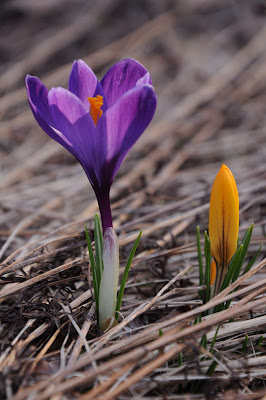
 And there, in the "field" (the unmowed portion of my yard),
 two crocuses (crocii?) had raised their cheery heads.
And then, to top it all off, last night, as Toby and I were walking the golf course, I heard them: the first frogs. First, it was a lone peeper, who, after two peeps clammed up. But then we came around a bend in the trail and in front of us a pocket wetland was full of woodfrog songs! As we approached, a chorus of coyotes started calling from the woods. Toby, of course, had to respond, which promptly made the woodfrogs close their mouths and submerge.
I perched on a rock and tried "quacking" to entice the frogs back, but after several minutes nothing happened. The rock was becoming uncomfortable, and Toby was eager to move on, so we left the frogs to themselves. Maybe I'll try again tonight.
And then, the cap it all off, we heard the first peents of the woodcocks, followed by their twittering flights.
Note: the spring peepers are about 20 days earlier than usual, and the wood frogs 10-20 days earlier.
Friday, August 28, 2009
Insects in the Garden
I did a drop-in program today titled "Insects in the Garden," the purpose of which was to introduce visitors to the flighted things that visit our gardens most often. I only had a few takers, but they were interested in seeing what we had.
Most of the garden's visitors today were bees and flies of one stripe or another. And even though it is technically a Butterfly Garden, there wasn't a butterfly to be seen.
As I stood there, sneaking up on insects, I finally decided to try and identify to species (!) some of the bees I've been seeing with relative frequency. Are there really many species visiting the blooms, or are there only a few? It was time to find out.

Many of the bees I've been seeing are these medium-sized, fuzzy bodied ones. What stands out are the orange sides. I paged through the photos in the Audubon Field Guide to Insects and Spiders and I'm fairly confident that these are Red-tailed Bumble Bees (Bombus ternarius). They are described as "robust and hairy," the male drones measring up to a half inch in length, while the Spring Queen may reach three-quarters of an inch. The adults sip nectar while the larvae eat honey. Like many bees, only the young, mated females overwinter, to start the next generation the following year. The field guide then notes that "unlike the honey bee worker, a bumble bee can sting many times." Hm - so much for the "bumble bees don't sting" statement I've been told for years and years. Still, I wander among the bumbles with relative ease these days and with the exception of one last weekend who repeatedly stung the tire of my lawnmower (I really wasn't trying to run it over - in fact, I gave every bee I encountered plenty of time to fly off before I mowed on).

One of the other diagnostics of the Red-tailed Bumble Bee is the "broad black band between the wings." Could this be a Red-tailed, even though we don't see the red bands? I doubt it - the red bands are probably essential to the ID of the Red-tailed. What species could it be?

Ah, now this one is different. Note that it is mostly yellow. No red bands, no broad black band between the wings. I have no idea what species it is, though.
 There were some bumbles out in the garden that were positively huge! Size is difficult to record on "film" unless one has a ruler handy, which I didn't (not that a bee would sit still enough for a portrait with a ruler). This was one of them, though. The globe thistle upon which it is nectaring probably measures two-and-a-half inches across. Could it be a Golden Northern Bumble Bee (Bombus fervidus)? Also described as "robust and hairy," the Golden Northern queen can reach 7/8" in length. The face and head are mostly black and it also sports a black band between the wings, although the description goes on to say that the female has a mostly yellow thorax. And the wings are smoky. Sounds pretty close, doesn't it?
Not a single honey bee was to be found, though.
Friday, July 17, 2009
Nosing Around the Butterfly Garden
No butterflies were in the butterfly garden today, but we had a very industrious ant hauling its catch off to home:

and a couple of bees busy in the milkweed:

and a couple of bees busy in the milkweed:

Thursday, April 30, 2009
You Just Never Know What You're Gonna Find
Every April, usually around Earth Day, we have our annual Spring Clean-up Day, when staff and volunteers, armed with gloves and large trash bags, scour the parking lots, trails and road for trash. Today was the day, and our lone volunteer and I hit the road, eager to find the castoff stuff of passing cars. Amazingly, we found very little!
The big find of the morning (and of course I had no camera, seeing as how I was picking up trash and didn't think I'd need it) was colonies of busy little bees flying in and out of their nests in the ground. They were small fuzzy bees, and their nests were pencil-sized holes centered in small mounds of sand - very much like anthills. I hunkered down next to them to watch, and our volunteer stood nearby taking it all in. I suspected these were some sort of solitary ground dwelling bee, and as such no threat.
When I came back inside, I hopped online to scour the ether for any information I could find to ID these bees. I believe they are miner or digger bees. The best information I could find was at: forums.gardenweb.com/forums/load/bees/msg0314292022043.html.
Digger/miner bees are solitary, building single cell nests in loose sandy soil that has little vegetation. Several of these bees may be nesting in the same area. They come out on sunny days (like this morning), foraging for pollen and laying their eggs. They are beneficial pollinators, and they are apparently fairly docile (translation: they don't sting unless highly provoked). If you have them in your yard, you want to keep them around for the benefit of your gardens.
I was going to grab the camera after work and snap a couple shots, but it's clouding over now and is supposed to rain. I'll try to get photos the next sunny day we have that I can escape the office for a few moments.
The big find of the morning (and of course I had no camera, seeing as how I was picking up trash and didn't think I'd need it) was colonies of busy little bees flying in and out of their nests in the ground. They were small fuzzy bees, and their nests were pencil-sized holes centered in small mounds of sand - very much like anthills. I hunkered down next to them to watch, and our volunteer stood nearby taking it all in. I suspected these were some sort of solitary ground dwelling bee, and as such no threat.
When I came back inside, I hopped online to scour the ether for any information I could find to ID these bees. I believe they are miner or digger bees. The best information I could find was at: forums.gardenweb.com/forums/load/bees/msg0314292022043.html.
Digger/miner bees are solitary, building single cell nests in loose sandy soil that has little vegetation. Several of these bees may be nesting in the same area. They come out on sunny days (like this morning), foraging for pollen and laying their eggs. They are beneficial pollinators, and they are apparently fairly docile (translation: they don't sting unless highly provoked). If you have them in your yard, you want to keep them around for the benefit of your gardens.
I was going to grab the camera after work and snap a couple shots, but it's clouding over now and is supposed to rain. I'll try to get photos the next sunny day we have that I can escape the office for a few moments.
Monday, July 14, 2008
Life on a Milkweed
I headed out to our butterfly garden to snap a photo or two of the milkweed flowers to use for my Plant of the Month this month and got completely wrapped up in all the life on the milkweed! The more I looked, the more I saw. Ants, bugs, beetles, bees, spiders, moths, butterflies...the list went on and on. Here are some images of what I saw:


 This white admiral butterfly (Basilarchia arthemis) has seen better days. Behind it a variety of ladybug is creeping along a blossom.

I think this is a flower spider (Misumena spp.). If so, the neat thing about these spiders is that they can slowly change their color (presumably to blend in with the flower on which they are hunting). This one seems to have successfully caught an ant.
I've seen this lovely beetle before. This one was skulking around the flowers of the milkweed, but fell onto the stem as I was jockeying for a better photographic position. Thanks to the marvels of modern technology (the Internet), I now know that this is a Labidomera clivicollis - Swamp Milkweed Leaf Beetle.
This white admiral butterfly (Basilarchia arthemis) has seen better days. Behind it a variety of ladybug is creeping along a blossom. And here we come to one of the facinating things about milkweed: its pollination strategy. Rather than tyring to paraphrase the entire process as I found it on http://globalswarminghoneybees.blogspot.com/2007/07/got-milkweed.html, here is not only the link, but also the text that the owner of this blog copied down from her (his?) copy of a 1920s book titled Honey Plants of North America:
"Milkweed flowers are called pinch-trap flowers because they possess a remarkable clip-mechanism found in no other family of plants. Two club-shaped masses of pollen are attached by flexible bands to a small, dry, triangular disc placed midway between them. In this membraneous disc there is a wedge-shaped slit at one end. In its effort to obtain a foothold on the smooth flowers an insect is likely to thrust a claw, leg, antennae, or tongue into one of the slits. If one of these organs is drawn upward in the slit, the dry disc becomes tightly clamped to it. When the insect flies away it carries with it the disc and the two masses of pollen strapped to it. Exposed to the air, the strap-like stalks dry and draw the pollinia close together. As the insect alights on another flower, they are easily thrust between two anther wings, where they come in contact with the stigma; but, once inserted and pulled upward, they can not again be withdrawn. The insect can obtain its liberty only by breaking the connecting bands. If it cannot do this, it perishes slowly of starvation. Disc after disc may thus become attached to an insect until it is crippled or helpless."
Now, then - take a close look at the feet of the bumblebee above. Do you see the yellow bits by its feet? Those are the pollen bits that have detached from the plant and stuck to the bee's feet. This robust bumblebee seems to have been able to escape from its floral traps, but can you imagine being permanently caught by the foot by a flower? Kind of makes you stop and think, doesn't it?
Still, it is a lovely flower.
Subscribe to:
Posts (Atom)