Showing posts with label burn. Show all posts

Sunday, April 10, 2011

Winter to Summer in 24 Hours

 Wow!  Yesterday the started started off cold and grey and damp, and ended up about 50*F - quite pleasant.  Today we began overcast and chilly, but by noon it was 77*F, and by 4:00 it was 84*F and HUMID!

I had to go into the office today to do some work, and decided to also head out on the trails - primarily to get photos of the prairie three weeks post burn, after rain and warmth.

So, off I went, stopping first to visit my skunk cabbage friends.  Look!  New green leaves have sprung forth from the soggy ground!


And hidden within the modified leaf (the spathe) is the spadix, the actual flowering part of the plant, complete with little flowers.  There were even a few little flies buzzing around.


Reaching the "Dug Pond," which I refer to as the muskrat pond because there is a muskrat lodge out on it, I saw some interesting white "things" sitting on top of the floating vegetation.  What were they?  Some sort of seed pod?  Perhaps a bunch of white berries left over from last year?


Turns out they were snail shells!


Now, some of you may have noticed in last night's photos that the burn was looking significantly less charred.  If you did, then you get gold stars, each one of you!  Yes, indeed the burn is finally showing some green at a distance.  It's amazing what a little rain (okay, a lot of rain, actually) and some heat will do for plant growth.


I thought this was interesting, though.  The part that's really looking green is not the restored area, which is still looking quite brown by comparison.  My educated guess is that this demonstrates just why invasive plants are so successful - they out compete the natives, in this case growing more quickly after a disturbance.  Fear not, though, for when examined up close, the restored area does have quite a bit of new growth coming along, too - just not as significant an amount as the rest of the prairie.


The quaking aspen catkins were looking mighty robust today.  Another example of a flower that we ignore because it isn't showy (and on the ground).


I just love this tree.


I visited one of the coyote dens.  The bits of grass Mickey had placed across the entrance are gone.  Hm.  Activity?  Or merely strong winds?


Here's what I mean by strong winds (that's my hair blowing about):


There were tree swallows galore flying all over the grassland.  Plenty of insects on hand today, thanks to the extremely warm weather.  They were having a feast, and perhaps even enjoying flying on the strong winds.  I watched this pair for quite a while at the nest boxes.


 Might this box become a nest site?


Well...

...maybe we'll keep looking.


I headed next to the glacial pond, where the spring peepers, northern chorus frogs and wood frogs were all in full voice.


Saw a nice pile of painted turtles out on a hummock.  How many can you count?


While I was sitting on a log, enjoying the sounds of spring, I heard a rustle and looked down by my feet.  A large garter snake had crawled out of a tuft of grasses and was sliding beneath my legs...until I moved my hand to get the camera, at which point it did a 180 and zoomed back into the grasses.  I waited patiently and shortly it crawled back up and onto the log.  I noticed its belly was rather large - perhaps it found a good meal in that tuft of grasses at the marsh's edge.


I also saw several dragonflies - they were out and cruising the marsh.  It was as though we skipped spring entirely and went directly to summer today.

The heat was beginning to get to me, though, and I had finished up the bottle of water I brought.  It was time to head back home.

Sunday, March 27, 2011

Back at the Burn

Okay - so here we are, the second half of my Saturday Morning Walk, and we are once more back at last Sunday's burn.


 One of the really exciting things about a burn is just how quickly the vegetation takes over.  There are several reasons for this: the sun can now reach the soil to heat it up (thus germinating the seeds hidden therein), and the blackened soil just speeds this process up; many native seeds in prairie habitats evolved with fire, and thus often need fire to prep them for germination (for some this involves fire melting a resinous coating that otherwise keeps the seed from the light and moisture that would stimulate germination for a regular seed); there is no struggle to get light (in an unburned field, the old dead vegetation creates a barrier that may hinder rapid growth).

So, I got down on my belly, on the charred ground, and snooped around in search of a new green sprout.  And there it was!

I was actually quite surprised to see this sprout.  All week the temps have been below freezing - both day and night.  Not conditions that really trigger growth.  This just goes to prove that the sunlight is heating up the dark ground just enough to make things grow, even if only very slowly.

I really should come back once a week and set up my camera at the same place each time and take a shot - see the greening over time.

ANYway - continuing through the burn, I saw a small pile of bones:


I looked around, for I had heard that the Tuesday Morning Group had found old coyote den holes nearby.
I had a lovely view of this tree against the springtime sky.  Doesn't this shot just sum up the prairie?


And there, hard by the tree, a pile of white sand caught my eye.  This looked highly suspicious.  What would cause a pile of white sand in an otherwise blackened and charred landscape?


AH-ha!  It was the aforementioned coyote den!  The hole to the den is to the left side, with the sand dug out from it piled up around the right side.


Nicely placed on top of the pile of sand was a perfect pile of scats.  Definitely coyote.  They are white, though.  Hm.  Knowing that there are no snowshoe hares around here, this meant that these were probably older scats.  Older because they are white with age, or older than the fire and they are ashen from the blaze.  Whatever the reason, they aren't terribly fresh.


Here you can see the placement of the scats next to the den entrance.  Notice also the pieces of vegetation across the entrance.  One of the Tuesday Morning Group did this as a test to see if the den was active.  If it is, then the vegetation would be moved aside.  If the vegetation remains in place, then the coyotes are no longer here.  


Two more entrances were located just downslope from the first.  One still had vegetation across the opening, but the other did not.  Hm...perhaps the den is not completely abandoned.


And here you can see all three entrances, forming a nice little triangle!


The coyote den wasn't he only source of holes.  Here we have some much smaller tunnels going below ground.  Voles?  Mice?


And more greenery showed up as I continued to look!  This thistle is doing quite well.


As is this mullein.  Mullein has very thick and fuzzy leaves to begin with, which makes it well-suited for growing early in the season when cold temperatures are very likely.  Thus protected, it doesn't feel the bite of winter's cold.


Ah. Now here is an important view of the prairie, a view that demonstrates why native grasses are so important to these ecosystems.  Here is a view of the restored portion of our prairie:


...and a view of the prairie where non-native plants dominate:


Do you see the difference?

Once again, the native portion:


...and the non-native (conveniently side-by-side):


Here is the answer:

Clumps of native grasses.  Looking at the restored area, you see lots of charred bumps - these are the native grasses, which will resprout once things warm up a bit.  Native grasses grow in clumps that are dispersed across the open ground.  Non-native grasses tend to grow in mats - solid mats that don't clump up. 

This is an important concept.  If you have native grasses, then there is space in between them for other native plants, like the many wildflowers and other forbs that call prairies home, to grow.  Additionally, these spaces give wildlife (small wildlife) places to move, and places to hide.  And, when winter comes around, native grasses remain tall, providing additional shelter (and food) for small birds.  Non-native grasses tend to just smoosh down under the weight of winter's snows.  This might provide some nice protection for small mammals traveling below the surface of the snow, or it might not - maybe it hinders their travel by being so compact.  Hm.  Something to ponder.

 Well, the morning was moving along toward noon, and I had plenty of work to do back in the office, so I headed back.  Along the way, though, I did find some more proof that spring is in the offing:


Woodland flowers are sending up their leaves, soon to be followed by stems and flowers.  Woodland flowers bloom before the trees fully put out their leaves, taking advantage of the sunlight while they can.

A Morning Walk

 Saturday morning dawned sunny and bright...although it remained below freezing.  When I arrived at work, I decided it was imperative that I work on learning the property.  After all, I've been here three months now, so it is about time I became familiar with the place I was hired to interpret.

So, camera in hand, I hit the frosty trails.


 Frosty branches in wetland.


 Frosty deer scats on boardwalk.


 Very frosty railing along boardwalk.


 Frosty vegetation on the ground.


Frosty leaf.

This tree trunk fascinates me every time I walk by.  Three holes, each atop the last.  Why?  What caused the crease in which these holes reside?  There must've been some sort of damage done to this tree, which caused the crease (the tree's continual growth giving the original injury rounded sides).  This damage must have in turn attracted insects, which took up residence inside.  And then the insects attracted birds, which excavated the holes.


Not all strange growths on trees are due to nefarious causes.  Burls, like the one seen below, still confound scientists.  Some may be caused by external agents (similar to galls), but not all can be attributed to specific causes.  Whatever their source, they don't seem to harm the trees on which they grow, and they are often sought by woodworkers, for burls make spectacular bowls, with their swirled grains and tight growth patterns.


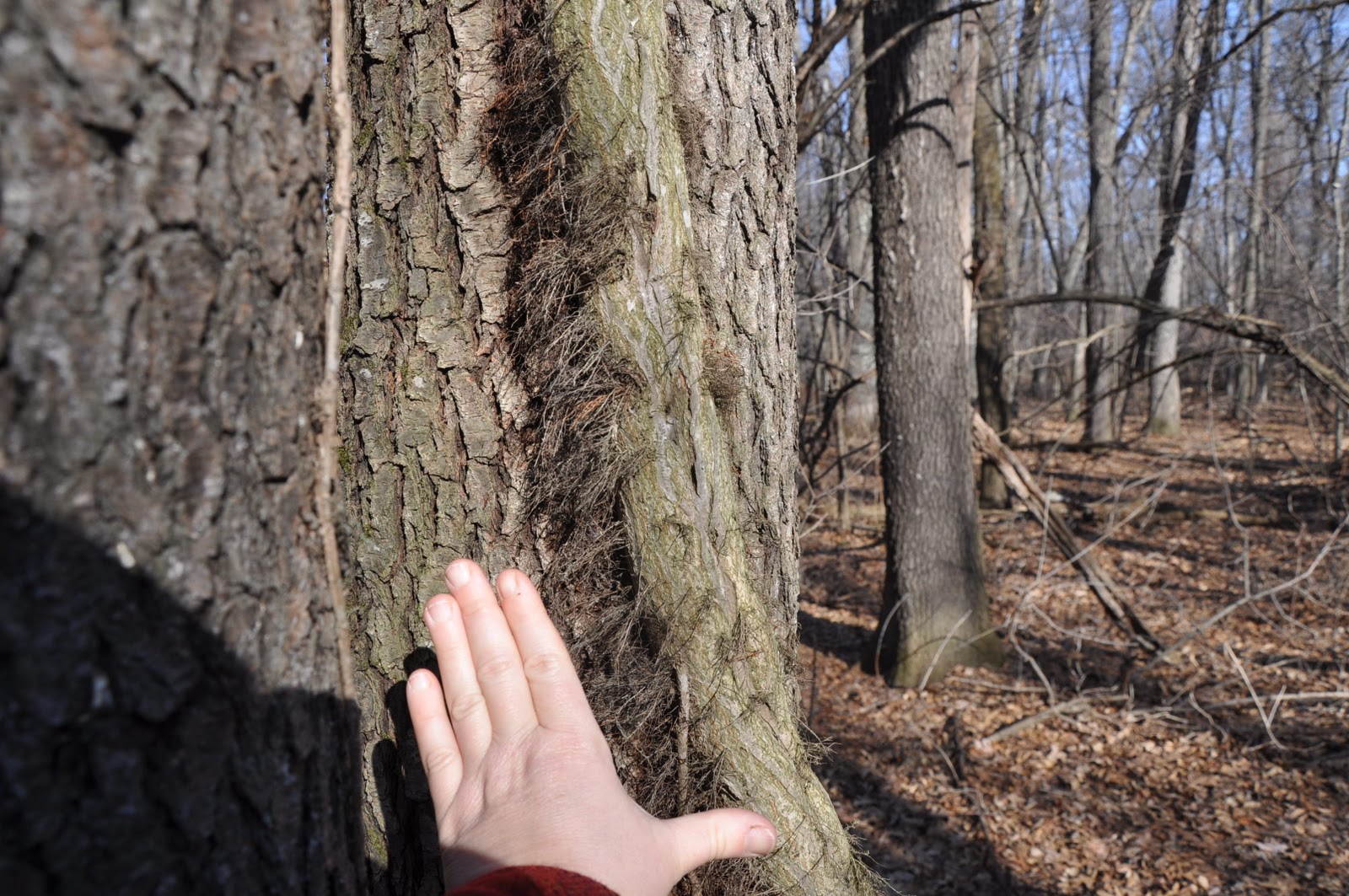
Now, here's an impressive specimen of poison ivy.  Sadly, but with good reason, most people despise poison ivy, for it harbors an oil to which most of us are allergic (see my post from last summer about my own run-in with the stuff). 


Still, it is a native plant, growing both in vine and ground-cover form, that produces white berries that are important to many bird species as a source of food.  In other words, PI is an important part of the native landscape; we humans just need to learn how to live with it!


My primary goal on this morning's walk was to cover the perimeter trail(s) - I wanted to see parts of the property I hadn't seen yet.  Much of the property is either hardwood forest or open field/prairie.  There is, however, a nice patch of conifers out along the northeastern perimeter.


The winged wahoo (I just love that name) is quite prevalent in several parts of the property.  A highly invasive non-native, it is, never the less, kind of attractive, especially when viewed through a macro lens.


I was soon nearing the edge of our property. 


Definite signs of previous human use soon became apparent.


And then I found myself facing one of the neighboring farms. 


I turned around and retraced my steps, and before long I was at a lovely vernal pool.  These temporary habitats form in the spring (vernal) from the melt waters of winter's snows and the added moisture of spring rains.  Last week, they were full of frog song.  This week, they have been pretty silent, thanks to the return of below-freezing temperatures.  Still, I did hear a lone chorus frog calling a couple times during this walk.


Previously I posted a video of this glacial pond, recording those very frog songs.  Today I found myself on the far side of the pond.  I had no idea a trail went along this side.  There's even a bench here, where those who are so inclined can sit quietly and enjoy the sights and sounds of this pond.


Today, however, things were a bit frosty for sitting for any length of time.


Following the trail just a little bit further, I found myself back at the burn.  It was now almost a week since we burned, and I was curious to see if there was any new growth yet.  I suspected not, since the weather had turned chilly - not conducive to seed germination.


My trip through the burn will be posted next.  Stay tuned.