Showing posts with label damselflies. Show all posts

Thursday, June 20, 2013

Woodland Jewels

Ebony jewelwings (Calopteryx maculata) are stunning damselflies that we often find in the woods here, not too far from water (they like slow-moving woodland streams).  Their bodies are metallic green or blue, and their wings are black as black can be.  The females sport a single white dot (the stigma) on the tip of the wings (these are all males).  There's no other North American damselfly that looks like these.


The males arrive on the scene first.  It could be that since on the day that I took these photos I only saw males, and today I saw several females in the same location, that the females have just recently arrived in our woods here at work.  This particular location is near the small stream that runs through the property.


These lovelies live a mere 2-3 weeks, and 11 of those days they are not yet mature enough to mate.  When it is time to mate (and this is really cool) the male lands on the female's stigma (the white dots) and then walks down her wings to reach the position he needs to join with her and form the "tandem."  Does he land on the stigma because they are obvious, or are are the stigma obvious in order to provide him with a perfect landing spot?  It's the old chicken-or-the-egg question all over again.

I was pondering recently about the coloration of these insects.  Are there some that are blue and some that are green, or are they all green, but only appear blue in certain light (or light angles)?  I suspect it is the latter, if only because one of my dragonfly books refers to ebony jewelwings as green and black in color, although they "often look blue."

These insects are difficult to photograph - they never want to sit still long enough for you to focus and shoot.  I continue on my quest to get a perfectly focused image of one some day (although these aren't too bad).

Tuesday, July 19, 2011

Lazy Hazy Dayz of Summer

Here in the Midwest we are stuck under a "heat bubble."  Texas to Michigan, we are all suffering together in ridiculously hot and humid weather.  Bleh.  

So, what's a girl to do?  Why, go paddling, of course!

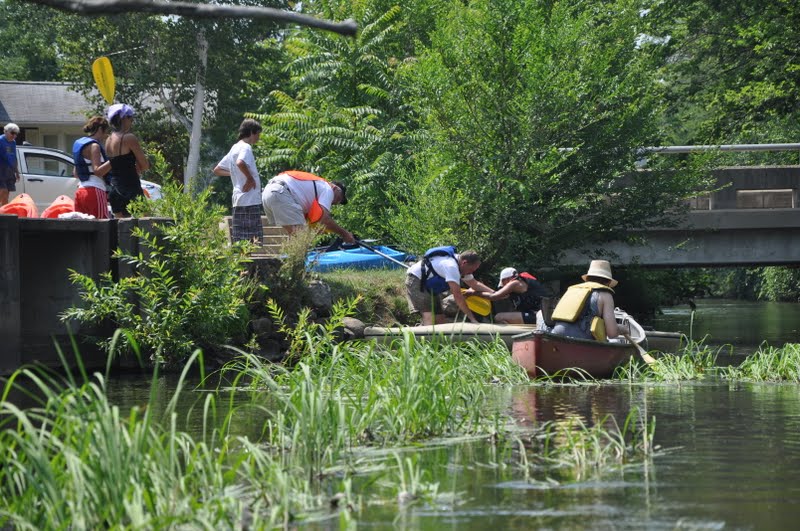
On Sunday, GREAT (The Grand River Environmental Action Team) was hosting a paddle on the northern branch of the Kalamazoo River.  I had my doubts at first, for it was in the 90s, with humidity in the 90s, and the paddle would go through the hottest part of the day (it began at noon).  But, I loaded the Spitfire anyway and drove an hour to the put-in spot.  They had a shuttle service set up, so after dropping off our boats, we drove to the take-out up in Albion and caught a ride back to Kings Road.

I was one of the last boats in the water, and because I was being a naturalist, I soon was the last boat.


How wonderful to see some old friends, like pickerel weed.


It was a day for damselflies.  If I saw one, I must've seen a thousand this day, mostly ebony jewelwings and these little tiny bluets.


Most of the river passed through open land...no shade to be had.


There were plenty of wild roses blooming along the banks.


Another old friend, arrowhead, was blooming in fair profusion.  Some were submerged, which was odd since we haven't really had any rain to speak of in a long while.


This damselfly led me on a merry chase.  It's an American rubyspot, and when it flies, it flashes a brilliant red from its wings, as if the sun was glaring off a ruby.  It is a very nervous insect and just wouldn't sit still for a photograph.  I must've chased about a dozen of these before I finally got one decent shot.


There were quite a number of these blinds along the river.  Somehow, I doubt they are bird blinds...unless they are for duck hunters.  Maybe they are deer blinds?


Parts of the Kalamazoo were quite shallow.  Twice I got hung up on a sand bar.  According to Gary, this is a good river for brown trout, which apparently can reach some prodigious sizes.


By this time I was well behind the rest of the paddlers, so I had high hopes of seeing some wildlife.  As I was drifting along (the current was pretty good), I started to hear this splashing and sucking noise.  Off to my left, a tributary entered the main waterway.  I saw some ripples on the water's surface and thought that perhaps one of the other paddlers had taken a detour to see what was up the channel.  As I passed and turned around to look upstream, this is what I saw:


When she saw me, she froze.  Then she decided that I was just too scarey and she took off - behind her was a second deer, who bolted around the bend before I could capture its image.


A short while later I also saw a sandhill crane's head peeking above the tall vegetation, but it ducked before I could get a photo.

I was now entering some farm lands.


The presence of electric fence on posts in the river was not reassuring.  This must mean that cattle are allowed in the river. While on the one hand this seems to make sense, for the animals can drink and wallow to stay cool to their bovine hearts' content, but from a river health point of view, it is not so good.  Cattle cause a great deal of erosion along riverbanks, and we won't even mention the "pollution" they add to the water.

Now, I've paddled down rivers when I've had to go around cattle (I'm thinking of the Raritan in New Jersey).  It's interesting.  But I was glad to not see any cows today.  However, one of the trip leaders later asked me if I'd seen the cows in the water - apparently they were bathing when she went by.


It's milkweed season.  I'm thinking this is swamp milkweed, with the narrower leaves.  


Here we are at our first obstacle.  One of the trip leaders was stationed here to guide boats to the left side of the river, so they could line up for a shot under the bridge and through the rapids.


Here's the line-up...


 ...and here we go!  Woo-hoo!


Bank beavers!  I guess this was the biggest surprise of the trip for me.  I don't expect to see beavers down here in farm country.  To me, beavers are animals of the northern wilderness.  But, according to Gary, they are definitely here in the Kalamazoo.


Vervain.  A very tall vervain.  My wildflower book is at home (I looked at it before I left the house at 6:15 this morning), so I can't tell you which vervain this is right now.  I'll come back to that.

More farms.


And another damselfly.  This one is a river jewelwing.  Like the ebony jewelwings, these damsels have beautiful metallic blue or green bodies, but only the tips of their wings are black.  Just for the record, photographing damselflies who won't sit still from a boat that is drifting on a swift current is not easily done.  I'm lucky this is as clear as it is!


Halfway there, Kenny, GREAT's president, was on the bridge to document each paddler's journey.  Here's my photo of Kenny taking of a photo of me taking a photo of him.


Shrubby cinquefoil was in bloom in a few places along the river. HM...it seems like a good number of the plants I saw this day were species I saw every summer in the Adirondacks.  I guess they do just as well in warm, alkaline areas (southern Michigan) as they do in cooler, more acidic habitats (Adirondacks). 


My attention was grabbed by a bird flitting around this tree.  Then I spied the hole.  It was a bird with a nest in a cavity.  I crashed into the bank, had to extricate myself and reposition the boat so I could get a photo.  The sun, of course, was behind the bird, so everything is in silhouette, but I'm pretty sure it was a bluebird in its natural habitat!  No nestboxes for this bluebird - it was nesting in a cavity in a tree.  Huzzah!


Obstacle number two:  the culverts.


For those who were unsure of their skills, Kathy, another member of the GREAT crew, was on hand to maneuver boats into position.


Some paddlers guided their own boats through.


I was among the latter group and got myself lined up to shoot through.  Actually, the water wasn't moving too swiftly at this point. so it was a slow shoot.

 
Woo-hoo!  And out the other end!


Everyone made it through safe and sound.


Farming has a long history in this part of the state, and evidence of older claims still dot the landscape.


Shade!  This was the only bit of shade the whole seven miles of the trip (not counting the three bridges and the culvert).  Ahhhhh.


I was quite taken with this bridge.  Something about its architecture just appealed to me.


And here I just couldn't believe my eyes - bat houses!  Not one, but two, side-by-side, and of good size!  Someone here likes bats and knows the proper way to build and erect bat houses!  The river was moving right along here and I was well past them before I was able to get the camera up for a shot.  I wonder if any bats are using them.  It's certainly a good location, right here along the river.


We were definitely nearing civilization now, for some lovely homes were perched right along the river banks, we could hear traffic, and we saw construction.  Still, at this spot the river entered a bit of a marsh.


I'm thinking it's probably quite buggy along here at night.


And suddenly, we were at the take out!  How quickly the trip went by.  I didn't think I'd been paddling all that fast, but the current moved us right along, so seven miles passed in only a couple hours or so.


I highly recommend this trip.  It was a very pleasant paddle, and even with the heat and humidity, it wasn't too bad on the water.  Sure, the sweat was dripping off my chin when we took out and began loading boats and gear, but on the river there was just enough of a breeze to keep it tolerable, and with a big floppy hat and my three-liter camelbak hydration system, I was quite comfortable.

Thank you, GREAT, for a terrific trip!  For more information about GREAT, visit their website.  These are good folks who have done a LOT to clean up the Grand River, and who sponsor paddling trips around much of the greater Jackson area.

Saturday, June 4, 2011

Here there be Dragons

 Dragonflies and damselflies are notoriously difficult to photograph.  Still, I never pass up the opportunity to give it a try.

I had a walk to lead this afternoon - six folks signed up, one folk showed up.   It was hot and humid, but we hit the trails anyway - who am I to stay inside when nature calls? 

 There wasn't much happening.  A few green frogs called out from a pond, but that was about it...except for the dragon- and damselflies.  These glorious insects were out on patrol, along with one eastern kingbird, keeping the skies safe for us humans; insects beware.

Mostly we saw the same characters that I saw Thursday afternoon:  the ebony jewelwings along the wooded edges...


...and the dot-tailed whitefaces hovering over the pond.


We saw male and female common whitetails (dragonflies, not deer), but they were not amenable to having their photos taken.  However, this very handsome Canada darner (Aeshna canadensis) took a nice long pause on the side of a tree, giving me enough time to dig the camera out of my backpack and take not one, but two shots.


I have a bumpersticker that was given to me by a friend, which reads:  Do not meddle in the affairs of dragons, for you are crunchy and good with ketchup.  I think insects should read this, reflecting on the appetites of dragonflies (and their kin).  I, for one, am glad that there are dragons around, even if they are small and only after insects.

Friday, May 14, 2010

A Beautiful Day - Part II: Things with Wings (and a frog)

Lots of insects were out yesterday, which is not surprising with the warm sunshine. I fed plenty of blackflies - a coworker commented when I came back inside that it looked like I'd been bitten on the neck by a vampire!

Some of the insects were willing to pose for photos, others less so. Still, I submit for your curiosity, a gallery of things with wings.

This first insect was flying around and landing on the toothwort blossoms. The narrow waist makes me think it is a wasp, but the sponging mouthpart, and the antennae say "fly." I'm waiting for results from BugGuide.


While photographing the ginseng, I watched this mosquito as it flew in for a meal...not on me, but on the flower. It must, therefore, be a male mosquito, which I know feast at flowers instead of humans.


How scary-looking is this beetle (you may have noticed him yesterday lurking on the indian cucumber root)? You can't tell by this photo, but it had a bit of a green iridescence to it's elytra (wing cases). This is a stag beetle (Platycerus virescens). Most stag beetles have these enormous antler-like mouthparts (mandibles), but this fellow's mandibles are fairly small. Even so, I don't think I'd want to be on the receiving end of a bite.


I was a bit surprised to see this damselfly flitting about - it seems too early for them. But, they would know better than I when it's best to emerge. They are flighty things, and difficult to track down for photos. I believe this is an aurora damsel (Chromagrion conditum), the key for ID being the yellow patch on the side of the thorax (looks greenish to me). These damsels emerge in spring and early summer and are considered rather sedentary (yeah, right). They are perchers, staking out their territories from vegetation near streams, swamp, and spring pools. We were near the beaver pond when we met.


A bit later on, I spied this common baskettail (Epitheca cynosura). What caught my eye about this lovely dragonfly was how furry its thorax was. An adaptation for emerging early in the year when the mornings can still be quite chilly?


Not far from where I found that dragonfly, my attention was grabbed by this:


A dragonfly emerging from its nymphal exoskeleton (exuvia)! Actually, the dragonfly had already emerged and was just standing on it's shed skin, resting. This gave me a great chance to get some close-ups.


I really wanted to capture the eyes, but had a devil of a time doing so.


Again, note how furry it is, even on the abdomen! I believe this is another common baskettail. These dragonflies are erratic and rapid fliers, so it's a good thing I saw them shortly after emergence, when they weren't quite to energetic (I saw some more up by the frog pond, and there was no way I could capture them with the camera - zip, zip, zip!).


Why are they called "baskettails"? Because the female rolls her eggs into a ball, or basket, which she holds under the tip of her abdomen before she releases them into the water.


I was up at the beaver pond when I heard a ruckus of hawk calls from the general vicinity of this tree. I saw a hawk fly to the tree and vanish. Could there be a nest here? Then another hawk soared over the tree and off to the east. I'm pretty sure it was a red-tail. Of course, I had the wrong lens on the camera, so I couldn't get any shots. So, I fumbled with the camera bag, got out the correct lens and assembled the camera. In short order a second hawk flew from the tree.


The camera decided to focus on the sky! After a couple failed attempts, I managed to get a couple shots as the bird flew overhead. A broadwing (Buteo platypterus)! Could the fuss have been because it felt threatened by the red-tail?


I wanted to check out the mining/digger bee nests I remembered being along the roadside a couple years ago. I found the nests, but no bees were in sight. It was nearing mid-afternoon by now, so perhaps they were all on siesta. I'll have to check these again on a sunny morning.


Heading back up the road, I saw two tiger swallowtails (Papilio glaucus) puddling on the roadside. One had flitted past me while I was watching the hawks, so I knew they were "back," but I was surprised to see these two.


They were so focused on their mineral meal that they completely ignored me, allowing me to get quite close. The wind had begun to pick up by now and kept catching their wings and flipping them up.


And down at the frog pond, I startled a number of frogs, which all when "peep!" and lept for the water before I even had a chance to see them. One brave soul, however, held its ground. Can you see her?


This is a small green frog (Rana clamitans), and because the tympanum (the circular thing behind the eye - what serves as an ear) is smaller than the eye, we know it's a female. On male frogs, the tympanum is larger than the eye.


What wonderful finds! Every day on the trails is bound to end up with at least one new discovery. It's a beautiful thing.