Showing posts with label school programs. Show all posts

Thursday, December 3, 2009

We're Wriiiiii-ting in the Rain...

The sixth graders from Wells were here today for a journaling class...all six of them (two were out sick). It was pouring rain when they arrived, so we spent the first half of the program inside, learning about journaling, and making some hand-sewn journals. After lunch the rains had let up a bit, mostly misting, so we donned our coats, grabbed our journals and pencils, and hit the trail.

It didn't stay misting for long...soon it was raining pretty steadily. Still, a little rain is not enough to deter determined naturalists. Our first stop was the overlook along the lake's outlet.


The bridge over the outlet was a hit - until the rain became more insistent. When we came back at the end of the program, however, the rain had turned to fog, making the view quite attractive.


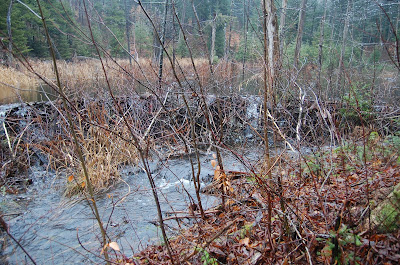
We ended up at the beaver pond...because in my opinion this is a gold mine for journaling...even in the rain. With the rain we've had in the last 24 hours, water levels were up significantly.

We could hear the water rushing over and around the dam from a distance. Once there, we could see water rushing where no water has rushed before.


Across the way we could see the lodge, hard by the bank. Freshly chewed sticks made it stand out like a beacon in the damp grey light.


Despite the damp conditions, the kids did their best to record their observations.


Journaling has become quite popular in recent years, which is great, considering the decline in our society's ability to actually write. Too often I read the writings of students in grades 6-8 and find that they are barely writing at a second grade level: they can't string together coherent sentences, they haven't got a clue about grammar, and forget punctuation. Computers and text messaging, I fear, spell doom for the written language.

So, let's encourage kids to keep journals; it'll get them writing, and, if they are nature journals, it will get them observing - two skills that we should do our best not to lose.

Wednesday, October 28, 2009

Spooktacular

Every year near Hallowe'en, we (the Visitor Interpretive Center here in Newcomb) do a Hallowe'en program for the two local schools (Newcomb and Long Lake). Students in grades K through 4 are invited to learn about three animals that are associated with Hallowe'en. Our staff of three (boss, seasonal, and me) each get a topic and a station. The kids are divided into three groups and rotate through each station, spending about a half hour at each one. Afterwards, we all feast on seasonally appropriate snacks. It's a good time.

The program runs on a five-year cycle, so that the kids in Kindergarten have a new program every year through fourth grade. Year 1: Bats, Owls and Skeletons. Year 2: Spiders, Cats, Ravens & Crows. Year 3: Snakes, Coyotes, Frogs & Toads. Year 4: Rats, Vultures, Newts. Year 5: Weasels, Raccoons and Skunks. Our goal is to teach kids the truth about animals who have bad reputations or who have been portrayed poorly due to the Hallowe'en season.

So, this year (Year 7), we were on Year 2 of Cycle 2: Spiders, Cats, Ravens & Crows. I, of course, was Spider Woman! I really do like spiders, and the more I learn about them, the more fascinating they become. For instance, did you know...

* ...spiders have light blue blood?

* ...spiders have special oils on the hairs on their feet so they won't stick to the sticky parts of their webs?

* ...not all spiders build webs, and most spider webs are not the large spokes & spiral contraptions that most of us envision when we think of spider webs?

* ...spiders do not have ears; they "listen" by feeling vibrations with the hairs on their legs?

* ...some spiders spend their entire lives under water?

* ...spider web is antibacterial and excellent to use as a bandage over bleeding wounds?

* ...some spiders are chameleon-like and can change their color to blend into their background?


I could go on and on (and some day I might).

Unfortunately, the only photo I have of the day is this one:


Fresh Graves, one of the snacks we made for the event. These are very tasty (with or without the tombstone), and relatively easy to make.

Dump a box of Devil's Food Cake mix into a bowl.

Add one cup sour cream.

Add one egg.


Mix until it looks like chocolate mousse.


Now comes the hard part. Scoop up some batter in your hand (I recommend using three fingers, like poi), and "shape" into a rectangle about 1"x 4" (good luck). Place on a greased cookie sheet. Make another one. These will really puff up when you cook them, so leave plenty of space between them.


Pre-heat oven 350 and pop these babies in for about 15 minutes. They are done when they spring back to your touch.
Cool.


Meanwhile, make the headstones. I used Milano cookies, broken in half. The recipe said to pull apart the two cookies and scrape out the frosting, but Pepperidge Farm must've changed their recipe because the cookies are extremely brittle now and they do not pull apart, which is why I just broke them in half. Using black frosting, write your message on the headstone.


When the cake part is cool, cut a slit in the top. Dab a bit of chocolate frosting on the bottom of the cookie and shove it into the slit - the frosting will hold it there like glue. Voila! You are done.


You get 12-16 graves from a box of mix, depending on how big you make them.

Thursday, October 15, 2009

At Least the Kids had Fun

This fall I agreed to do an aftershool program at one of our local schools. Nature hikes, that's what they wanted, so I said "Sure!" At this time of year, first graders are really just big kindergarteners, and most of the group is in first grade; the oldest is in fourth grade, and there's only one. Needless to say, I have my hands full!

Yesterday was our third program, and thankfully the sun was out (sort of), so we went for our hike (last week we made journals inside, thanks to the rain). As soon as they were out the door, they took off, heading right for the oak tree in front of the school.


Acorns were picked up by the handful and stuffed into pockets, but the big ticket item was the acorn caps. Why? Because one of the most important things you can take into the woods with you is a whistle, and if you forgot your whistle, you can always make one with an acorn cap! I taught them this on our first hike, and once they learned how to do it, well, let's just say it was a big hit.


We walked down the hill to the nature trail behind the local library. The gravel parking area was full of maple keys, and even though they were all dried out, I showed them how to split the seed end and stick them on their noses.


Milkweed pods are still quite green up here, but that didn't stop the kids from pocketing fistsful of them as well. Pods were soon ripped open to expose the not-quite-ripe-yet seeds inside.


Along the creek we encountered a common merganser. As you can probably guess, the kids just couldn't stand there quietly and watch. The poor bird swam upstream as rapdily as it could to escape the screaming horde, then turned tail and ran down stream, much to the shrieking delight of my charges.


We checked out the beaver dams, smelled the wild thyme, and drew in our newly made journals. By 4:00 it had become quite chilly out, so we headed back towards the school to meet the buses.

I find these programs to be very draining - two hours with a dozen little kids fresh out of school is enough to wear anyone out! You have to have eyes on the front, back and sides of your head to keep track of them all, and they all want your attention NOW. They'll ask a question non-stop until you give them your attention to answer, but they won't wait to hear what the answer actually is. At the end of the day I'm usually just glad that we all survived the experience and no one was hurt. But then I hear them the next week talking about what they learned the week before, or they come up to me and say "I can't wait until next week," or "How many more programs do we have, because I want to do this every week," and I realize that even though I can't see it at the time, these kids are really getting something out of these programs.

And, y'know, that makes it all worthwhile.

Wednesday, June 10, 2009

It Came from the Bottom of the Lake

Okay, not quite, but we were looking for aquatic invertebrates in a frog pond and at the outlet of Rich Lake - close enough.

This group of seventh graders had a great day for insect dipping. First we sampled at the outlet, where rushing water and rocking rocks made dipping a challenge. Mostly we had to turn over rocks to find the critters.


Stonefly nymph cases abounded - they were on every rock and all over the grasses along the shoreline! Here is a close-up shot of one; note the crack in the back, from which the adult (see below) emerged.


Some of the kids were really into it, while others preferred the view from the shore.

After a leisurely lunch on the bridge,

we moved to the Frog Pond. What a difference: still water, lots of emergent vegetation. Frogs galore, one tadpole, and many minnows.


This scarey-looking thing is a giant diving beetle (water tiger) larva - the mouthparts are impressive:


These guys were communing on the cattails:

All in all, it was a successful outing. Chaulk another one up for insects!

Thursday, February 12, 2009

It's Like Christmas Every Day

Every day is an adventure when you strap on your snowshoes and head out on the trails - you just never know what you may find.

It was so tropical yesterday (high of 49.5*F) that the first snowfleas (Hypogastrura nivicola) put in an appearance. It was great, because the third graders I had with me got to see them for the first time ever, watching as the fleas "jumped" all over the place. Sadly, the photo I took did not come out, so you will have to imagine where a pepper shaker exploded all over the snow, and all the little bits of pepper are jumping about into the air.

Snowfleas are actually a primitive insect called springtails (not fleas at all), and they measure no more than 1/8 inch. The snowflea has no wings, and it doesn't actually jump. Instead, it tucks a pair of modified legs under its abdomen, and little hook-like structures hold the "legs" securely in place (the spring is now wound up). When the hooks relax, the spring is released: the "legs" push against the ground and zing! up goes the critter into the air. Not all springtails have this launching apparatus - only those that live in the leaf litter do (snowfleas).

Snowfleas eat the mold and fungi found in leaf litter where things are decaying. They are attracted to wet surroundings, and we usually only see them in the winter, when on mild days they they prepare to migrate. At this time upwards of a million of these critters rise and make "haste" for new digs, probably because the food ran out where they had been living.

This morning Toby and I had a great find (no photo of this, either). As we cruised through the parking lot of the medical center, we came across a circular splatter of feathers, and one small gobbet of meat: some bird had bit the dust. I suspect the bird was a blue jay, although none of the feathers were blue any more (could be because they were soaking wet; blue in feathers is due to structure and light, not pigment, so water can change the color). I tried to acertain if the bird had been done in by another bird or a mammal, based on how the feathers were removed (plucked or sheared), but the feathers had been driven over by enough vehicles that nothing was certain. Still, a nifty find on a dreary wet morning.

And finally, today I had a group of 6th graders in who were phenomenal! And they were here long enough that I could not only go into great tracking detail indoors, but we could also do our one-mile trail! I didn't have high hopes for good finds today, thanks to the rain and melting snow of the last 36 hours. I was pleasantly surprised. We saw otter trails, fresh beaver chews, and even followed a large canid (probably coyote) down the trail, marvelling at its footprints,


and oogling the lovely pile of scat it left behind (we so seldomly encounter scats here). I'm not sure, but those white "beads" might be parasite eggs.


We even came across a pile of beechnut husks that something had recently emptied for a mid-winter feast.


And now, for your "listening" pleasure, and by way of celebrating today's find, I give you one of my all-time favorite songs - the Scat Rap, which I think was written by Doug Elliott (although I could be wrong). This is dedicated to all the folks out there, who, like me, get excited about finding animal scat.

Scat Rap

Chorus:
It starts with an “s” and it ends with a “t”,
It comes out of you and comes out of me.
I know what you’re thinking, you can call it that,
But let’s be scientific and call it scat.

You’re walking through the woods and your nose goes “ooooo”;
Must be some critter’s scat’s near you.
It may seem gross, but it’s okay,
They ain’t got no place to flush it away.

Down the trail something’s lying on the ground;
Nature’s tootsie roll all long and brown.
Don’t wrinkle your nose, don’t lose you lunch,
Break it apart, you might learn a bunch.
Don’t use your fingers, use a stick;
Keep sanitary now that’s the trick.

If you wanna find out what animals eat,
Take a good look at what they excrete.
Stuck in the scat are all kinds of clues,:
Parts of the food their bodies can’t use
Like bones and fur (2x)
Hard berries and seeds (2x)
Crawfish shells, ouch! (2x)
Grass fibers and weeds (2x)

'Possum up in a ‘simmon tree
Eating all the ‘simmons he could see,
Backed his butt into the weeds,
His scat was nothing but ‘simmon seeds.

Down by the creek on a hollow log,
Scat full of berries and bones of a frog.
Late last night he was out with the moon;
Wading the creek it was Mr. Raccoon

You’re driving your car by a woods or a field,
Scat goes splat on your windshield.
It’s full of seeds, all purple and white;
You just got bombed by a bird in flight

Peas porridge hot, peas porridge cold,
Scat on the trail two minutes old.
Two minutes old, is this a joke?
No, it’s still warm, look at it smoke!
Cat scat, rat scat, bat scat, too;
All god’s chillun do scat a lot, too.

Peas porridge hot, peas porridge cold,
Scat in the woodlot nine days old.
Nine days old, how can you tell?
Getting kinda dry and not much smell.
Dog doo, frog doo, hog doo, too;
All god’s chillum do a doodley do.

Pease porridge hot, peas porridge cold,
Scat in a cave 1000 years old.
1000 years old, could that be right?
Sure that’s no jive: petrified copralite.
Mole scat, vole scat, bear scat, more;
There’s so darn many kinds of spoor.

Sneaking through the woods, be quiet now, shish!
Take a quiet step—something goes squish.
Don’t put it in your mouth, it ain’t delish.
Let’s put some in a Petri dish.
Look through a microscope, what do you see?
Microscopic organisms 1, 2, 3.
Bacillus, streptococcus, and E. coli,
They eat scat and then they die.
Don’t you worry, no need to cry,
They ain’t that different from you and I

If you want to know who was out and around,
Take a long hard look at the scat on the ground.
It tells us what they eat, tells us who they are;
That’s what we know about scat so far.

Thursday, February 5, 2009

More Fun on the Trails

I find it is harder to impress 8th graders. They are too cool to actually participate...or maybe they are just too focused on fashion and technology...or maybe, just maybe, it was too cold for them today.

Still, I had a good time out in the 1*F weather, because I found red fox scat on a fox trail that was scatless yesterday (and we so seldomly find scats here):


Fox scats are pretty easy to identify. They typically end in a narrow taper and often have a bit of a curlicue at the end. This one didn't show those traits, of course, but I knew it was fox because it was smack in the middle of the fox trail. This particular fox visits our bird feeding station nightly - must be hunting the mice and voles that snack on the fallen seeds. A regular fox cafeteria, I imagine - easy hunting.


And then we found a mink slide:


At first we just saw the "mystery mustelid" tracks (2x2, like a series of colons : : : : :). By process of elimination, we narrowed it down to mink or marten. Next we found where the animal had come up from under a bridge, where a little snow cave marked the end of a pseudo tunnel. This made me lean even more strongly toward mink, since minks live near water and I've seen mink tracks in this particular area in the past. But then we encountered the slide - and what a beautiful slide it was! You could see where it bounded (: : : :) over the crest of the hill and then, whheeeeeee, down it slid to the trail packed by snowshoers!

Of course I made them all sniff the fox scent post. I suspect, however, that 90% of them just went through the motions and did not really take a sniff. Oh, well. You can lead a horse to water...

Wednesday, February 4, 2009

Tracking, Again

Today's school group was from Schroon Lake, and we lucked out with some great weather (cool, but sunny), and some great tracks.

My favorites today were the snowshoe hare tracks. This is the first time I have seen the actual toes on the tracks. Usually hare tracks only show the outline of the foot because it is so furry. But the hares that have been out lately have had their hind toes all spread out and you could see them perfectly! This photo was digitally enhanced so you could really see the toes:


But even in non-enhanced photos, the toes show up pretty well:


The red foxes have also been moving around. I finally got some good shots of the "perfectly straight line" they leave as they trot along:


Wild canids often trot as their regular gait. When moving at a relaxed pace, the hind foot lands directly in the track made by the front foot (a direct register). The same is true with walking - on the ground a walk looks the same as a trot. The neat thing is that wild canids leave these nice straight lines of tracks - one foot after the other - plop, plop, plop. Rover can't do this. Neither can Fido. The domesticated dog is too fat and cannot get its leg perfectly under its body, so a dog's trot (or walk) does not show a perfect direct register and is certainly not in a nice straight line.

Fox mating season is in full swing (the female is in estrus for about three weeks, and the mating season runs from January through March). The red fox we were following today was leaving one scent post after another.
As I explained to the kids, leaving a scent post isn't the same as just peeing. If the animal is just relieving its bladder, there will be significant yellow snow. When the animal is scent-marking, though, a little goes a long way.


Of course, I made them all take a sniff.

"Ewwww!"

"That's gross!"

"Do I have to?"

It wasn't until the dad in the group started to talk about fox scenting posts and how his dad used to collect the stuff and make his kids wear it (presumably to cover their own scent while hunting or trapping) that the kids got into it. I guess I need a better lead up into sniffing scent posts.

Tuesday, January 27, 2009

I'm So Proud!

When you get a group of kids who catch your excitement for tracking, it is magic!


One of the groups I had today really got into the stories and finds on the trails...even to the point of getting down and sniffing red fox urine!


For those of you who don't know, red fox urine is very skunky - if it is really fresh, the smell is quite strong, as in dead-skunk-in-the-road strong. If you have an active red fox den nearby, you will likely smell it long before you see it.


And right now it is breeding season for red foxes, so scent marking is going on all around. It's very exciting.


Y'see, tracking is more than just looking at footprints. It's looking at how the animal moves, figuring out what it was doing, trying to get inside the animal's mind. It's looking for scat, for browse, for hair (we found fox hair on the trail!!!), for scratches, for kill sites. It's detective work at its finest - CSI eat your heart out.

Friday, November 7, 2008

What is That?

I love third graders!!! They are full of curiosity and so eager to examine everything! What's this? What's this? Old decaying leaves...fungi of all shapes and sizes...pieces of bark...bits of rock...shells...mosses...lichens...insects...it was all fair game! We surrounded the glacial erratic, and spread the spores of puffballs and lycopodia alike. This was a group that needed very little encouragement to get out and explore!

This item though, threw me for a loop:


I had no idea what it was, so I brought in inside, all soggy and crumbly, and commenced my search for an answer. (For reference, it is over a foot long, maybe 15 inches). Answers come from some unexpected places. I showed it to our handyman and he knew right away what it is: part of a fern, from the root end. Armed with this information, I grabbed my Fern Guide (Edgar T. Wherry) and started to flip pages. Sure enough, it is the rootstock of a fern (or, perhaps, the rhizome, according to Fern Finder by Anne & Barbara Hallowell).

According to Wherry, the wood ferns (Dryopteris spp.) have a "stout, scaly rootstock, holding old stipe-bases." This seems to fit what we found.

On my next trip out towards Pickerel Pass I will have to keep my eyes open for ferns and see if I can find any attached to similar rootstocks and thus obtain a definite ID.

Wednesday, November 5, 2008

The Morning After

This morning the other half of yesterday's school group arrived for their chance at uncovering the diversity and abundance of wildlife off our trails. This group really took their time and looked. We had some great discoveries, including one boy who, thanks to hunting trips with his dad, found deer tracks pressed into the wet leaves in the mixed woods! That takes a practiced eye. And even though we passed through the same habitats as yesterday's group, we found plenty of new things to record. Some lent themselves well to photography, while others were too mobile to allow me a clear shot.


Girls looking under rocks. That's actually the title of a book, I believe. Anyway, some of the girls were a little squeamish about touching stuff, and some were taken aback by the aromas that issued from underneath rocks partially buried in swampish muck. New doors were opened for them. By the end of the program, even the most fashion-conscious of them expressed an interest in exploring their own yards back home. Another success story.


The image of this girl in the wetland along the shore of Rich Lake was just too good to pass up. She was one of our most engaged students today. She told me how much she loves being outside and how spending time exploring sure beat playing video games indoors. This was music to my ears!


I apologize for the quality of these shots - the beast just wouldn't stand still! I believe it is some kind of wasp, but I'm not 100% sure. What was fascinating to us was its coloration: dark with white/cream-colored stripes/bands on antennae, legs and body, including what I think was a white/cream-colored stinger. If anyone has an idea of what it might be, please let me know.


Snowshoe hare scats! I was very excited to find these. We are lucky to find hare tracks once in a while during the winter, but this is the first evidence I've had of their presence outside of winter. The girls were somewhat less enthused with the discovery, and were especially appalled when I picked the scats up to show them up close. Oh, well...what can I say? I guess I'm just a scat fanatic!


On a side note: many thanks to those of you who have left me comments and who visit my blog on a regular basis! It's always nice to hear that one's efforts are appreciated!


I encourage everyone to take some time these next few days while the weather remains mild to go out and explore the late-autumn woods. Or even the late-autumn yard! It can be a real eye opener to discover that many animals are still active, hording food, grabbing last-minute morsels to see them through the winter, and foraging among the seed heads in gardens and berry-laden shrubs in wetlands and yards alike.

Tuesday, November 4, 2008

Election Day Off the Trails

What better way to spend Election Day than to go for a ramble off the beaten path? We had a group in today from the Lake George region and we took them bushwacking through three different habitats to record all signs of wildlife they encountered. Here are some photos commemorating the morning's exploration.


At this time of year, there aren't a lot of insects or other animals readily visible in the landscape, so we have to look for them where they lurk for the winter. Looking under the bark of dead and decaying trees is always a good place to start.


If we take the time to look really carefully, we find where animals have stopped for snacks. This mushroom was likely dined upon by a member of the rodent family. Mouse? Squirrel? I'm leaning towards squirrel.


One boy brought me a mussel shell and a berry. While not animals, they were good finds. He then tossed the shell into some water, where it landed right-side-up, making a perfect boat for a berry sailor. To me it looks like a bright red pearl nestled in it's shell.


Fresh beaver chews! We came across several of these at Pickerel Pass - the beavers must be working overtime to get in food before things freeze for real this winter.

And even though it was a cool, damp and overcast morning, the view of Goodnow Mountain was nice, especially with its reflection on the still waters of Rich Lake.


Tuesday, October 21, 2008

And The Beat Goes On

I haven't forgotten about the blog-o-sphere...I've just been terribly busy. Which is a good thing. It seems almost every day this month we've had a school group in, which is wonderful. Today's group cancelled due to the weather (there was a possibility of snow in the forecast - which so far hasn't happened), so I find I have a few free moments to drop a note on-line.

While "autumn is the season that I like the very best," I find that it doesn't provide a lot of easy nature stuff to write about. It's not like there are new flowers blooming, or new insects flying around, or birds feeding their young. Oh, there are certainly fascinating things happening, but who wants to read another essay about how leaves turn color, or why the birds are migrating southward?

As I look out my office window today, the world is grey and brown. The sky is grey, the tree trunks are grey. The leaves remaining on the trees are tan: American beech, which will hold onto their leaves through the winter. The wind is blowing, making the leaves shiver. And who can blame them - it's in the lower 40s out there and the temp is dropping, it's been raining, and snow is predicted. If I was left standing out there, I think I'd be shivering, too.

Looking back at this fall, it seems like it came and went in a heartbeat. The leaves, when they finally turned, were colorful en mass for about a week and a half, and then they dropped. The shaggy mane mushrooms erupted from the soil and self-digested within two days. Warblers came and warblers went. Even the migrating geese seemed to have consolidated their trips into about a two week window. And now the mountains are holding their collective breath and waiting for that first snowstorm (not counting the snow that has already fallen on the High Peaks).

This weekend I will be at the New York State Outdoor Education Association's annual conference, which this year is in Lake Placid. I'm hoping for good weather for the commute, and for the paddle on Sunday on the Chubb River. And I'm looking forward to making an ulu in one of the workshops! I expect I will see some familiar faces there - people I've worked with in the past. It should be a good time! And when I get back I should have plenty to share.

In the meantime, my brain-tanned and smoked deer hide has arrived and I will be trying to get up the courage to attempt learning quillwork on leather. It's one of those things that looks easy enough, but when you read about others trying it, it seems to be a lot more difficult that you anticipated.

We are also gearing up for our annual Halloween Program for the local schools. I have to start making bat tortillas, owl cookies, bone-shaped breadsticks...and preparing my portion of the program: bats. It's my favorite one of the cycle: I transform the exhibit "maze" into a bat cave, have the kids all don hardhats, and with my headlamp on, we enter to cave to learn about bats. The exhibit is draped in black cloth and I have many of my bats (I've quite the collection) hanging around. They will learn about the cultural as well as the natural history surrounding these animals. Our other staff will be doing similar bits about owls and skeletons. Afterwards, we have homemade Halloween-ish snacks. It's a lot of fun.

So, in case I don't get back to the blog before November (and Election Day), I hope you all have a Happy Hallowe'en!

Wednesday, September 24, 2008

Discover Nature Walk

We had a very energetic group of students in today for a Discover Nature Walk. We couldn't have had a more perfect day for it! Cool, bright and sunny, autumn colors, mushrooms, etc.


So, I thought I'd just share some photos from our walk.


We found some amazing growths under water at the bridge. They looked like giant brains growing on the rocks. I suspect it's some sort of algae colony, or cryptozoans; another thing to look up.

Puffballs abounded. This batch wasn't "ripe" yet, so we couldn't puff out the spores. Still, the students found them interesting to touch and examine.

We took a trip to the "underworld" - using mirrors to look at the underside of mushrooms, under logs and leaves, and into holes. Here we found a toothed fungus (maybe Hericium americanum), which they thought was both disgusting and fascinating.

These small, peach-colored blobs caught everyone's attention. They were about the size of one's little fingernail, and squishy. I suspect they are a slime mould.

And the leaves are finally turning red - spectacular!

Thursday, July 10, 2008

Birding with Kids

There are days I definitely love my job. Today was one of those.

We had a group of students in from the southern part of the park today to do birding. They were 4th-6th graders, about 17 in all, and they had just finished doing some studies on birds in the Adirondacks.

For their birding program here, we had half sit in on a Bird of Prey program where they got to see, up close and personal, a red-tailed hawk, an American Kestrel and a great-horned owl. The other half went with me to learn the ins and outs of Birding (with a capital B). I reviewed binoculars (how to use them - as in how to focus), spotting scopes, field guides. We went outside and worked on techniques for finding birds in the forest. We discussed pishing and making squeaky noises.

But the highlight, of course, was when they actually saw birds.

The first group was wowed by red-breasted nuthatches. There were many of these little tree climbers flitting all over the place, and, as it turns out, the young have recently fledged and what we were seeing was foraging lessons! At one point we were watching a group of four: a small (and rather harried-looking) adult stuffing food (seeds and insects found on/in the tree bark) into the mouths of the larger (and brilliantly plummaged) offspring. They were going up and down and round and round the trees, flitting from one trunk to the next. The kids wanted to stay there and watch them the whole time...and we had only gone about ten feet down the path on our walk! I couldn't blame them - the nuthatches were fun to watch and this feeding behavior was a first for me as well.

The second group got a great view of an osprey flying overhead. "Look - there's a bird up there!" "It's a just crow." We trained our binocs on it and lo! and behold, it was not a crow, but another raptor to add to their list of raptors seen that day.

Chickadees, purple finches, robins and a chipping sparrow completed the roll call, with red-eyed vireos calling continuously in the background.

While not the most glamorous set of birds to encounter, for kids just learning how to use binocs, it was a great way to begin! I think one or two might even add birding to their list of hobbies as they get older.

Monday, February 4, 2008

Good Stuff

The day started off well with the sighting of a blue jay! Normally, this is not something of note, but they have been conspicuous by their absence this winter. Haven't seen one for 2-3 months. This morning, while we were strolling around the 'hood, Toby and I saw a jay as well as two or three mourning doves at a bird feeder. Spring must be on its way (reenforced by the fact that the groundhog couldn't even get out of his hole to look for his shadow the other day thanks to the ice).

I had a great group of 5th graders in today for tracking, and we hit pay dirt on the trail! We had all sorts of tracks: red fox, red squirrel, mouse (white-footed), ruffed grouse, long-tail weasel, marten, raccoon, possibly fisher, and a whole pack of coyotes!!! The coyotes were the high point, in my humble opinion. The tracks were difficult to ID at first: very large (possibly double registry of front and back feet in same spot), splayed toes, but filled with snow and not well-defined. So, we followed them. When we hit the lake, we found a patch of yellow snow (very musky - I made everyone take a sniff), and finally distinctive canine prints. They were very large - almost as big as the palm of my hand. As we continued around the trail, the coyote tracks kept crossing ours. Finally I came to the conclusion that either this animal was going around and around the peninsula on the ice, crossing over the land where we were walking, or we had a pack. Considering the tracks all looked the same age, and knowing that the eastern coyote demonstrates pack-like behaviors, I decided that we had multiple animals here. Very cool!!!