I was cruising some insect blogs today and came across a link at Dragonfly Woman's blog (here) about a study done a couple years ago that proved ants (or at least some ants) can count. She had come across a cartoon done by National Public Radio that explains the whole thing. So, of course, I had to check it out. It is not only a funny little cartoon, but it also explains the science behind the study pretty well. And it's just another example of how varied and wonderful the life is on this planet. So, here' the link to the cartoon/story. I hope you enjoy it as much as I did.
http://www.npr.org/templates/story/story.php?storyId=120587095&sc=fb&cc=fp
Friday, December 4, 2009

Thursday, December 3, 2009
We're Wriiiiii-ting in the Rain...
The sixth graders from Wells were here today for a journaling class...all six of them (two were out sick). It was pouring rain when they arrived, so we spent the first half of the program inside, learning about journaling, and making some hand-sewn journals. After lunch the rains had let up a bit, mostly misting, so we donned our coats, grabbed our journals and pencils, and hit the trail.
It didn't stay misting for long...soon it was raining pretty steadily. Still, a little rain is not enough to deter determined naturalists. Our first stop was the overlook along the lake's outlet.

The bridge over the outlet was a hit - until the rain became more insistent. When we came back at the end of the program, however, the rain had turned to fog, making the view quite attractive.

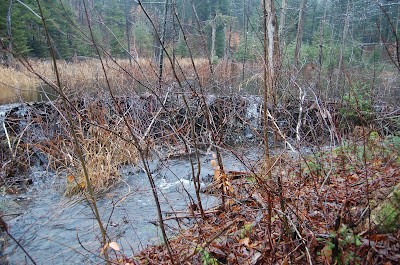
We ended up at the beaver pond...because in my opinion this is a gold mine for journaling...even in the rain. With the rain we've had in the last 24 hours, water levels were up significantly.

We could hear the water rushing over and around the dam from a distance. Once there, we could see water rushing where no water has rushed before.

Across the way we could see the lodge, hard by the bank. Freshly chewed sticks made it stand out like a beacon in the damp grey light.

Despite the damp conditions, the kids did their best to record their observations.


Journaling has become quite popular in recent years, which is great, considering the decline in our society's ability to actually write. Too often I read the writings of students in grades 6-8 and find that they are barely writing at a second grade level: they can't string together coherent sentences, they haven't got a clue about grammar, and forget punctuation. Computers and text messaging, I fear, spell doom for the written language.
So, let's encourage kids to keep journals; it'll get them writing, and, if they are nature journals, it will get them observing - two skills that we should do our best not to lose.
Wednesday, December 2, 2009
And this is Beau
The morning was rushed - I keep oversleeping. So, Toby got a very short walk down the street to the water tower and back. But, on the way, we encountered our neighborhood's newest resident:

This is Beau, an English Shepherd. He's a bundle of fuzz and energy, with one blue and one brown eye. He's very friendly and curious, and Toby wants nothing to do with him (Toby really doesn't cotton to puppies). After a little coaxing, Jeanne and I got Beau to sit still long enough for me to take his portrait, with the promise he would be on my blog. So here he is.
Jeanne was telling me that she was visiting her grandkids this last week, with Beau in tow, and one night they were outside playing with flashlights (her grandson, it seems, thinks "scared of the dark" is "scaring the dark," so he runs around waving his flashlight to scare the dark away - isn't that cute?). Anyway, the beam of the flashlight caught the eyes of the two other dogs that were out with them: yellow eyeshine. And then it caught Beau's eyes: one yellow eyeshine (the blue eye) and one electric blue eyeshine (the brown one). How cool is that?!?
The curious naturalist in me is now wondering: why is that? I guess I need to do some research on eyeshine.
A Sudden Rush
Here I was, sitting in the office trying to identify a pixie cup lichen, when I heard a sudden muted rushing sound, reminiscent of snow coming off the roof. But we have no snow, on the roof or anywhere else (the dusting from this morning is all melted now).
Curiosity got the better of me. I craned my neck to look out the window, checking out the ground below the roof (just in case something else had come rushing off it, like leaves maybe).
And there, under the building (yes, for some strange reason our building was built on pillars - go figure), was a ruffed grouse (Bonasa umbellus):

Lots of folks call these birds "ruffled" grouse, and this one is indeed looking a bit ruffled.
And it must've been this bird coming in for an abrupt landing that I heard, for I know that when a grouse takes off, its wings can make a thunderous sound. I wonder if it was cruising through the woods and suddenly encountered our building, slamming on the brakes so it didn't collide. Would that make the same rushing sound? I imagine so.
I grabbed the camera, opened the window ever so slowly, and snapped this shot. I reached down to move a mug out of the way so I could lean a little closer and get another shot, but when I looked up the bird was gone. This is why I prefer working with plants - they tend to not rush off at the slightest provocation.
A Dusting of Snow Reveals All
It doesn't take much snow to make a tracker happy. In fact, a dusting of snow is usually better than a foot of snow, for the tracks are laid out in perfect detail, whereas with a foot or more of snow all you are likely to see is a hole where the animal's foot sank into the white powder.
So, here we have this morning's find on the back deck at work. In this first photo, you see the classic pattern of this animal: the hind foot placed next to the front foot.

Can you count the toes? Five on the front, five on the back. The hind foot is larger than the front (which indicates that the nether region of this animal is heavier than the front), and the tracks look uncannily like human handprints. Have you guessed it yet?

This animal is a good climber and agile on the railing:

Here we see that this animal made the rounds on the deck, leaving full sets of great prints. If you look closely, you'll see the smaller tracks of a second mammal, the giant tracks of a third mammal, and the small paired tracks of a fourth animal, the latter non-mammalian. Can you name them all?

Here are the answers (don't cheat and look ahead):

I had high hopes of getting out on the trails today. As you can see the sun is out, and with just a trace of snow, I was anticipating all sorts of potential tracks and such. But, one co-worker called in sick, and the other had a plumbing emergency. Translation, I'm stuck inside. Ah, the travails of having a small staff. I guess I will have to settle for reading my new books: Lichens of the North Woods, and The North American Porcupine.
Tuesday, December 1, 2009
A Ramble on the Golf Course
Sunday was a beautiful day, so Toby and I went out for a two hour ramble on the golf course. Often our walks take us on a short route around the upper portions of the course, but today we decided to walk the whole thing (at least until some other folks and their unleashed dogs mobbed us, at which point we headed off into the woods to avoid further encounters). I usually like to walk the perimeter of the course, eyes trained into the woods and wetlands that remain, in search of something unusual that might be lurking just off the beaten path.

View from the top of the third hole.
 It was actually pretty calm out, windwise, but by the position of the leaves on this beech tree, it is pretty obvious which direction the wind usually blows.
 This lovely outcropping of rocks is located at the base of the second hole. During the summer it becomes quite overgrown with vegetation (until the staff weedwack it), but with the barren days of November upon us, it was a perfect time to go exploring to see what calls this place home.

 Litter was prominent. When the golf course was under construction, much of this area was littered with the debris of past generations: old pots, old farm equipment, old 50-gallon drums. As harsh as the climate is in Newcomb, there used to be a fair amount of farming here way back when. Obviously, this was necessary for the early settlers, since they couldn't just bop over to North Creek (25 miles away) to get groceries: if they wanted to eat, they had to produce the food themselves. Some of the old "litter" is interesting, a peek into the past. Modern litter, however, is a little more disappointing to see.
 Looking straight up the side of the largest boulder. Is this a glacial erratic (a rock brought from somewhere else by the glaciers and dumped when they melted), or merely a broken off chunk of the local exposed rock? Whatever its provenance, it is now home to many growing things: mosses, lichens, ferns, small trees, herbaceous plants, et al.
 This delightful moss covered the greatest portion of the boulder. I believe it's Hedwigia ciliata, a fairly common rock moss. Like many mosses, this one has no common name.
 A real close up look at the leaves shows that they have white tips. This is a good diagnostic for this species.
 Hedwigia, is capable of survival in more exposed areas than most mosses. When things get dry, the leaves shrink up and pull in close to the stem, reducing further moisture loss. As with many mosses, the addition of a little water reconstitutes the plant into its lovely yellow-green lushness.
 This moss might be a Dicranum. Dicranum scoparium, aka Broom Moss, is a fairly common species, found on dry-ish forest slopes and in moist habitats near woodland streams. It seems to like a variety of substrates: soil, rocks, rotted woods. One of the characteristics of broom moss is its windswept appearance.
 Common Polypody, Polypody virginianum, is, as the name suggests, a pretty common fern and is often found on top of rocks (the ferns in this genus are appropriately referred to as Rock Cap Ferns). The smooth, rounded leaflets, and the obvious sori, make this fern pretty easy to identify. Apparently, at one point in time (pre-1753) only one member of this group of ferns was referred to as polypodium, which is a Greek word meaning "many feet" and was used to refer to the branching of the rootstock. Carolus Linnaeus, however, came along in 1753 and decided to use the name to refer to the whole genus.

The sori, or little spore packets, on the back of the polypody show where some either erupted or were torn apart by some outside force. In some places this fern is called Golden Polypody, which reflects the color of the sori rather than the color of the plant itself.

 Many of the cattails in the remnant wetlands look to me like marshmallows that have been slowing melting over the warm coals of a campfire.

I've always thought that these large, single-flowered thistles were bull thistles (Circium vulgare), but it turns out that there are other species of thistles that also meet this definition: field thistles (C. discolor), pasture thistles (C. pumilum), and swamp thistles (C. muticum). So, next summer I will have to take the field guide out and peer closely at the leaves and stems of these plants to determine which we have and where.

Many of our milkweed plants never had the chance to send their seeds out into the world this year. First, it seems their ripening was delayed; I saw milkweed fluffs blowing around south of us much of the fall, but ours weren't even splitting yet. When they finally did, the rains arrived and many merely ended up matted masses, barely emerged from the pods. Once they reach this state, the ends of the parachutes are snarled together and they will never float on the wind. It's kind of sad.

I saw two clumps of this spectacular orange jelly (Dacrymyces palmatus) on my ramble. Another common and widespread species, it grows on dead conifer logs and stumps. Both clumps I found were on stumps. It looks to me kind of like loosely scrambled eggs, where the whites and yolks are not completely mixed. Of course, these would be eggs from the local chickens, not the store (which are pale, anemic-looking by comparison).
Give me a fresh, local egg any day!
Give me a fresh, local egg any day!

I am not 100 percent sure what this gone-to-seed plant is, but if I had to guess, I'd say a goldenrod. I saw several of these, and on all the wispy silks of the seed parachutes were pretty snarled with each other, preventing the escape of the seeds (much like the milkweeds above).
 Ah - scats! No ramble is complete without at least one pile. My first thought when I saw this specimen was bear, because of the apples, but the hair suggests it might be coyote instead, although bears will eat other animals and carrion. By now most bears should be hunkered down for the winter, but since the days remain fairly mild and snow is not covering anything, bears are still out and about foraging. Size wasn't much help in determining whodunnit - could be large coyote or small bear. The slightly tapered ends on some of the segments, however, suggest to me it is more likely to be coyote scat.
Saturday, November 28, 2009
Here and Gone
We celebrated last night as we left work with the snow pouring down all around us. At last! It's snowing! By 7 PM even the roads were white.
I enjoy walking the dog at night in the winter (when there's snow) because it's like walking in a perpetual twilight. Even in the areas where streetlights don't reach, it's never quite dark, thanks to the blanket of bright white that reflects even the tiniest bit of light. It's also enjoyable because now I can see the animal signs that only the dog and his powerful sniffer have been able to witness.
So, we all went to bed expecting to have to shovel our way out of our driveways in the morning, hoping the plows will have cleared the roads. Imagine our surprise to wake to green grass again (and powerful winds)!
What happened to the snow?!?!? Did the wind blow so hard it evaporated? It's not like it really warmed up overnight (it's only 33*F now). Maybe the borderline freezing temps changed some of the snowfall to rainfall, and it washed the snow away? It's a mystery.
I was all set to take the camera out and get photos of our lovely white forest and lawns, but the snow that remains is in tiny patches - hardly worth the bother - although the mountains are speckled white and looking rather nice, when the clouds part enough to see them.
Well, we still have all of winter ahead of us, and I'm sure we will all be sick of the snow before it's over. I guess we can wait a few more days.
Subscribe to:
Posts (Atom)