Wednesday, August 11, 2010

Viles Arboretum - Augusta, Maine

I know...you all have been waiting with bated breath for details about the arboretum I visited on Monday. Your wait is over.

Viles Arboretum, located in Augusta, Maine, is a 224 acre oasis of fields and forest that provide a welcome respite for residents and wildlife alike.

Originally the site of the State Hospital (1835-1905), its lands were used extensively for agriculture. Much of the hospital's food was grown here - pigs were a mainstay, and psychiatric patients were each responsible for an acre of land. Over time the farm grew to about 600 acres - not something we see at state hospitals any more. Pity - more institutions should be responsible for producing their own food. The clients would eat better, and they'd get some good exercise and fresh air (where appropriate).

Anyway, the Maine Forest Service started working on this plot of land in 1981, converting it into the Pine Tree State Arboretum. Trails were built, tree collections were planted. In 1990 it became a private, not-for-profit entity. 1991 saw certification as a Demonstration Tree Farm, and 1992 saw the addition of a hosta collection.

Today the arboretum, now known as the Viles Arboretum, is working to bring its mission and image into the 21st century. They hope to resurrect their American Chestnut project (working to improve the genetic stock of the chestnut tree and ultimately make this species a survivor in the US once more). They've added an heirloom apple orchard, and have a green ash collection that may come in useful as the emerald ash borer makes its inexorable way into the Northeast.

I arrived at the arboretum a couple hours early for my interview, so I took a walk around the trails. It was a terribly hot and humid day, although a nice breeze was starting to blow up. Here are some views from along the trails.

First up, we have a look at the Urban Forestry collection. There were maybe a dozen trees here, several of which were oaks. Urban forestry may seem like a contradiction of terms to many folks, but in truth, cities are often full of trees. Collections like this can demonstrate which species are better suited for urban settings. Some traits to take into account are how tall a tree can grow (some streets might do well with tall, majestic trees, while other locations would be better served with shorter species); what kind of root system it has (deep or shallow; water-seeking or drought tolerant); does it produce fruit, and if so, how much (in some areas, fruit or mast-producing trees might be unwelcome, especially if the wildlife attracted to this food source deface personal and public property; in other locations, attracting wildlife may be a real plus).


Next I came across their Conifer Collection. It was so hot in the field that I opted not to walk over to check out which species were here, although from a distance I think it is safe to say spruces and firs predominate.


I was eager to see some of the historical artifacts that remain on the property, so I sought on the site of the piggery. There isn't much left today - some metal rods emerging from the tall grasses and goldenrods.


A delightful little pond made a welcome sight. Dragonflies galore skimmed the water and patrolled the vegetation.


I loved this rustic bridge.


Eventually I came across the Rock Garden. This is one of two stunning garden collections on the property. Tended by local master gardeners, it is easy to see that they love what they do.


The other garden of note is the Hosta Collection.


Located along either side of a wooded path, it is delightful to the eye.

I don't know how many species they have, but it is an impressive amount.


Not only do the plants line the path, but some have been cleverly arranged around the rocks in the woods.


You can't tell from this photo, but that light green specimen in the back has leaves that are half again the size of a human head. They were HUGE!


I'm not necessarily a huge hosta fan, but some of these plants caught my eye, like this "Americana."


Back in the fields, I came across the heritage apple orchard. These are young trees, which are too young to produce fruit yet.

I was curious to see what varieties they had, so I went in search of labels. The one below is a Black Oxford. Sound familiar? This is the very same variety that I had to cut down in my yard earlier this year due to fire blight.

The white paint you see on the lower trunks of these trees is a practice advocated by some growers to help control damage by apple borers (remember the round-headed apple borer I found a couple months ago?). I believe the thought is that the layer of paint can either deter the insect, or it makes the telltale signs of infestation (sawdust) easier to detect, thereby making immediate treatment (a wire into the hole to skewer the larva) possible.


This arboretum has a lot of potential. As collections grow, and science is brought back into the mission, school groups and the general public can learn about the importance of trees, a major source of income and pride in Maine, and discover how often their lives are tied to the success of our forests.

If you live in Maine, or are just visiting, I recommend a visit to the Viles Arboretum. Bring your binoculars - there is pretty good birding here, too.

Monday, August 9, 2010

Walking in the Clouds

What a night. I think I'm working on about three hours of sleep. It hasn't hit me yet, but there's still that ten-hour drive this evening.

When I left the hotel and greeted the world this morning, it was very foggy. Overnight it had rained a little bit, but the forecast said it would pass. So, off I headed for Cook's Corner and the islands off that spit of land, in search of the ocean and a rocky beach with tide pools.


Lots of boats seemed stranded on the sandy shoals in the fingers of water that reached inland. Was the tide coming or going? I couldn't tell.

Lots of houses, some agriculture, and plenty of roadwork waiting to continue when the crews clocked in for the day. But where were the rocky beaches?

I drove to the end of the road, which stopped literally a stone's throw from the ocean. There to the left was a Land's End shop (closed - it was only a bit past 8 AM), and in front was a rocky beach, sort of, smaller than most parking lots.

Here's the beach to the left:


and here it is to the right:

I could hear the rush of water out there in the fog. This did not bode well. Was the tide coming or going? I still couldn't tell. So I clambered down the rocks to the beach proper to see what interesting things awaited.

Found some cool seaweeds.


Are these nobbly pods seed pods or air bladders? Woodswoman Extraordinaire wrote about this very same seaweed on her blog recently from her trip to Maine. She and her husband found a GREAT rocky beach to explore, with plenty of tide pools. They were further north than I and on vacation.

Is this stuff great or what?!? It is no surprise to me that the early people who lived along coasts (I'm thinking England and Ireland here) thought this was the hair of some kind of water sprite that would entice men to their watery deaths.


Could it look any more like hair?

Here's another rubbery seaweed - reminded me of moss or a lichen. This was washed up in the flotsom cast upon the shore by the waves.

I spent several minutes watching the rocks at the water's edge, trying to determine which direction the tide was flowing. I finally concluded it was coming in. The rise was not as dramatic as what I witnessed when I was up in Alaska, where you could literally see it rising; one could out-walk it, but one also had to keep one's eyes open.

I tried to get some classic Maine coast tourist shots. Here are some boats in the fog.

Isn't this the best weather vane? It was on top of a church. Can you see the little people in the boat?


I drove around some more, still searching for that rocky beach. No luck, but I did find some more little coves that looked kind of neat in the fog.


By 9:45 I was hungry, so I drove to a Friendly's for breakfast, then headed up Route 24 towards Augusta. It was a lovely back road (speed limit about 40), with glimpses of the ocean, of fingers of seawater reaching in towards the land, of railroad tracks, of small towns with beautiful old New England houses (none of which I photographed).

And now I'm at the Arboretum. I've walked the trails (that will be in the next post), and am now just waiting until my designated slot for my interview. I have 45 minutes to go.

Sunday, August 8, 2010

Oy Vey - What a Day!

The bottom of the key card below says it all:

I've been on the road since 9:00 this morning, driving to a job interview in Maine. MapQuest declared it was upwards of a seven hour drive from Newcomb to Augusta. Guess what - they are wrong! Let's see... 9-10-11-12-1-2-3-4-5-6 - that's 9 hours and I'm still an hour away. HM...methinks MapQuest should actually send out staff to drive these routes. Okay, take off an hour for all the stops I made to stretch my legs and get maps and a lunch, but still, it's a far cry from 7 hours. I think we have to give them some slack, though, because in Vermont the speed limit varies from 40 to 50 MPH on most of the main roads; MapQuest probably doesn't consider that.

Still, regardless of driving time, here I am in Maine!

That's the view out the window of my hotel room. I wonder what that pipe is for...

That's the only photo I have of Maine yet, though - sorry. Most of my driving has been on major highways, which a) are not really conducive to taking photographs, and b) are not terribly photogenic.

I did take some shots at Lake Champlain, though. Here we are at the former sight of the Crown Point Bridge (at about 10:30 AM).

Obviously, there is no bridge there now - they blew it up this last winter after it was deemed unsafe for travel. Hundreds of people flocked to the bridge the day of the demolition, only to be disappointed when gale-force winds blew up near-blizzard conditions. Between the blowing snow and the fog, there wasn't much to see. One moment the bridge was there, and then >poof< onblur="try {parent.deselectBloggerImageGracefully();} catch(e) {}" href="https://blogger.googleusercontent.com/img/b/R29vZ2xl/AVvXsEhPIeXpONljVTq9BJ5YcM6dnBprZD7btm567KXMzP9CnICEJqi5UqDZyPgdczztukU6sLnZVAgPaFKPPPbmaCgbYjeygd7m7cmKNoHUFwkZVWk2N68yV1xFMYXyvlaXPLooLLFB3VlYmcxs/s1600/20100808_2.JPG">
There was a sign as one approaches the ferry that said "Bridge Construction to begin August 10." Wow - that's in two days. Looking out into the lake, it looks like they are ready to go!


I know this looks like the same shot, but in this photo you can see the other ferry (middle right) just as it is leaving its dock to come back to the NY side of the lake. I couldn't believe how short the distance was. Somehow, it seemed a lot further away when I drove across on the bridge!


This next shot is kind of interesting - past and present colliding. In the foreground you see all the construction equipment for the new super modern bridge. In the background, on the grassy knoll, you see stone walls - part of all that remains of the fort at Crown Point.

This fort was built originally by the French in the 1730s, back when they thought they ruled this part of the world. Twice the British tried to take it over during the French and Indian Wars. The French finally blew it up in 1759 so the British couldn't have it.

The British promptly rebuilt it.

Then the American Revolution came along, and the British only kept a handful of soldiers on at the fort, which meant that when push came to shove, they lost it pretty handily to about 100 militiamen (the Green Mountain Boys) in 1775.

There's a lot of history here, including Benedict Arnold (when he was still on the Colonies' side). If you are a history buff, then this should be a place for you to visit some time. Unlike Fort Ticonderoga, which is a private outfit and all restored, with re-enactors and all that, Crown Point is a grassy expanse (lots of hills) filled with all sorts of ruins. There may even be ghosts there for all I know!


Anyway, here's the other ferry, headed back to NY. The ferries run 24 hours a day. Must be a bit of a drag for the operators, but it sure is a boon to us travelers!


Here's another historic structure on the NY side of the lake. This is the Crown Point Lighthouse. Pretty interesting structure, isn't it? I've never visited it, but it looks like you can climb up to the top (see the people?).

Apparently the first structure here was a windmill, which the French blew up in 1759 along with the fort. They were thorough, it seems. It wasn't until about a hundred years later, when things had calmed down a bit, that the need for a lighthouse at this location was broached by those in the maritime commerce business. Lake Champlain is a VERY LARGE lake - vying with the Great Lakes in size. In fact, I believe it is considered the 6th Great Lake, at least unofficially.

One of the famous parts of this lighthouse is a genuine Rodin sculpture. A bronze thing. Last year the lighthouse (with the Rodin) was reopened after restoration. It's kind of cool that an original Rodin is sitting out there for the viewing pleasure of people in a campground!

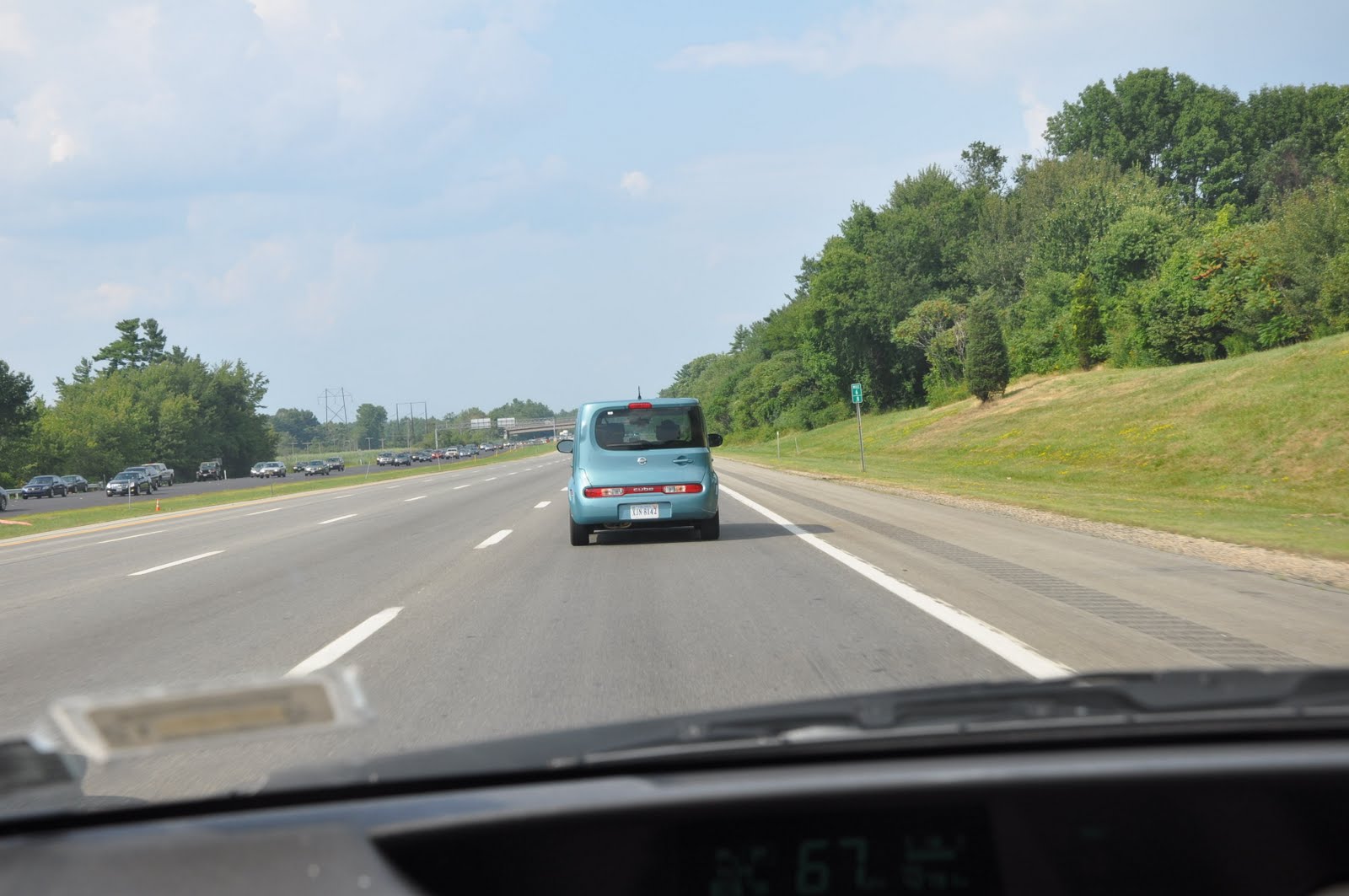
Okay, I admit I did take one photo while on the highway. I think this is in Maine, although I could've still been in New Hampshire. Anyway, this car was just the weirdest looking thing. It's called, get this, the Cube. The CUBE! And it is! You thought those refrigerator boxes on wheels (Kias, I think) were strange? Well, they are naught compared to this thing. Check out that rear window - it wraps around the right corner of the vehicle!

So there you have it. My trip to Maine so far. I am staying the night in Bath, which is along the coast. The plan is to get up early and head to Cook's Cove (or was it Cook's Corner?) and drive out one of the fingers of land that stretch out into the ocean. I want to see the coast and take in a tide pool or two before my interview. I don't have to be there until 3:00, so I have a little time to sight-see. Then it's interview time, followed by the ten-hour drive back to Newcomb. It's gonna be a looong day tomorrow. I'd better get some sleep.

Monday, August 2, 2010

The Gentians and the Bees

The narrow-leaved gentians were blooming is such profusion along the river that it was stunning. I've never seen carpets of this flower before. But even more amazing was watching the industrious bumblebees diving into the "closed" blossoms in search of pollen and nectar.

I took several series of photos, hoping to capture the entire event. Here we have Madam Bumblebee diving into the flower:


...and then backing out:


When she emerged, she used her middle legs, which are equipped with pollen combs, to rake the pollen off her hair and transfer it to the pollen sacs on her hind legs (for more information on this, read the piece I just wrote for the Adirondack Almanack).


And then off she goes to dive into another flower:


Here we go again. Into the flower:


...within the flower (sometimes buzzing, sometimes silent):


...and backing back out:


And then it dawned on me: I have a video option on the camera! So, take your Dramamine and sit back - you can watch LIVE ACTION of the bumblebee visiting the gentians! If you turn the volume up, you can hear the vibration buzzing when the bee is deep within the flower.

[Okay - I couldn't upload it onto the blog, but you can see it here.]

Rapid Assessment Part II

I am "on vacation" again this week. According to the weather gurus, it's not going to be the beautiful weather we've had the last few days, so I took advantage of yesterday's pleasant weather to get in another invasive plant survey.

This time I was able to do it on foot, for it was the snowmobile trail that parallels the Hudson River in town here. So I packed up the dog and we went for a walk.

The only invasives I found were a single plant of spotted knapweed and a small stand of honeysuckle.

I found plenty of other interesting things, though, like the virgin's bower in full bloom:


And narrow-leaved gentian, everywhere! (More on this to come.)


The cherries are ripe, and when you have trees and shrubs loaded with ripe cherries,

you also get trees and shrubs loaded with cedar waxwings.


This shelter was a surprise find! Someone was rather industrious and built a fine retreat right along the banks of the river.


How about this tall plant? I have to check my field guides, but I'm thinking false hellebore?

The coolest thing we encountered was the bumble bees in the gentian, but, as mentioned above, I'm going to have them in a separate post.