Sunday, October 2, 2011

Things Falling from Trees

 Well...y'know, they don't call it "fall" for nuthin', nosiree.  This time of year there's all sorts of stuff falling out of trees.  Why, one might just be advised not to go out one's front door without wearing a hardhat!

Sure, we all know about the leaves turning color and falling to the ground:


 And then there are the random assorted nuts that come plopping down:

walnuts

 acorns

 hickory nuts

And every so often a caterpillar may come tumbling out of a tree, or swing in the air as it lowers itself down on a silken line:


Sure, none of those should cause one trepidation - the worst that might happen is a walnut might conk you on the noggin, but it won't do any real damage.

But the other day, while Toby and I were on our evening stroll, I saw these:


Good gracious!  What in the world are those?  No...it can't be!  Is it...really?  Well, bless my buttons, by golly it is!  It's an osage orange!


I haven't seen one of these since my dendrology days in college - 1985!  And those were specimens planted as ornamentals in a cemetery near campus, and they were small trees (key word being "small," as in 6-8' tall at most).  Where we were walking that evening, there were no "small" trees.

I looked around...and up.  And there they were - up high in the branches!


The bark is characteristically deeply furrowed.  And there were quite a number of them, all planted in a row along the road's edge.  Their presence here was intentional.  

I wracked my brain to see if I could remember anything about osage oranges, and nothing came to mind, except that one of my friends referred to them as brain fruit (the knobby green balls look sort of like brains).  I asked at work - are osage oranges native to Michigan (I kind of had it in mind that they were southern trees)? 

It turns out the answer is yes and no.  The osage orange (Maclura pomifera), aka horse-apple, was apparently only found historically in parts of Oklahoma, Texas and Arkansas.  How on earth did it end up here in Michigan, or anywhere else, for that matter?  It's not like a squirrel is going to grab one of the fruits, run off with it and bury it somewhere - the fruit probably weighs at least three times as much as a squirrel!  Ditto birds.  And the wind certainly isn't going to carry it off to places unknown (well...maybe some of those tornadoes, for which Oklahoma is famous).

As with so many plants, it turns out that man was the agent of its dispersal.  Not for the fruit (I'll get to that in a moment), but for the wood.  Along with black locust, osage orange was highly desired for the making of fenceposts.  It is a sturdy, hard wood, and it is slow to decay.  It is also, apparently, fairly resistant to many insects.  So, as people moved around the West and Midwest, herding their cattle and whatnot, they needed to mark their borders and keep the livestock contained.  For that, they needed fences, and the wood of this tree was ideal.  Therefore, it behooved these settlers to bring the trees with them as they moved - and seeds are a whole lot easier to pack than fence posts and whole trees (or at least they were over a hundred years ago, before haulage firms were around to cart massive loads from one part of the continent to another).

What about the fruits, though?  Are they edible?  They certainly don't look terribly appealing.  Well, I was dying to know what the inside of an osage orange looked like, and I'm sure you are, too.  So, I brought one in to work, where I just happened to have my hatchet.  A couple good whacks, and here we are:
 

Ta-da!  Not quite what you were expecting?  I didn't know what to expect, so I would've been surprised by anything.  Essentially, it is a solid mass of...well...stuff.  The brown bits toward the center are the seeds, each of which is tethered by fibers to a lump on the outside.  Sometimes the fruits have no seeds at all.
The very center of the fruit is solid, and as we stood there marveling at it, the center started to ooze.

The thick white sap is a sticky latex, not unlike that found in milkweed and dandelions (I know, for I stuck my finger in it).

For the most part, the fruits are inedible (no kidding).  The literature says it's not, strictly speaking, a poisonous fruit, but if you attempt to eat it, you may end up with a serious case of vomiting.  You've been warned.  Sometimes squirrels will tear the fruits apart to get to the seeds, but I'll bet it isn't very often - even squirrels don't want to get covered with the sticky sap.

So what in the world is the evolutionary purpose of such a fruit?  Like I said, nothing (really) eats it, the wind can't blow it, animals don't carry it off to bury - so how in the world can it spread?  If the fruits just drop at the base of the tree, and maybe roll a foot or two, it isn't going to increase its range except maybe at a glacial pace. 

Well...and this is very cool...a recent hypothesis  has been put forth that this fruit was once eaten by (drum roll please) a giant ground sloth!  And there were four species of these critters around during the Pleistocene, two of which (Jefferson's and Harlan's) called the Midwest home.  These guys were about the size of an ox.  Here's an artist's rendering of what one might have looked like:


And, amazingly, they ranged about the same part of the future US (sort of) as the osage orange trees!


These giant herbivores hung around with mammoths, mastodons and gomphotheres, all of which went extinct shortly after the first humans came on the scene.  Hm.

Some think that there was a now-extinct horse ancestor that also might have enjoyed the fruits and spread the seeds around, based on the fact that modern horses sometimes gnosh on the fruits.

As for me, I'm just grateful that one of these massive fruits hasn't falled from the trees as I walk or drive under them.  I imagine it could put quite a dent in a car roof, and likely break a window.  It certainly would hurt if it hit one's head.

So, what did I do with the orange after we opened it up to see its innards?  Well, the literature said they float, so I lobbed the pieces into our pond, just to see.  Lo! and behold, they floated!  Maybe Todd the Turtle would try sampling them.

Monday, September 26, 2011

Old Cemeteries

In addition to old cars, I like old cemeteries.  Okay - I like lots of old things.  But, I digress.

On my way home from the Fall Festival, I stopped at this small, old cemetery that is down at the end of my road.  There are fewer than 100 stones in this lot, and none are terribly recent.  Most are from the 19th century, and most are in pretty poor repair.


Is the earth reclaiming this stone, or was it vandalized 
and only this short piece remains?

It's always sad to see the stones of infants and children.  


Several stones were embraced by trees.

And a good number of the stones had willows on them:


There must be some significance to this, because there so many.  So, I did a little quick research, and it turns out that in the first half of the 1800s, there was quite a revival of interest in all things Greek (just look at the dresses and hairstyles of the time...and architecture).   This carried over into cemeteries, with urns and willows featuring quite prominently on gravestones.  Apparently willows were the symbol of the Greek goddess of the underworld:  Peresphone.  Not only that, but Orpheus was said to have carried a willow branch with him when he went into the underworld.  Willows, it seems, were the most popular gravestone image up until about 1860.  This certainly is supported in this cemetery.

I also came across a reference that said that willows were used to signify the graves of Iroquois.  Hm.  This isn't Iroquois country, so I think we can rule this out.  And I don't recall anything from Iroquois stories that suggested that the willow held any particular significance to the Iroquois nation.  Does anyone know about this?


This last marker, well, I just thought the name was unusual.  I've heard of Althea, but never Altha.

And she was all by herself - no other family around.

Clinton Township Fall Festival

A friend told me that this last weekend was the Clinton Fall Festival.  With autumn in the air, I was in the mood for a fall fest, so Saturday morning I decided to check it out.  It was less than 20 miles away - a good deal.

Well, who knew it was such a popular event!  

Upon arrival at the outskirts of town, I blew right by the first venue:  the antique car show!  Turned around and headed back.  Good thing, too, because it was one of the few places where there was parking.

I love old cars.  They have character.  They are fun.  They have beautiful lines.  Today's cars, by comparison, are pretty darn dull and boring.  Here are some shots of my favorites.


I loved the reflection in this tire, but had a hard time getting it - 
people kept walking by!


Now, I think this window visor is great!  Why don't we have these today?
From Dad:  G'pa R had a car with the windshield visor.  It helped to keep snow off (almost - there was a gap between the rear edge and the car body) but it never was designed to be raised or lowered.


This person obviously had a thing for tigers (how many can you count?):


Update from Dear Ol' Dad:  Esso gasoline had an ad campaign re: putting a tiger in your tank -- and one could purchase tiger tail (imitations) to hang out of the trunk and over your bumper.


 Fins!  Lots of fins...and lots of land yachts!


 I love these!  So beautiful!


And how cool is this vintage van!


We had VW buses when I was a kid, but they didn't quite look like this one:


The placement of the license plate on this truck caught my eye.  I've never seen on like that before.


After viewing the vehicles, I grabbed the shuttle bus to the rest of the festival, which was downtown.

There are a lot of neat old buildings here, including an old wool mill that I had a great view of from the bus, but when I walked back past it later on, I was too short to get any decent shots.  Perhaps I'll try on another visit.  Meanwhile, here is the clocktower downtown:


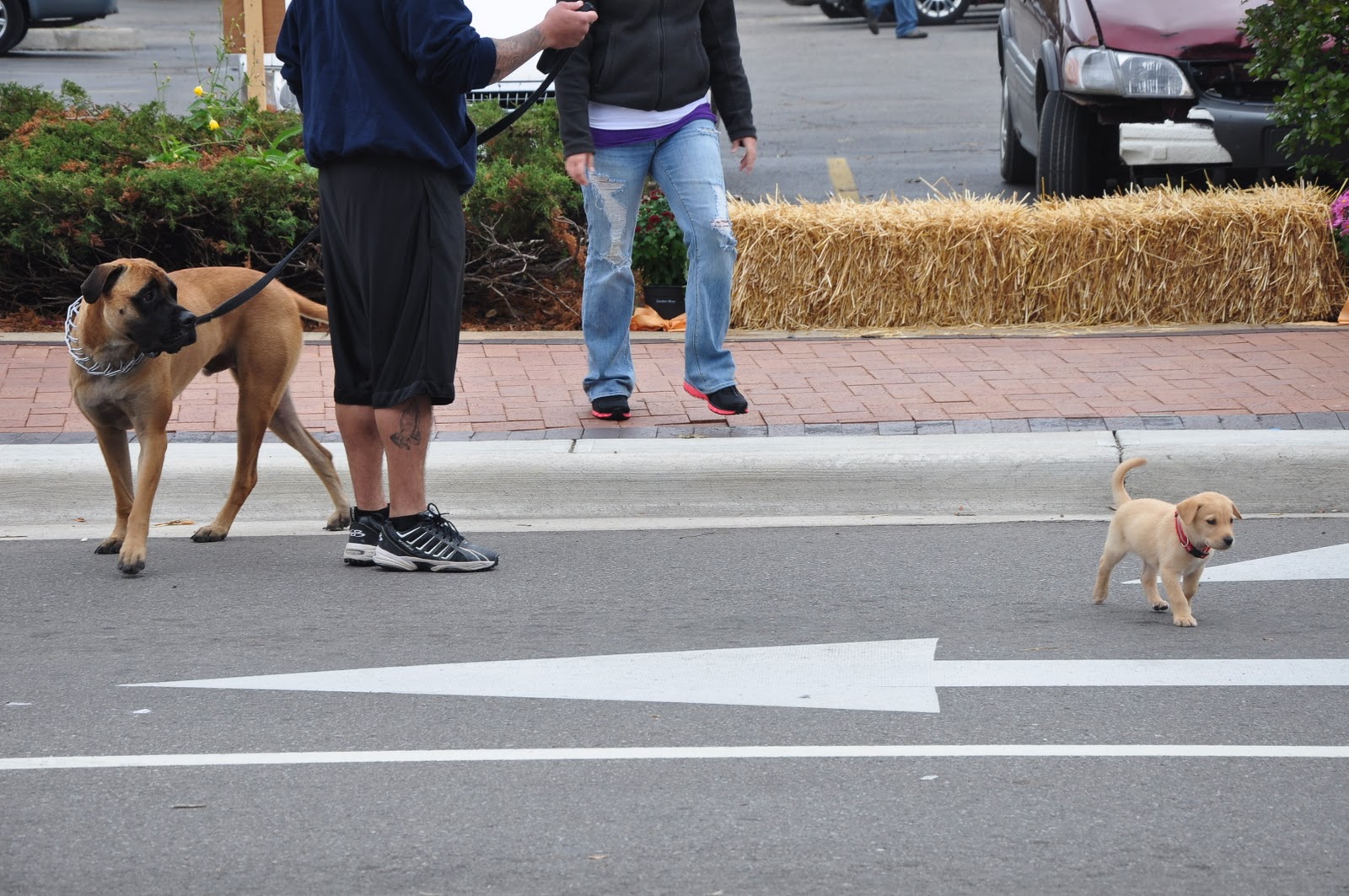
There were dogs of all sizes and shapes out and about at the Festival.  Lots of puppies.


And, to wrap up, here are some shots of vendors - they capture the flavor of the season.


This last image is a booth of "Witches' Hats."  And it was probably one of the most popular booths there!  I saw many women, of all ages, walking around wearing their newly purchased black hats. And no, I didn't get one, but I was tempted...a little.  No, instead, I bought an old-fashioned washboard.  I got a lot of strange looks for that, but, well, y'see, sometimes you have to wash things in the sink, and, while doing just that this last week, I found myself wishing I had one of those old washboards.  Ask and you shall receive, eh?  I count myself very fortunate.

Friday, September 23, 2011

That's a Lotta Watta!

I just received the Long Lake e-Newsletter and on it was this photo.  It doesn't say, but I'm presuming this was taken after Hurricane Irene hit. (Update - nope.  This was from the flooding this spring, back in April.)  That's the Adirondack Hotel in downtown Long Lake - and that's Long Lake lappin' the front porch.  Normally, about where the person is holding the camera is the town beach, which looks across Route 30 at the Hotel.  Do you see a beach?  A road?  Nope - the lake flooded right over both!  And here I thought Keene had taken the worst hit!  Looks like Newcomb was surrounded by damage, but squeaked by with only a token amount of rain.


Here's a video I just found from when the water started to recede:


And here's another this one from the Long Lake, NY blog:

Saturday, September 17, 2011

Random Stuff


Earlier this week, while on our evening walk, I noticed a sulphur buttefly deceased along the side of the road.  I didn't think much of it - we often find butterflies and moths who had terminal encounters with vehicles.


But then I found another.

 And another.

And groups of them!


I only found two survivors, and this one I'm not sure actually made it.  What in the world happened?  On the way home, I counted 44 bodies in about a quarter-mile stretch.  This was not normal.  The only thing I could think of was puddling.  This road is a dirt road, and we'd recently had a fair bit of rain.  Could all these butterflies have been puddling, and then gotten run into by vehicles that either didn't see them or didn't care?  I can think of no other explanation.  


On a cheerier, note, however, we also saw this kestrel!  It really liked this oak tree (lots of birds do, especially starlings, which nest in its many cavities).  It soared around a bit, then came to rest in the tree.  Took off, flapped around, returned to rest.  I'm glad to see this bird - I haven't seen a wild kestrel for many years - just the merlins in the Adirondacks.


Meanwhile, at work, we had someone bring us this mystery caterpillar:


We looked and looked in our caterpillar ID books, but to no avail. I finally sent this shot off to BugGuide and the answer came back "dogwood sawfly."  Not a moth or caterpillar at all!  It turns out that this larva is quite a pest of dogwoods.  The adult is a fly, but looks somewhat like a wasp, but it's the larva that does the damage.  Now, I didn't see it listed as a non-native insect, so, although it does damage to dogwoods, it must be a native insect, and therefore, part of the circle of life for our native plants.  If you have ornamental dogwoods, well, that's something else.  Go native - the plants and their associated critters are used to each other.  You will get some damage, but that is natural!  Plants are food - not museum specimens.

Saturday, September 10, 2011

Grab a Tissue

Every day when I come home, and every morning when I leave, there is someone who is there for me - my dog Toby.


These days, however, his age is really showing. He's got quite a hitch in his get-along, stairs are a real challenge. He often stumbles when we walk, and tall grass is a nightmare.  He drinks water like there's no tomorrow, which is unusual for him (when he first came to live with me, it practically took an act of congress to get him to drink). His bladder isn't what it used to be.

Despite all this, he is always there for me. Any pat on the head, any kind word, he appreciates it.  Even if I don't toss the ball any more, and our walks are short, and I'm out of the house all day, come home late and soon got to bed - he still seems to appreciate the time we have together.

It is hard to know if "it is time."

Anyway, today I saw this video, and it beautifully demonstrates why we love our animals so. Sure, it's all anthropomorphic, but it is beautiful...and I challenge anyone to get through it with a dry eye.

Thursday, September 8, 2011

Very Cool Caterpillar


How cool is that!?!

You can read all about it on my other blog here.  (I posted the video on this blog as back-up in case it didn't post over there.)