Thursday, July 22, 2010

The Unknown Sedge

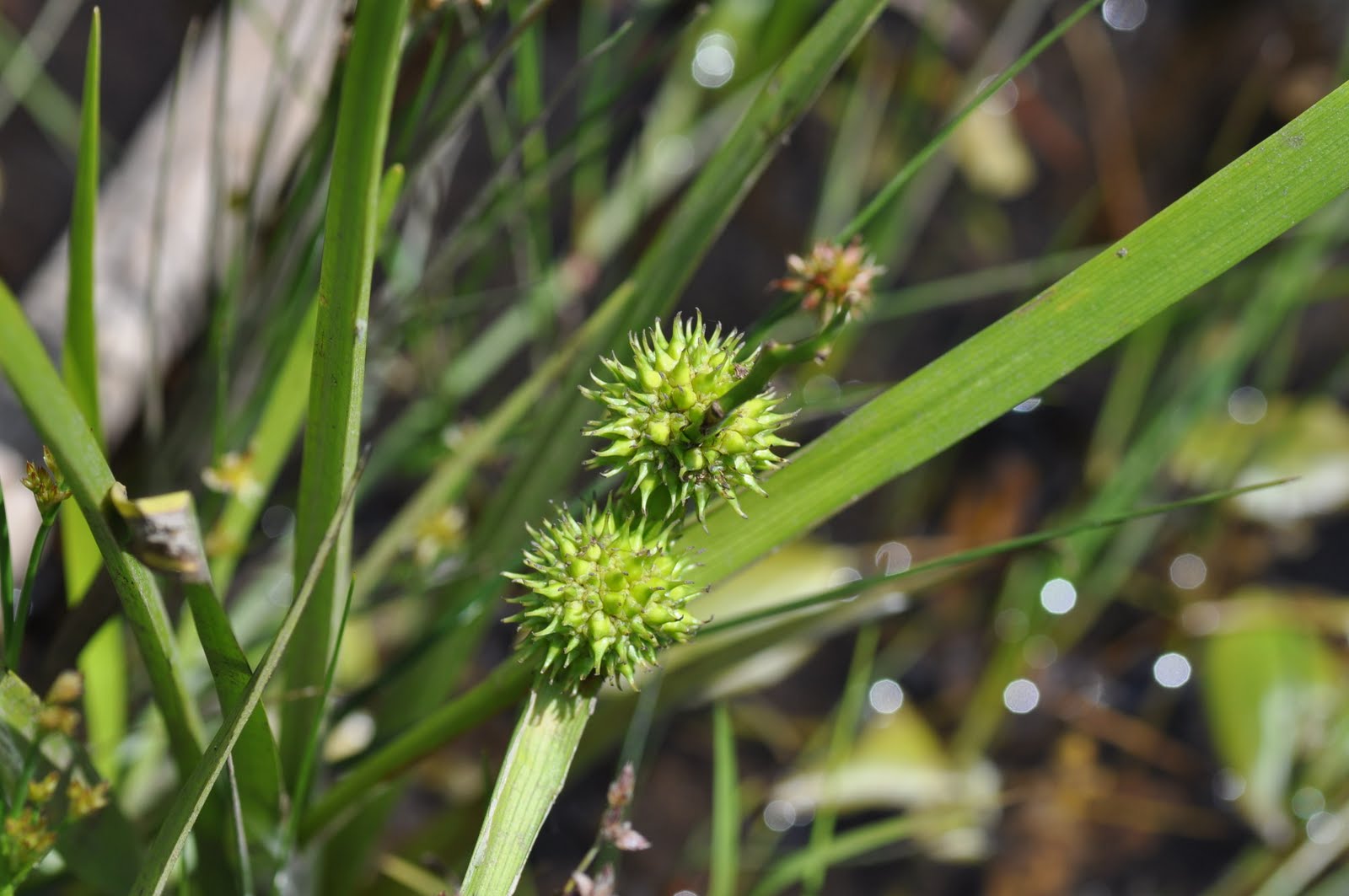
I was really hoping I could ID this sedge before I posted it, but I've had no luck. Perhaps a sedge expert is lurking out there and will chime in.

We found this sedge (note the triangular leaves - an important clue that it is a sedge and not a rush or a grass) down at the Ice Meadows.

It was such a lovely thing that I had to take its photo.

Up close it is even more intricate than one could imagine.


I'm leaning toward it being some kind of bulrush (which are in the sedge family), but my books are just not detailed enough. For all I know, it could be a Cladium (Cyperaceae).

Tuesday, July 20, 2010

Bluebird Update

Saturday evening I decided to check up on my lone little bluebird chick - the one whose siblings had all perished, and for whom I'd cleaned out the nestbox. I wanted to reassure myself that the little one was still alive.

When I reached the first green on the golf course, the adult bluebirds were flitting out of the trees and dancing in the air above my head. An unusual display for these birds. Up on the tee were two golfers. I slunk along the edge, hoping the golfers wouldn't hit me with a ball while I headed for the nestbox.

I didn't have to go far, for within moments my attention was grabbed by a rustling motion at the edge of the woods. There on the ground was the little bluebird - it had fledged early (I was afraid it might). It fluttered along and hid next to a stump. This explained the agitated actions of the adults - they were trying to protect Junior from me and the dog!

Since the baby had left the nest, there was nothing I could do. Once they fledge, even if it is before they can actually fly, they cannot be returned to the box - they will just jump out again. So, it was on its own, with its parents to look out for it. Maybe it will survive, or maybe it will be eaten by a fox, or snake, or some other ground-dwelling animal.

Search for the Orchid - Part III

Okay - I'll say it right up front - we didn't find it.

"IT", of course, being the ragged fringed orchid, aka: green-fringed orchid (Habenaria lacera).

"We" were my flower friend Jackie and I. Sunday, which turned out to be a beautiful day, we met at the Ice Meadows. Jackie was pretty sure she could relocate this orchid for me, so we were on the hunt. We walked up and down, and down and up the boulders, cobbles, and massive shoulders of bedrock, but to no avail. We found lots of stuff, but not the orchid.

But, just so you all are not disappointed, I've swiped Jackie's photo of this orchid from her blog (http://www.saratogawoodswaters.blogspot.com/) and here it is:


Now, isn't that a lovely, if understated, orchid? I've heard they exist up at the Paul Smiths VIC, too, but I've never seen one.


Here are some pics of what we actually did see.

Kalm's lobelia (L. kalmii) were blooming profusely all over the rocks. Looks a lot like the Indian tobacco I found last week, although the blossom is narrower.

There were lots of little white asters blooming, and some large purple ones. According to Jackie, purple-stemmed aster (A. puniceus) is the only purple flowered aster that blooms this early, making it one of the easier asters to identify. Asters, like goldnrods, can be notoriously difficult to ID.


I had noticed these sweet little bell-like flowers all over the Ice Meadows last week when I was on my search. Did I photograph them or ID them? No, of course not - I had done what I apparently do a lot more often than I realized: I assumed (!) I knew what they were and ignored them. It turns out, it was a new flower for me: marsh or bedstraw bellflower (Campanula aparinoides).


This funny looking plant is branched bur reed (Sparganium erectum), an emergent plant of many wetland situations. One website I found states "It is easily uprooted and therefore is not found on exposed shores or by rapidly moving water." Hm...then why is it growing here on the Ice Meadows, where moving water and ice are common through the winter and spring? Maybe it's in a little secluded nook that protects it from the worst ravages of its chosen home.


I was duly impressed by this goldenrod. There it was, blooming on a very small ledge, down the side of a VERY steep rock. It was probably a good six to eight feet below me, straight down.


And just upstream was Jackie, taking photos of the river, and of me taking a photo of the goldenrod above!


Meanwhile, about a half-dozen turkey vultures were circling overhead. HM...were they waiting for one of us to take a wrong step? Or was there a meal on the other side of the water? Perhaps they were, like us, just enjoying the strong breezes that were blowing down the river.


We had over an inch of rain Friday afternoon, so there were plenty of little pocket-sized puddles filling the depressions on the rocks.


For a delightful sensory experience, one should find some mountain mint, gently crush the leaves, and give it a sniff. It is one of the BEST mint scents in the world! I first encountered mountain mints in, of all places, the Great Swamp in New Jersey. Haven't seen them since, so I was thrilled to find them here.


This is narrow-leaved mountain mint (Pycnanthemum tenuifolium), and from a distance (it is on the ground and you are standing above it), you'd never notice the purple dots that grace the petals. Jackie handed me her hand lens and there they were!


We had a number of dragonflies and damselflies flitting around us, mostly guarding the various puddles and pools. There are several red dragonflies in the world, but this one I believe is a band-winged meadowhawk (Sympetrum semicinctum). We also saw several male eastern forktails, the masculine counterparts of the orange damselfly on my previous post.


Jackie was enthralled with this "stuff" that was clinging to the rocks underwater at one of the small pools. We both had difficulty photographing it. For me it was a matter of balance - the only dry place was a very narrow strip of rock - about the size of one foot. With my macro lens, I couldn't crouch there still enough to get a clear photo, and there was no way to spread me feet apart for a more secure stance. Anyway, we suspect it's an alga of some sort - it had these wonderful yellow blobs dotting its otherwise green surface. Hopefully an aquatic plant enthusiast will help us out with ID.


Here's another grass that was in bloom. I have no idea which one it is, but I thought it was quite lovely.


This viceroy butterfly was enjoying a meal on the Joe-Pye weed. Viceroys looks a lot like monarchs, although they are smaller and have that extra black line on the hindwings.


We found lots of boneset buds, but just this one plant actually in bloom. I belive this is just regular old ordinary boneset (Eupatorium perfoliatum), although I suspect the scientific name is one of those they've changed. Again, my field guide with all the corrections is at home.


And we wrap up with this dragonfly, which I was surprised to ID as an elfin skimmer (Nannothemis bella). I thought for sure it was a white-faced meadowhawk, based on the last photo.

Have a Happy Day!

Saturday, July 17, 2010

A Bzzzy Day in the Garden

It's just the interns and I at work today, so I couldn't hit the trails. Instead, I dashed out into the garden to see who was hanging out in the flowers.

We had over an inch of rain yesterday (hooray!), and it was nice and cool last night (in the upper '50s - ahhhh), but today the sun is hot, and the humidity is trying to rise. A nice strong, but sporadic, breeze is keeping it fairly pleasant, though.

First up, we have our friend the small milkweed bug (Lygaeus kalmii). Nothing new to most people. These guys are often lurking about the milkweeds, where they ingest the latex-like sap, making them taste nasty to insect-eating predators. The red and black markings serve as a signal to "leave me alone - I taste bad." This one was tip-toeing across an immature echinacea blossom.


The stars of the garden, if by shear number alone, were the flies. Lots of flies, of all sizes, shapes and colors. Here is a sampler. I'm awaiting ID confirmations from BugGuide.

I wrote on my BugGuide ID request that I thought this looked like a house fly,
and it turns out it is in the house fly family (Muscidae).
It is a fly from the genus Graphomya, of which there are nine species in North America.

This turned out to be a horse fly! One expert on BugGuide called it
a Hippy Horsefly, Stonemyia tranquilla. This horsefly, apparently,
is not a blood-feeder, which is why it was supping at the flowers in the garden.
According to Marhshall's Insects - Their Natural History and Diversity, these
are "an entirely North American genus of unknown biology." That could
explain why I can't really find any info. about them!


And this one is a Syrphid, one of the flower flies. It is a female from the genus Sphaerophoria.


This lovely damselfly caught my eye, namely because it is orange! I've never seen an orange damselfly before. It, like all the other damsels flitting around the foliage, was very small. It's body was no thicker than an applique needle, and maybe and inch and a half long. These insects are soooo thin that at first you aren't even sure you see them...but then you see the eyes bulging out the sides of the head, and that's a pretty good clue it's an insect.


So, I took this lovely's photo and couldn't wait to ID it. Some sort of spreadwing, I thought, based on the the attitude at which it was holding its wings (a logical assumption). No orange spreadwings were in my field guides, although admittedly they are pretty basic books.

My next resource: the internet. I typed in "orange spreadwing damselfly." Nada. HM.


Finally, I went to the experts: BugGuide.net. I typed in "orange spreadwing damselfly" and two photos popped up. One was from Texas - I could eliminate that. The other was from New Hampshire - an immature female Eastern Forktail (Ischnura verticalis) - not a spreadwing at all!


These small damselflies are common across most of the eastern US ("eastern" meaning everything east of Washington, Idaho, Utah and Arizona). They are one of the first to fly in the spring and continue flying right up until the first frost in the fall. Their preferred habitat is any body of water that isn't moving rapidly: ponds, lakes, slow streams. They can be seen flying low in the vegetation along the shoreline (they rarely venture out over the water). OR, in my case, in the garden several hundred yards uphill and through the woods from the lake.


The males, by the way, are black and green (instead of black and orange), with a blue band near the tip of the tail.

Celestial Beauty


They weren't quite irridescent, but the clouds sure were lovley last night.
The bright spot you see in the first two shots is the waxing crescent moon.

Tragedy Strikes

I've seen some tragic wildlife moments lately. All seem to involve young animals.

The First One
On Sunday I decided to hit the Farmer's Market in Keene Valley - always a good time. I headed up the Blue Ridge Road, a scenic drive between two wilderness areas (the High Peaks and Vanderwacker). The first part of this road is windy and hilly, so the smart traveller drives slowly. This usually frustrates the idiot traveller, who just wants to get where he/she is going. So, of course, I had an impatient driver behind me. As soon as we hit the more open and straight section of the road, this car blew by me. It was less than a minute later that it happened.

I saw a small mink emerge from the left shoulder of the road to make a dash across the macadam. I watched in horror as it was just missed by the front left tire. But as it passed in front of the front right tire, it disappeared from view, only to reappear in a flash, tumbling tail over tea kettle and into the grassy verge. The car sped on, oblivious.

To the left, I saw two more small minks stick up their heads from the roadside. Where was their compatriot? I pulled over, thinking that I'd forego the Farmer's Market if I found the injured animal; if it lived and looked like it might survive, I'd drive it to our local rehabber. I searched the grasses but found no sign of the animal. Hoping it was only bruised and battered, but not mortally wounded, I climbed back in my car and pulled away.

I had Toby with me, and we hadn't gone but a few feet when he had his nose sniffing out the front window. Then I smelled it, too - the unmistakable musk of the weasel clan. Either the animal had indeed been injured, or it had been frightened by its flight through the air. I didn't stop. Maybe it lived, maybe not. I don't think the people in the other car even saw it - too busy chatting and not watching the road.

Incident #2: The Bluebirds
Last night Toby and I walked the golf course again. I decided to check the nestbox that had the four fledglings earlier in the week. When they reach about a week and a half to two weeks old, one shouldn't check the nest box in case one forces them to fledge too early. So, I figured I'd just scope things out, but wouldn't open the box.

When we arrived on the first hole, I saw one of the parents sitting on top of the box. It seemed the young were still inside. I tapped gently on the side of the box to see if this would get a reaction. Nothing. But it didn't smell good. Something was wrong. Carefully I eased the nail out of the door and lifted it open. One small chick stood in the box, trying to vanish into a corner, while under its feet were the rotting corpses of its three siblings.

What had happened?!? They were all fine Monday! They had survived the heatwave of the previous week. Sure, it had been hot and humid this week, too, but not quite as bad. Whatever the reason, they had perished.

I couldn't leave the lone chick standing in an abattoir, so I reached in and lifted it out. It didn't struggle at all. While holding it (and the dog's leash), I pulled out the soiled nest and lobbed it into the woods. I needed some dry grass to refill the nest box, but that is difficult to come by on a golf course, especially yesterday, when we'd had over an inch of rain. Leaving the door open, I carried the chick across the fairway to some tall grasses. They were relatively dry, so I grabbed a handful and returned to the nest box. One of the parents was again sitting on top and flew away as I approached. Had it seen the box empty, and me carrying off its offspring?

I wrapped the grasses around my hand (not easily done with a chick and a dog occupying the other hand) and stuffed them into the box, making a substitute nest. Then I placed the chick inside, closed the door and replaced the nail. Toby and I retreated up the cart path. I wanted to wait until I saw one of the adults go into the box, because I was concerned that they might abandon it, having already seen it completely empty while I was scrounging for nest material.

I watched as the parents flew around, catching insects on the grass, perching in the trees or on posts to eat them. It seemed like forever, but was likely only a couple minutes, before one of them flew into the nest box and was greeted with the high-pitched chirps of the baby. All was well.

I hate to disturb them again, but I may check the box this weekend just to be sure that Junior is still doing okay. Maybe I'll bring the rest of the mealworms I have in my fridge. (Hm...wonder if they are still alive!)


Incident #3: The Deer
This one isn't quite so tragic. This morning T and I were walking along the highway when I heard a metallic ringing noise, like someone was rattling chains. As we cleared the shrubbery, I saw the source: a young deer had found itself "trapped" on the ball field. As I watched, it repeatedly flung itself into the chain link fence that wrapped around the outfield. The fence doesn't surround the whole ball field, but the deer didn't know this. I thought for sure it would break a leg, or even its neck, in its panic.

On the other side of the fence, were a doe and a buck. They stood there and watched as the young one tried again and again to jump through the fence. Finally, it found the end and took off across the side road, disappearing beyond the community garden.

Toby had discovered the deer by now and was barking furiously, which probably added to the stress of the young one, spurring it to flee along the fence to freedom. The two older animals simply ignored him. After the young one had vanished, they continued to stare through the fence as if to say "Where did it go? Should we keep waiting for it?"

Toby and I continued our walk, and turned the corner, passing the route the young one had taken in its flight to freedom. I kept an eye on the adults to see what they were going to do. They decided to cross the highway. Bound-bound-bound, and the doe was across. Bound-bound, the buck crossed, too. Then, out of nowhere, a third deer, either a doe or another youngster, made a mad dash across the highway to join the other two. The young one who had difficulty with the fence had disappeared in the other direction. Would they eventually all meet up again, or had the family unit given it up as lost? I'll have to keep my eyes open for the Winebrook deer herds to see how this saga turns out.

It's a rough life out there in the wild. We humans, and our pets, should really appreciate how easy we have it.

Thursday, July 15, 2010

Roadside Discoveries

Last night Toby and I headed towards the river, only to be diverted onto the golf course by my conscience - I really needed to check the nestboxes to see if the baby bluebirds fledged or died in the recent heatwave. The box was empty, so they probably flew off - a relief. Just before the heatwave hit, a second box had four new eggs in it, and Monday when I checked it had four feathered chicks - they should be fledging soon, too.

So, we left the golf course, cutting across the 7th tees, and as we traipsed over the verge by the roadside, I saw it: a single spiraled stalk of flowers. Ladies tresses! I hadn't seen them along the road here since before the golf course was completed. I didn't have the camera (of course), so we turned around and headed home as quickly as the nearly solid air and an arthritic dog would allow. I grabbed my camera, hopped in the car, and drove back before the sun set.

Further investigation of the area turned up three of these delicate orchids.


The spiraling blossoms are a clue to what species it might be, but only partially. My choices were slender ladies tresses, little ladies tresses, and grass-leaved ladies tresses. Of course, at this time of the season, there are no leaves visible. This makes ID a bit more tricky.

All three species grow in dry fields and open woods, although the grass-leaved (aka: spring ladies tresses) also likes moist places.


A close inspection of the flowers held the answer. Only the little ladies tresses (Spiranthes tuberosa) have upward-curling petals on the top. The upper petals on the other two are mostly horizontal.

When the golf course was put in, much of the roadside was torn up to facilitate the pipes needed for the irrigation system (bringing the water up from the river). Every year I looked for these flowers, but they seemed to be gone. The batch I found last night was in a different location from the ones I saw eight years ago, but at least they were there. I went back and checked the original location last night, just in case, but mostly it's bare soil and a few scraggly "weeds." What a joy to see these little orchids once more!

While I was there photographing the orchids, I also saw this pale blue beauty. My first fleeting thought was eyebright, but I didn't spend a lot of time thinking about it because my field guides were at work. This morning as I was loading the photos into the computer, I thought "that looks more like a lobelia."


Sure enough, it's downy lobelia (L. puberula). According to Newcomb's, it's found from NJ to Illinois. So what's it doing in the Adirondacks? HM.

Update: I'm beginning to wonder about this ID. Looking through my Revised Checklist of New York State Plants, it is not one of the seven lobelia species listed. Here are my options: a) I have misidentified it, or b) I have discovered something previously not found in NYS! "A" seems like the more likely option, but just in case, I'm going to send a copy of the photos to Steve Young, NYS Botanist with the Natural Heritage Program, and see what he has to say about it. Will keep you posted.

Further Update: I returned to the roadside yesterday afternoon to re-evaluate my ID of these lobelias. Would you believe that in less than 24 hours every single one of those plants disappeared? I couldn't find any at all! I found a fourth ladies tresses, but no lobelias. It was as if something had come and removed every plant.

So, all I could do now was wait for Steve's reply. It came this morning, and his professional opinion is Lobelia inflata, Indian tobacco. I had been leaning toward spiked lobelia (S. spicata) based on what I could remember about the plant, the photos I took, and what I could ascertain from Newcomb's. On a whim, I grabbed my Audubon Wildflower book, though, and looked to see what it had to say about these plants. Based on the close-up photos of the flowers (Audubon field guides use photographs, which can often be misleading, but in this case proved helpful), I am now inclined to believe Steve. So, Indian tobacco it is!


You just never know what you will find - even in the most unlikely of places. It pays to look, even when you think the only things you'll see are the old stand-bys (daisies, vetch, St. Johnswort). Serendipity is a wonderful thing.