Friday, December 11, 2009

Night Time "Snow" and Snowshoeing in the Morning

Last night, after thinking earlier in the day that it's been quite some time since I saw a snow goose, I had an interesting encounter.

First, we (that would be the dog and I) were walking in the teeth of a gale along the highway (snow was horizontal in the air and across the ground) and I kept hearing this odd sound. I thought to myself "Is that a dog or a goose?" I couldn't see anything in the dark and the snow, so I kept going. As we were coming down the home stretch, I heard it again, and I thought "Is that a goose or some metal thing creaking in the wind?" I looked up, and there, in the dark, lit up by the orange glow of the street lights, was a "V" of snow geese. They were so low that had it been light out I could've counted their toes and seen all the details of their faces, without binocs! It was a small group, maybe 15 or so. A second, smaller flock flew crosswise above them. I was stunned.

A little bit later, as I stood in the back yard and Toby ran around barking, I heard more of them, but they were high enough in the dark and blizzard that I couldn't see them (although they certainly sounded close). Later on, as I was waiting for my ride to rehearsal (we have our first holiday concert tonight), I heard yet more of them. I was starting to think that maybe they were all the same flock or two, going in circles, but later I consulted with our local wildlife rehabber and bird nut, and she said that snow geese love this kind of weather. Who knew?

**********************
This morning, after our walk was cut short by some aggressive neighbor dogs, I strapped on the ol' snowshoes and set some trails in the yard for Toby.


Once the snow gets deep (we have about 10 inches now, which is pretty darn deep when you walk on four legs and it about reaches your belly), Toby doesn't like to sashay forth much, so I help him out.
Over the course of the winter the trails get well packed and are easy for him to dash about on. It also makes things easier for me, like refilling the birdfeeders and the bird bath.

Sometimes, though, a good dash through deep snow is all one really needs!


My snowshoes are the old wood and rawhide kind,


made by yours truly way back when I was an intern at Beaver Lake Nature Center.

Every winter they had (do they still?) a snowshoe-making workshop or two. I learned how to make them in one workshop, and then taught the next one. They really are not difficult to do, especially since they come in a kit. Now-a-days, though, I suspect the kits come with neoprene instead of rawhide. You have to soak the rawhide to work with it, and it becomes a slimy mass, kind of like working with overcooked spaghetti, but I much prefer it to neoprene, which stretchs and frays as it ages. Rawhide has to be varnished to keep it from getting worn and wet with use, but I think it makes a nicer-looking snowshoe.

Of course, today most snowshoes are metal or plastic. We use plastic MSR snowshoes at work, and I must say that I do like them (except when the snow is crusty, at which point using plastic snowshoes is downright deafening). They are lightweight, have teeth on the bottom (they sure beat my old wood and rawhide ones for going up and down steep hills), and have the best bindings I have ever encountered on snowshoes (and I've seen and used a lot). I'd love to get a set of these bindings installed on my snowshoes...I wonder if I can. Hm...

Thursday, December 10, 2009

The Naturalist's Desk

Yesterday you had a peek at my desk, which inspired one comment from a reader. So, on a whim, I thought I'd grant you all a glance at the bigger picture.

As you can see, my "desk" (I use quotations there because instead of real desks, we have kitchen counters and cabinets) is a busy place. We have assorted books (one set) next to the computer on the left and outside the photo (there are more in the cupboard above and around on the other side of the computer); we have assorted plants (two spider plants hang above the window, too - you can just see the fronds of one of them); we have assorted chatchka (?) on the windowsill (Smellum Potion, flamingo, galls, acorn caps, rocks, feathers, chalk, expired batteries, pins, pens, rubber bands, et al); we have assorted liquid-containing vessels (at least two mugs and two bottles of water); we have wood waiting to be identified (I suspect it's cottonwood, but I'm not 100% sure); we have more books, birdseed, a calendar, office supplies, school program info, a small mammal trap, dog biscuits (just in case), a hat, a robotic bat, a wooden fish-shaped fishing pole; and under the desk the Naturalist's Day Pack (full of still more books and stuff), a dry bag (for those summer days when I lead canoe trips), an empty box (I sort of collect these - you never know when you'll need one), and the ubiquitous trash receptacle.

The bright glare out the window, by the way, is from all the snow we received, a total of about 9 inches from yesterday's storm. Everything is covered with white, and the wind is blowing mightily. Brr. I finally broke out the long johns this morning (it had to happen some time).

Wednesday, December 9, 2009

Success!

Back in November (the 19th, to be exact), I came across this interesting lichen:


It was nestled among some low blueberry shrubs and assorted "reindeer mosses" along the side of the road. What drew my eye was the lovely pink fruiting bodies. What kind of lichen was it? My Quest had begun.

First, I fired an email off to a friend who seems to know the identity of just about every plant and plant-like organism in the Adirondacks. She had a suggestion, but wasn't 100% sure.


So next I went on-line, and found recommendations for a couple lichen books. A quick trip to Amazon-dot-com and I placed an order for each.


Lichens of the North Woods arrived first. This is a wonderful little pocket volume that covers the most common lichens found in, you guessed it, the north woods. In this case, the north woods specifically refers to the northern ends of Michigan, Wisconsin and Minnesota, and the southern bit of Canada, all surrounding Lake Superior and parts of Lake Huron and Lake Michigan. Since the Adirondacks are very similar to this area, the book applies well here, too. It is part of the same series as the spider book I purchased a year ago (and currently cannot find; I know it's somewhere). Needless to say, this little book will have a permanent place in my Naturalist's Day Pack (which gets heavier and heavier all the time as I add more field guides to its contents).


Still, as wonderful as this book is, it didn't have my little pink friends in it. So, I waited for the second book to arrive, which it did, yesterday:


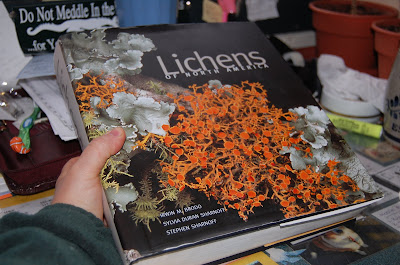
As you can see, Lichens of North America is not really a field guide, unless you plan to hire a Sherpa to schlep it along for you. I don't, so this massive tome will reside in the office, where I can use it for reference.


According to L of NA, there are over 3,600 species of lichens in North America alone. This book may look like all 3,600 are in it, but in fact, it only has photos and ID for about 1500 species. Still, that is nothing to sneeze at, and it is probably the only user-friendly lichen ID volume out there that has as many species as it does.


So, this morning I pulled up the photo of my little pink lichen fruits on the computer and started paging through the photos, looking for a match. I'm not ready to handle the key yet, for it requires a) a good grasp of lichen terminology, b) microscopic evidence in some cases, and c) chemical tests in other cases. Nope, I am too impatient and want to know NOW what my little lichen is.


So, while co-workers are putting the lights and ornaments on our tree in the lobby, I'm sitting here in the dark (I refuse to turn on lights when I have enough light from the window to read by) paging through my new book. And there, on page 299, I saw it:


Down there in the lower right-hand side you can see it. "There it is!" I exclaimed to an empty office. I read it's name: Diabaeis baeomyces. Hm. Doesn't exactly roll off the tongue, but because lichens are not really in the limelight when it comes to popularity of ID, most of them do not have common names. My little pink friends, however, do. In layman's terms, they are called Pink Earth Lichens. And here is what L of NA has to say about the Pink Earth Lichen:

* it is a two-part lichen, with a crustose primary thallus (that's the crusty looking bit, kind of grey-white in color), and fruiticose apothecial stalks (the tall, mushroom-like pink bits);

* the photobiont (the alga or cyanobacterium that produces the food for the fungus; the combination of these lifeforms is what makes up a lichen) is Coccomyxa (that's the genus; most photobionts are not yet identified to species);

* it's very common (one always hopes for something rare, but one is usually disappointed);

* it's mostly found on clayey or sandy mineral soils (in my case, sandy), especially in disturbed areas such as roadsides (bingo!)

And that's about it (except for chemical tests, with which I won't bore you because they probably won't mean anything to you unless you are a lichenologist, and if you are, then you probably already have this book and you can look up these data for yourself).

Many lichens are pioneer species, turning bare soil (in this case) or rock faces into friendlier habitats that other plants (or plant-like organisms) can move into. Pioneer lichens manage this by retaining moisture and producing shade. Some lichens are major sources of food for wildlife (reindeer moss is a classic example), while others are edible by people (like rock tripe, but from what I've been able to gather, you'd have to be really desperate to try them - they might keep you alive, but they aren't going to win any taste tests). Still others were used historically for making dyes for wool and other fibers. Today fiber artists in Scandinavia and the British Isles (and probably elsewhere, too) still use lichen-based dyes to create some of the brilliant colors used in their work.

So, was it worth the purchase of these books? Yes; in my humble opinion, you will seldom be wrong in the acquisition of a good book (unless it's a cheesy romance - but then I did say a good book). Although the price of L of NA ranks right up there with college text books, making it one think twice before purchasing it, those of us who've simply gotta' know will find it a welcome addition to their libraries.

Be Careful What You Wish For


The overall haze to the photos is the rapidly descending, very fine snow. Coming in to work this morning there were moments when visibility was near zero. Still, as of 9:00 AM, we only had 4.4" new accumulation. It's collecting rapidly, though, so it could be over 5" by now. It's the kind of snow that when you finish shovelling and turn around to head back inside you discover you have to shovel again just to get back to the garage. Can't wait to discover how high the plow bank at the end of the driveway is when I get home tonight.

Tuesday, December 8, 2009

Some Snow at Last

After moaning about the lack of snow on Saturday, we woke to a white world on Sunday. It wasn't a lot of snow, but enough to make things white. The sun was out and the wind still, so Toby and I took a nice long walk down to the river. Along the way we found some great tracks.

The first, and very exciting, find of the day were these 2x2 tracks. It's a member of the weasel family. Around here, we have several mustelids: long- and short-tailed, mink, marten, fisher, otter. The footprints are fairly small, so we can eliminate all but the long- and short-tailed.

Based on the size of the footprints, and the fact that they are pretty common around here, I'm pretty confident these are long-tailed weasel tracks.


What did the weasel find? Or were there two weasels? Hard to say.


Did the weasel meet a hare on this snowy driveway? Odds are, they passed this spot at different times. Had they actually met, I'm sure the tracks would show the encounter.


The hare continued down the road, leaving some splendid tracks in its wake. Toby, of course, had to sniff the them:


For some reason, the hare did a quick turn. It was hopping along and suddenly made a sharp left:


I looked around to see where the hare had gone. Very faint, in the brush, there is a trail. Can you see it? This must be the hare's highway...or back road.


Canid tracks were prominent at the dead end of the road. I couldn't tell if there was just one animal or a group, and with the dog in tow, I couldn't investigate thoroughly. The tracks weren't terribly large, which would suggest fox (and foxes don't travel in packs), but if they were fox, then the animal was pretty good-sized. They could be from a small coyote, but most of the coyotes I've seen around here are bigger than Toby. I'll have to remember to bring my ruler in the future - sometimes measuring is the only way to know for sure. In the end, I found myself leaning towards fox.


The canid came along and did a little dance here. My first thought was that maybe it smelled something and was sniffing the ground, shifting its feet as it did so. My second thought was maybe it stopped to mark the spot (pee on it), but there was no evidence of yellow snow, and the tracks don't quite measure up the positioning dogs usually use when doing this.


These tracks show where our canid shifted gears. It was trotting down the road (you'll have to take my word for that), changed into a lope (the middle set of tracks in the photo; in horse lingo, a lope is a canter), and ended up in a gallop (the lower set of tracks):


Following the tracks back up their trail, I saw something odd. Our canine came trotting down the road and suddenly did something that left these triplet tracks:


Here they are close up. I am totally flummoxed. If anyone has an idea of what this animal was doing, please drop me a note!


After we had our fill looking at the tracks, and figuring out who did what, we headed home, where I made an apple pie for a potluck on Monday.


As Calvin of "Calvin and Hobbs" fame said: the days are just packed.

Saturday, December 5, 2009

Spring is here, Spring is here

Life is skittles and life is beer... (a little something for all you Tom Lehrer fans)


But seriously, look what I found in the yard today:


And as if that weren't bad enough, I also found this:


Both, of course, are pussy willow catkins, in the fuzzy stage we usually see in April or May. The first is from my giant pussy willow, and it has over a dozen "kittens" already emerged along its branches. The second is from my black pussy willow, and while it has fewer fully emerged "kittens", there were plenty just starting to break through their buds.


>sigh<>

On a cheerier note, however, I finally found some evidence that the Wildlife Crabapple that I planted a couple years ago is indeed of benefit to the wildlife:


I wonder if the birds only became aware of it after I put out the birdseed and they started spending time in the yard. Or maybe they were simply waiting for the apples to reach a particular stage of ripeness. Hm.

Crabapples, in case you didn't know, are the original apple, or at least they were in Europe. As I recall, apples (as we think of them today) originated in the mountains of Kazakstan, and it was about 10,000 years ago that they became popular with traders and military personnel and started to make their way around the world. (Meanwhile, North America was still recovering from being over-run with glaciers.)

For an in-depth history of the apple, written rather delightfully, hop on over to this website.

Friday, December 4, 2009

The Seton Spot

Way back in time, some 21 years ago, I embarked on a path that led to a career as a naturalist. It was my first job out of college: an internship at Beaver Lake Nature Center. That summer found us interns (Judi, Dave, and yours truly) working primarily as summer camp counselors.

Camp Beaver Lake ran in several week-long sessions. Judi, who had worked there the previous summer and had extensive experience working at (and later being director of) a 4-H Camp in the Adirondacks, filled the spot as our fearless leader. She set up the weekly schedule and developed most of the activities.

One day was spent fishing. We caught bullheads using canned corn as bait. Yours truly was the designated dispatcher of caught fish - I learned quickly how to skin and fillet the bullheads without damaging their heart-shaped air bladders (I still have a couple of them floating around the house somewhere). The fish were then fried on hobo stoves we made from coffee cans, fueled by burning newspapers and twigs.

Another day might be spent learning about the bog, or maybe learning about reptiles and amphibians with a special guest speaker from SUNY ESF.

At the end of the week, the kids had a sleepover on the far side of the lake. We paddled over in the afternoon, set up camp at the lean-tos, and prepared dinner. Judi and I were in charge of cooking, which required the placement of a large square castiron griddle over the hot coals of a fire. This was especially important in the morning when pancakes were on the menu. When darkness fell, a night hike was in order - we looked for foxfire (bioluminescent fungi), juvenile barred owls (easily discovered as they made their "monkey" calls), and went stargazing.

One week was dedicated to older campers, and these lucky individuals joined us on a slog through the swamp. It was a bushwhack that found us sometimes on dry land, often in mud and shallow water, but ultimately in a stream that had us well over our waists in slow-moving water. It was here the yellowjackets found us.

But one of my favorite camp "activities" was the quiet time after lunch. This was set aside to give the kids a chance to slow down, digest their lunches, and learn the art of quietness (it didn't always work). We called this activity Seton Spots,after the famous nature writer Ernest Thompson Seton. Each camper was assigned a specific spot somewhere along one of the trails and had a Seton Spot booklet with a different observational activity for each day of the week. The goal was to have the kids sit quietly in their spots and observe the things that were happening around them. The longer you can sit quietly in one location, the more you will see.

Today you can find the concept of Seton Spots in the teachings of many outdoor awareness programs. Many simply call them Sit Spots, or Secret Spots. Whatever the name, the concept is the same. When you enter the woods, wildlife flees, seeking to either hide or put distance between themselves and the perceived threat (you). Studies have shown that if you stay put, things return to normal in about twenty minutes. So, the longer you can sit still in one place, the more you are likely to see.

When I do journaling programs (like yesterday), or outdoor awareness programs, I still like to use the idea of the Seton Spot. If I find I don't have time with a school group to have them sit in individual locations for 20 minutes or so, I pose it as a challenge at the end of the program before they leave. I'll share it with you here and dare you to give it a try.

The Seton Spot Challenge

Find a secluded spot somewhere that you can call your own. It could be in your back yard, it could be in the woods, it could be on the shore...the location doesn't matter as long as it is some place you can get to regularly and with little difficulty. If your spot is near water, great, for water attracts all sorts of wildlife. If you don't have water nearby, it's no big deal - it's just a nice perk if you do have it.

Next, you want to find a comfortable spot and have a seat. You want to sit quietly. Comfort is important, because you're going to be there a while. Give yourself at least twenty minutes, although thirty or more is better: the longer you can sit, the more you will see (and hear).

As you sit, you want to observe. Look around you. Listen. At first, things might seem awfully quiet and dull, but as time passes, your focus will change. You'll start to notice insects moving on the ground and in the vegetation nearby. Eventually a bird might fly in - watch what it does. Maybe you'll hear a rustle behind you. It could be a squirrel...it could be something else.

This is the easy part of the challenge. The hard part is to come back every day. If you can't make it every day, then try for at least a couple times a week. Visit your spot at dawn, at dusk, at 2AM. The more often you can visit your spot, the greater the chance are that the wildlife will get used to, and eventually ignore, you.

You will likely find a progression over time in how you feel about your spot. At first it is exciting. New things come to your attention. But then you enter a period where going there becomes a chore: it's the same thing every day. Same trees, same flowers, same midden pile. It is during this period that maintaining your interest in your Seton Spot may flag. If you keep at it, however, you will eventually break through that invisible wall and find yourself on a new plane of observation. Your mind and senses will now be tuned in to every little change: a couple hairs caught on a branch that show a deer passed by; the subtle indentation in the leaves where a fox lay down; the alert calls of birds that indicate a house cat is hunting nearby. When you reach this level, you'll find the world to be a larger, yet more intimate, place.

Give it a try. You might be surprised to discover just who (or what) is sharing your neighborhood.