Wednesday, May 1, 2013

Spring Flowers at Last!

Monday, between periods of threatening grey sky, the sun peeked out and tempted me to go for a walk.  I finally acquiesced, since I was wanting to check out the wildflowers blooming at the Nan Weston Preserve, which is only about 5 miles from my house.


I wasn't the only one to answer the lure of nature that day - one other car was already in the parking area, and another came along while we were in the woods.

Right away the forest was offering up beds of blooming beauties, such as the ever-lovely bloodroot.

There's just something so pure about the brilliant white petals of this delightful forest flower.  I fell in love with bloodroots many years ago when I discovered a patch down the road from my grandparents' house.  I collected some and planted them at my parents' home, where they have bloomed year after year ever since, but I never again saw them along the road by Grandma's.


Right by the bloodroot was another flower, which I couldn't quite put my proverbial finger on.


The ripply petals intrigued me,


and the leaves were definitely rue-like.  Must be an anemone, I said to myself.  When I finally got to work Tuesday (where my field guide was waiting), I confirmed it was rue anemone, which I have identified before, but only once or twice.  


Spring beauties were as lovely as they always are.  Some have obvious pink stripes, while others you really have to look at intently to discern any color on the otherwise white petals.  Do the colors fade with age, or is it just color variation?


It wasn't quite time yet for the trilliums (trillia?) to be in bloom,


although as the afternoon warmed up, some started to open.  I imagine that this weekend they will be much more prevalent.  I may be returning to Nan on Saturday with one of our volunteers from work, who gave up a trip To Nan Weston yesterday with our Tuesday Group to help me out last minute with a school program.  It's the least I can do to say thank you!


Likewise, the mayapples were just starting to poke their heads above the leaf litter.


Another flower that was confounding me was this one, which turned out to be purple cress.


Except when it was cutleaf toothwort.


There's also spring cress, which has white flowers, and I swear I saw some of those as well.  These three flowers look awfully similar, and it's the leaves that are key in telling them apart (as well as the petal color, although white and purple can look very much alike, believe it or not).

Soon I was on the boardwalk over the wetland.  


These blooming shrubs were everywhere!  They looked familiar, but I just couldn't place them.  The only thing I could think of was sweet gale, but I knew that wasn't it.  It was the other ladies who were there, who I met about halfway through my walk, who had the answer:  spicebush.  Of course!


They were blooming in such profusion that the woods had a yellow haze about eye level.  The bright green below is a carpet of skunk cabbage.


Another blooming shrub, and an old friend from back in the Adirondacks, was American fly honeysuckle.  After spending much of Saturday pulling up invasive honeysuckles during the work bee at work, it was so nice to see this native honeysuckle.  And now that I know it grows here, I will see if I can add it to the native plantings on my property.  Further Update:  One of these days I will learn not to jump to conclusions.  Two people have corrected my error here.  What I thought was American fly honeysuckle, is apparently eastern leatherwood (Dirca palustris).  I've only seen this plant once or twice (back in NY) and the dangling bell-shaped yellow flowers reminded me so much of the honeysuckle, which I had just been discussing with a volunteer that week, that I immediately assumed that was what it was.  Had I looked closely, I'd have noticed that the flowers are not paired, as they are on the honeysuckle, nor are the leaves opposite.  Leatherwood is a native shrub, and one that deer apparently dislike, possibly because of the tough bark, but also very likely because of the chemicals the plant produces, which can cause an upset tummy, if not worse.  This plant is now permanently ingrained on my grey matter...should have no problem identifying it in the future.


This thorny shrub, with the very strange flowers, remains a mystery.  It's not black locust, although the thorns suggest that it is, and I'm pretty sure it's not one of the buckthorns.  Our stewardship guy at work is also confounded by it.  Does anyone know it?  Update already!  Thanks to Jane, we have concluded that this is prickly ash!  Prickly ash is a tree I did not know prior to moving to Michigan, except by name.  We have some along the trails at work, along with a sign that calls it the Toothache Tree - chewing on the twigs will numb your mouth, apparently.  I've never tried it...but I bet I could get a kid to do so!  Apparently I need to spend more time on the trails at work, getting to know our native vegetation a bit better.


Here are the flowers up close...apparently not quite open yet, but soon.


Now, this flower may have purple buds, but it is golden ragwort, a brilliantly yellow plant of the damp woodlands around here.  Soon they will be open and covering the forest floors with their golden glow.


It was still a bit early for the dwarf ginseng, but maybe by Saturday it, too, will be open.
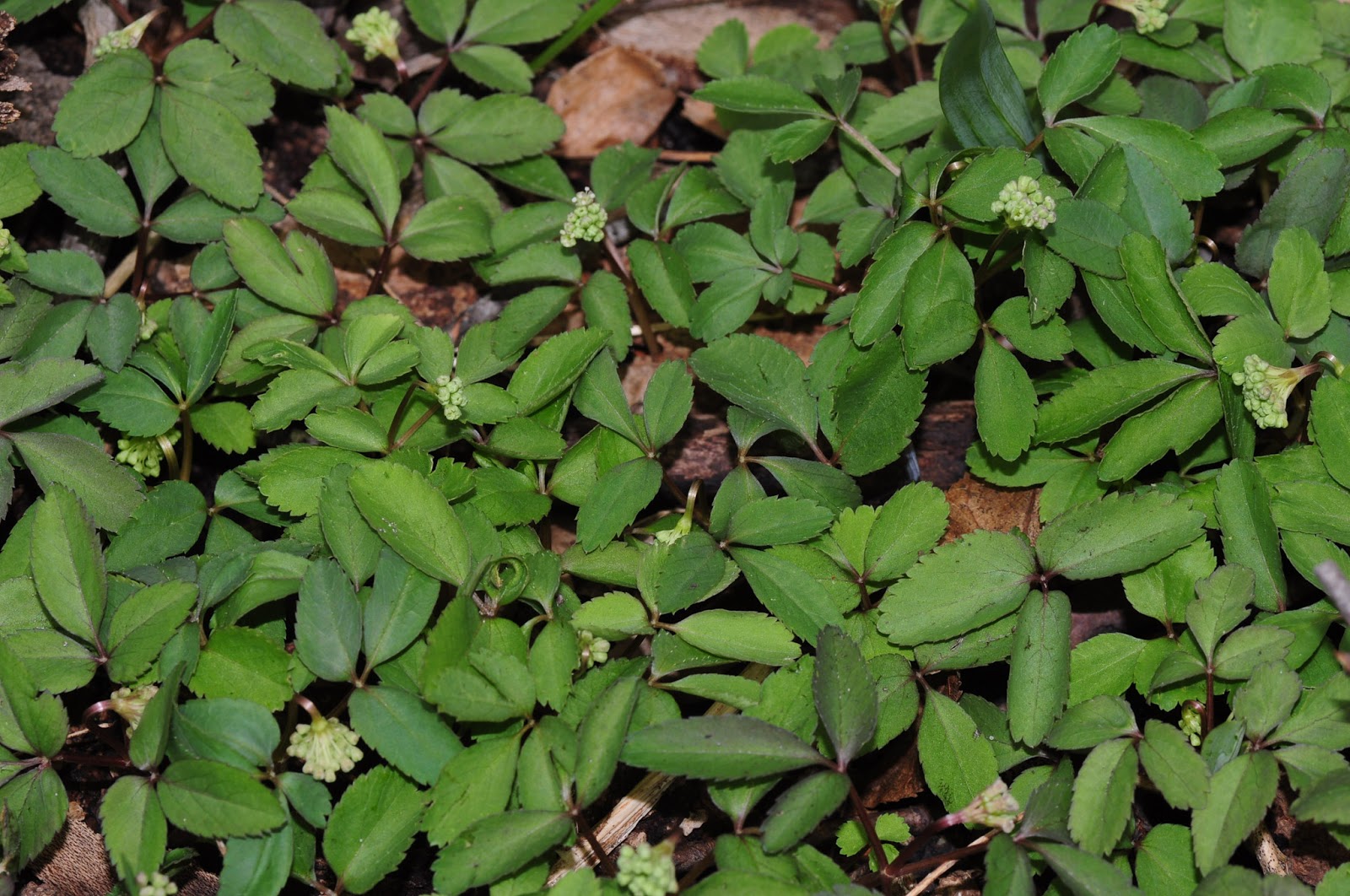

For some reason blue cohosh has always intrigued me.  I don't know why.  Perhaps its the blue-ish purple-ish cast to the leaves and the odd little flowers.  It was juuuust starting to blossom on Monday.  I expect we'll see more on Saturday.


The wetlands were full of marsh marigold - another brilliantly YELLOW! flower - I don't think it could be any more yellow than it is.  


I think Monday was the peak for Dutchman's breeches, for they were in full bloom in every clump I saw.  This relative of the garden-variety bleeding heart puts the domestic plants to shame.


There were plenty of hepaticas in bloom, too.  I believe they were mostly (if not all) round-leaved hepaticas.  Some were deep purple like these, while others tended toward lavender, pink or white.  


There were plenty of birds singing and flying around, but since I always struggle to see the birds, I concentrated instead on the other flying creatures:  the insects.

Lots of bees were buzzing around - including some very large bumbles.  I'm on a kick right now to learn some of our native bumble bees, especially since they are in decline.

This bee is not a bumble, but I'd be willing to guess it is one of the Adrenas.


This very handsome spider crawled out on the board walk to soak up the sun next to me.  I left him alone, and he left me alone, although I think I piqued his curiosity when I zoomed in on top of him with my macro lens - he turned to be sure he was facing me, just in case.


This insect is one that tickles my fancy for some reason:  the bee fly.  It's a very fuzzy yellowish fly, with long narrow wings and a very long proboscis.  It buzzes very loudly, and to the unknowing, it comes across as a bee.  There were several zipping about all over the place, but they never stayed still long enough for me to photograph!  I captured this blurry shot as this one kept returning to check out my bright yellow backpack.  Can you see it in the middle of the shot?


By the time I left Nan, the sun had opted to stay out.  I returned home and decided to join the masses by mowing at least part of the yard.  Ah, yes - the mowing season has finally arrived.  Huzzah (she said, with a definite lack of enthusiasm).

Tuesday, March 26, 2013

Saying Goodbye


It's never easy letting those we love go.

Last week Toby starting going into decline quite rapidly.  Stairs had become his nemesis, and there are stairs everywhere at our house.  His nether regions had become extremely weak, and going up and down stairs was a recipe for a tumble, head- or tail-first.  Even during our twice-daily walks he was stumbling and falling, and getting back up on all fours was a challenge.  Hearing was going, and I believe sight was going, too. Friday night he turned his nose up at his cheese snacks...and normally he would do ANYTHING for cheese!

So, on Saturday we took our final trip to the vet.  Tears galore.  But his passing was peaceful, and he is now reposing near the sugar maple out behind the house.  Come spring, I will plant a little native plant garden above him.

On Sunday I realized just how much he filled my life, for the house, even with two cats, now seems SO empty.  And quiet.  I had kept up a constant chatter with Toby - he was my roomie.  Now there are no conversations.  No one to share meals or to help clean the dishes.  And evenings (all three so far) I find myself preparing in my mind the schedule (let T out, fix and eat dinner, go for walk) only to remember that that is no longer the routine.  Taking off shoes, changing clothes...all those little things we don't think about are no longer important.

Sunday afternoon I couldn't take being in the quiet house any longer, so I went "shopping" - had to get some caulk for windows and doors.  I was browsing through the patio furniture at the store, thinking how nice it would be to have a table and chairs on the back deck, or a fire ring in the back yard...and then I realized I have no one to share these things with.  It's no fun to sit by a "campfire" on a summer evening if there is no one to sit there with you.  Ditto eating a meal on the back deck - although with T we usually just sat on the back steps.

I actually found myself at the animal shelter in Ann Arbor yesterday - desperate for a dog to fill the silence.  Lots of sweet pooches - many pit bull mixes - but the only one who "spoke to me" was a little mix-breed called Biscuit, who does not like cats apparently.  That wouldn't have worked out.  Sat with an enormous German shepherd called Panzer for a while, but he ignored me entirely and piddled on the floor.  I don't think he would've been a good fit - just too too big and apparently really has issues with other dogs (although cats are fine) - and the neighborhood is full of dogs running loose.

So, I find myself enduring the silence of the house.  The cats are, well, cats.  They interact on their own terms.  I have the bed mostly to myself now, too.  It means I get better sleep (three animals tend to push one to cling to one side of the mattress), but I miss the presence of so many warm bodies.

Toby was about 14 years old.  In three weeks we would've celebrated 11 years together.  He came home with me completely unplanned that warm April day in 2002.  I was at a commissioner's meeting at the APA headquarters in Ray Brook (NY), and on the way back to work I stopped at the animal shelter on a whim.  No intention of getting a dog - just window-shopping for our seasonal.  And there he was:  the only quiet dog in the kennels, lying there with his head on his paws looking so sad.

I asked the staff what his story was.  A woman had gotten him as a puppy.  She had some young kids.  After about three months he was tied out back and there he was for the next three years.  At least once he broke loose and had been hit by a truck.  The current boyfriend had brought him to the shelter to be put down because he was "dangerous" - claimed he had bitten him.  So, he was put into quarantine and the day I was there he had just come out.  He was due to be put down the next day.

I took him out for a walk.  He was in sad sad shape.  Fur greasy, and he had diarrhea, so he was a mess.  He cowered as we walked and cringed, tail tucked, when I went to pet him.  Afterwards, we went into the meet-n-greet room.  I filled my hands with water at the sink to give him a drink (it was unseasonably warm out), and when I turned to offer it to him, he hit the floor in complete fear.  He had been punished with water.

This dog needed help.

I took him home.

I remember taking him in for his first vet appointment (to be neutered) and the vet recognized him.  "Oh, God," she said.  "He's back."  A year later she told me it was hard to believe this was the same dog - a little TLC, good food and training had turned him into one of her favorite patients.

And that's what it was - months of training and working with him, making sure he had good food and exercise, and lots and lots of love.  The latter went both ways.

Toby was my best friend, and I miss him terribly.  But it was time - his quality of life was gone and as difficult as it was to say goodbye, it was the right thing to do.

Will I get another dog?  I don't know.  Not having to rush back home to let the dog out will free up my time...will certainly make my employers happier.  But I find that already I miss the companionship.  I don't have my hiking buddy any more.  On the other hand, MI is not as friendly to dogs as the Adirondacks are - too many natural areas say "no dogs allowed."

Only time will tell.  If another dog comes along who desperately needs love, I just might say, "C'mon - let's go home."

Wednesday, March 13, 2013

Sharonville Game Area

Sunday was bright and sunny...but boy was the wind blowin' cold!  Brrrr.  Still, it was too nice to stay indoors, so I hooked Toby up to his skijoring harness and we headed down the road to the Sharonville State Game Area.


Michigan has these game areas around the state (several in my neck of the woods).  They are set up primarily for hunters, so for a naturalist they aren't necessarily great places, primarily because they are not managed for natural features.  In other words, there are LOTS of invasive species.
 It also explains why there are so many deer.


The landscape was really quite barren.  With all the brush and tangles (mostly honeysuckle), one would expect to see a lot of nests and hear a lot of birds.  Nada.  The only thing that was interesting for the longest time was this bit of snow stuck to the stem of a leaf.


 Some enterprising soul built a three-walled fort.  Dollars to donuts it's a deer blind.


Now if you are like me and have a thing for trees with fabulous shapes, then Michigan is the place to be.  This is the land of the oak tree and in the fall, winter and early spring, the bare branches and contorted forms are incredible to see.

 
Being a state game area, this chunk of land is not laid out with a trail system per se.  There are lots of herd paths, although I couldn't tell you if they were formed by the hunters or the hunted.  Some of these have been in use for so long that they have eroded some serious ruts in the ground.
 

 After walking along what I would've sworn was at one time a road, we found ourselves back on a herd path that finally branched in three different directions.  The winding path that headed down this slope seemed the most intriguing - it went to the lake/pond.


 In the summer I hear cranes calling from this direction most evenings.  There are two small lakes (or large ponds) here.  This one, I discovered is posted.  Must be one of the neighbors owns it.  That little dark spot just left of center is a muskrat lodge.  Since it was posted, I didn't go down to explore further (darn!).


Why is it that hunters don't take their spent cartridges with them?  I could understand if they couldn't find them, but the bright red and yellow shells do stick out on the brown landscape.


Toby and I ended up spending about an hour and half wandering around.  He got lots of sniffing in - probably deer, rabbits and the markings of other dogs (wild or domestic).  The time we get to spend out in the fields and forests here is so limited:  late spring into fall is tick seas


WNS Update

Bat Conservation International

Tri-colored bat
Dear supporters,

Sadly, officials announced today that White-nose Syndrome (WNS), the devastating wildlife disease that has killed more than 5.7 million bats in eastern North America, has reached South Carolina and Georgia. WNS, which first appeared in upstate New York in 2006, is now attacking bat populations in 22 states and 5 Canadian provinces.

In South Carolina, the disease was confirmed in a tri-colored bat found at Table Rock State Park in northern Pickens County. Georgia, joining Alabama as one of the southern-most states with WNS, confirmed the disease in two sites:  Chickamauga and Chattanooga National Military Park and Cloudland Canyon State Park.  Tri-colored bats at both sites tested positive for WNS. 

Scientists had hoped that there might be a southern limit to the distribution of this disease, perhaps due to climatic or geographical conditions. Unfortunately, the confirmation of South Carolina and Georgia suggests that southern states are not immune to WNS. The disease has continued to move south and west this year. Fatality rates, some approaching 100 percent, continue unabated at infected sites, even as scientists and conservationists around the continent are searching desperately for solutions.

You can help by donating to BCI’s White-nose Syndrome Program and other critical conservation efforts.

We will continue to send you the latest updates on all WNS developments.

Warm regards,


Andrew Walker
Executive Director
Bat Conservation International
P.S. Learn more about White-nose Syndrome and its tragic impact on North American bats.

Progress?

Michigan is in the process of passing a bill (S.B. 78 (S-1)) that will take biodiversity and conservation out of the "toolbox" of "tools" the Department of Natural Resources can use to make decisions about land use and classification.

Listening to the politicians (who are in favor of it), you'd think that this is merely word smithing, not really tying the hands of those who are in charge of protecting our lands, wildlife and environment.  BUT, if you read the Floor Summary (the politicians' own document), here is what it says: 

The bill would amend several parts of the Natural Resources and Environmental Protection Act to do the following:


 --    Prohibit the Department of Natural Resources (DNR) and the Natural Resources Commission from promulgating or enforcing a rule or an order that designates or classifies an area of land specifically for the purpose of achieving or maintaining biological diversity.

 --    Delete the conservation of biological diversity from the DNR's duties regarding forest management, and require the Department to balance its forest management activities with economic values.

 --    Eliminate a requirement that the DNR manage forests in a manner that promotes restoration.

 --    Provide that a State department or agency would not have to designate or classify an area of land specifically for the purpose of achieving or maintaining biological diversity.

 --    Delete a legislative finding that most losses of biological diversity are the result of human activity.


Part 355 (Biological Diversity Conservation) specifies a State goal "to encourage the lasting conservation of biological diversity".  The bill would define "conservation of biological diversity" as measures for maintaining, managing, or enhancing biological diversity while ensuring accessibility, productivity, and use of the natural resources for present and future generations.  The bill would eliminate the definition of "conservation", which means measures for maintaining and restoring natural biological diversity through management efforts in order to protect, restore, and enhance as much of the variety of native species and communities as possible in quantities and distributions that provide for the continued existence and normal functioning of native species and communities.

Now, I may not be a lawyer, or a politician, but this sure sounds to me like they are aiming to take away ANY power the DNR might have for protecting land/water/wildlife/ecosystems.  It also sounds to me like this is a bill that is very likely sponsored by developers - money first, development first.  The heck with the needs of any other life form in Michigan.

And since when are politicians better equipped to make decisions about biological integrity?  

Michiganders:  call your politicians - don't do the email thing.  Call them...take a stand.  Don't sacrifice your lands to greed. 

Tuesday, March 12, 2013

Breakfast with Bluebirds

Sunday felt like spring.  We hit nearly 60 degrees!  It was so mild in the morning that Toby and I went out on the back deck to eat our breakfast.  

Wasn't too keen to see the house sparrow who was working on setting up his territory in our nest boxes (he's sitting o the far nest box, center of photo),


but he wasn't the only one checking things out!


This pair of bluebirds came and went, more intent on gleaning insects from the ground than setting up house, but that only meant they were perfect breakfast companions.


Nom, nom, nom...he chokes down a grub.


Toby enjoyed his snack, too.


After our gustatory delights, I decided that the day was going to be too nice to waste, and since the bluebirds were in the neighborhood, it would only be right to make sure the nest boxes were all fixed up and ready for them, just in case.  This meant evicting all the house sparrow nests.


I was thrilled to see that four of the white pines I planted last fall were still hanging in there.  Between the drought, the deer and the rabbits, I had my doubts.  I don't think any of the oaks made it.


Hark!  What could that be, sneaking around the tree out front?


By golly, it's a moose!  A moose in the lower peninsula!  Will wonders never cease?


Almost-spring Tally:
   3/9 - killdeer flying and calling over the fields
   3/10 - turkey vultures spotted soaring over the fields en route to work
   3/10 - I swear I heard the wing twittering of a woodcock during our evening walk
   3/11 - red-winged blackbirds descended on the birdfeeders