Showing posts with label beaver. Show all posts

Saturday, June 15, 2013

Up to the UP - Part 4, Day 3

It was a chilly and drippy morning.  Still, we had birds to seek and places to explore.  After the complementary breakfast at our motel, we drove out to meet the rest of the group.  Our first stop was along a dirt road to a place called Natalie.  Objective:  Canada warbler.


We heard a few birds, but the Canada remained elusive.  


I was soon wandering off the road to investigate the flowers.  Pale laurel was quite abundant here, but this white-flowering shrub was something new.  It was Labrador Tea, another friend from the mountains back east.


One of the quick ways to identify this evergreen shrub is by looking at the underside of the leaves, which are covered with an orange wooliness.  Yes, this plant was historically used in making a tea (or, more properly, a tisane), but some folks also used to chew on the leaves because they liked the flavor.  One of our group tried it, and soon declared it must be an acquired taste...and the wooliness was rather off-putting.


Leatherleaf, another blast from the past, was also growing rather prolifically along the road.  In fact, we were to run into vast populations of these two wetland plants later this day.  Leatherleaf flowers are reminiscent of blueberry flowers, but a close look soon tells that they are different plants.  


John Eastman's book, The Book of Swamp and Bog, is a very worthwhile read for those interested in learning about the life in various wetlands.  He points out that "Leatherleaf plants show zones of annual stem growth.  The branch...with smaller leaves, has produced this season's flowers and seeds.  Like the previous year's fruiting branch, it will wither and die [you can see these dead twigs when you look closely at a leatherleaf shrub].  Next year's flowering branch will sprout from [a] leafy branch [that you see now without flowers on it]."

We encountered a number of willows on this trip.  Here were a couple in bloom:


At least I think they are willows.  


Further up the road the woods opened into peatlands.  Perfect for moose.  We didn't see one.


We did see some very soggy cotton grass, though.


And one very early buttercup.  It was in the wrong habitat for early buttercup (R. fascicularis), but perhaps it was an early bloomer of one of the others, possibly swamp or tall.  It was too wet out to dig out my Newcomb's and I did not get a photo of the leaves for later verification.


We continued up the road to a campsite and a boat launch.  Very foggy, very windy.  Some waterfowl were added to the birders' lists...and a black tern, if I remember correctly.


We found some fairly recent beaver work.


And even saw where the logs ended up.


I was tickled pink to find bunchberry in bloom.


Our next destination was a short drive away.  The cherries were in bloom, and the only birds I recall hearing were robins.


What really caught my attention here, though, was the logging.  We were parked next to a staging area where thousands and thousands of logs were stacked, waiting to be packed onto train cars and shipped to their destination.  I suspect a paper mill was at the end of the line, based on the size of the logs.  Pulpwood.

  
Since the birds were not cooperating here, we hopped back in the cars and drove to our next spot.  The birders set off at a good clip, leaving behind those of us who were wandering more than birding.  We found a nice patch of goldthread, and I dug one up to show the golden roots while I explained how these plants had once been harvested to the brink of their existence in many areas. The roots were sought for various medicines, including as a treatment for mouth sores (hence the common name canker root). I seem to recall reading somewhere that it was once used in a popular beverage to combat hangovers, too, although its efficaciousness (is that a word?) remains in doubt.


We were walking along a lovely road through the woods.  There are many of these roads in this area, each providing access to the interior of the woods.  Some may have been old logging roads, and some are certainly used for hunting access and other forms of outdoor recreation.


The roadsides were soon gardens of mosses and lichens.


Small woody plants with white flowers had us confused for quite some time, until one of our group determined these were just really small serviceberries.  Blooming so young?  Perhaps they were dwarfed because of deer pressure and in fact they were much older than they appeared.


A familiar plant growing low on a mossy slope caught my eye.  Partridgeberry!  Update:  I am wrong - these are not partridgeberry at all!  From my plant pal back east, I received the following: 
"...both photos of tubular white flowers are Trailing Arbutus.  The first photo, where it looks like twin flowers, is an arbutus flower cluster that has shed all but two of its blooms.   You can see the shed blooms lying on the ground in front of it, and the bracts that held those blooms still remain on the cluster.  Partridgeberry has really distinctive small round dark leaves with a pale stripe, and I only see arbutus leaves in your photo."  I also looked up both plants again.  Partridgeberry has four petals, and trailing arbutus has five.  Looking closely at these (which I confess I did not), I see that they may look like they only have four, but indeed they have five.  And I never knew that TA had tubular flowers, too!


These flowers often grow in pairs and the two of them merge to form a single red berry, which is edible.

Mixed in with the partridgeberry  There are no partridgeberries here - they are all trailing arbutus (but I will leave the info on partridgeberry up, because it is true:  the flowers do grow in pairs and they do join to make one fruit).  This is a plant I've only seen a couple times with flowers, so I originally assumed it was just another partridgeberry and did not look closer.  Bad habit for a naturalist...and a trap I seem to have fallen into.  Add to this another bad habit:  Speckled Alder Syndrome.  SAS was something we learned about in college:  it's when you look at only one trait of a plant (or bird, or whatever) and use that one thing for your diagnosis/ID - you are bound to be wrong eventually, and it's happening to me more and more.  So, fellow nature nuts, be sure to look at more than just one trait of the object of your desire.  If it is a flower, consider not only the infloresence, but also the leaves, the stem, and the habitat in which it is growing!  Avoid jumping to conclusions and ending up with egg on your face - trust me, it WILL happen.


The woods started to open up a bit and we found ourselves next to more wetlands. 


One of these wetlands was a goal of our trio...there was an unusual flower that Lathe wanted to show us.


A primitive boardwalk led us out into the floating mats.


Lathe cautioned us to stay on the boardwalk...one misstep and we would go straight down twenty feet or so.  Even staying on the boards, we were going to get wet, thanks to all the rain that weekend.


More favorite bog plants were present, like the pitcher plant.  It's flowers were just starting to send up shoots (the red stem with the red ball on the end).


The delicate pink blossoms of bog rosemary were also present.


But this was what he wanted us to see.  Do you see the yellow "flower" just left of the center of this photo?


We had to use our binocs to see it up close, and I had to put my big lens on my camera to get a close-enough shot...and even that I had to crop and enlarge.  What in the world could this be?   The leaves at the bottom are definitely pitcher plant leaves, but this was not like any pitcher plant part I had ever seen.


This photo (below) was taken by Gary the day before.  Well, I was well and duly puzzled by this plant and just could not let it go.  I sent copies of these photos (gotta love the internet) to several botantists - some I know, and some I found via searches for pitcher plant specialists.  The conclusion they all came to was a) they had never seen anything like this before and b) it must be a deformed pitcher plant flower (all the strategic parts are there) - either a genetic anomaly or possibly something a critter ate (I doubt the latter since any critter would've sunk in the water trying to reach it).


After wading back to shore, we continued to the destination at the end, Clark Lake.  As we reached the shore, we saw a couple debris shelters on the slope below us.   They looked well-built and functional.


And there, beyond the trees and down the steep slope, was the lake.  A cold wind was blowing off the water and we bundled up and headed back down the trail to the cars.


Along the way I found a nice patch of crowned pixie-cup lichens, Cladonia carneola.


A black-throated green warbler came down to check us out.


When we reached the vehicles, one of our party called me over "I have a great photo for you."  Hm...there must be a story behind these shoes.  Is it a memorial to a hiker who never made it out?  Or merely someone's soggy shoes that were left behind?  We may never know.


After a somewhat leisurely lunch, with surprisingly few mosquitoes, we parted ways.  The birders went off to parts unknown while my car companions and I headed back to Taquamenon Falls, this time to take in the Upper Falls.

Stay tuned...


Tuesday, July 19, 2011

Lazy Hazy Dayz of Summer

Here in the Midwest we are stuck under a "heat bubble."  Texas to Michigan, we are all suffering together in ridiculously hot and humid weather.  Bleh.  

So, what's a girl to do?  Why, go paddling, of course!

On Sunday, GREAT (The Grand River Environmental Action Team) was hosting a paddle on the northern branch of the Kalamazoo River.  I had my doubts at first, for it was in the 90s, with humidity in the 90s, and the paddle would go through the hottest part of the day (it began at noon).  But, I loaded the Spitfire anyway and drove an hour to the put-in spot.  They had a shuttle service set up, so after dropping off our boats, we drove to the take-out up in Albion and caught a ride back to Kings Road.

I was one of the last boats in the water, and because I was being a naturalist, I soon was the last boat.


How wonderful to see some old friends, like pickerel weed.


It was a day for damselflies.  If I saw one, I must've seen a thousand this day, mostly ebony jewelwings and these little tiny bluets.


Most of the river passed through open land...no shade to be had.


There were plenty of wild roses blooming along the banks.


Another old friend, arrowhead, was blooming in fair profusion.  Some were submerged, which was odd since we haven't really had any rain to speak of in a long while.


This damselfly led me on a merry chase.  It's an American rubyspot, and when it flies, it flashes a brilliant red from its wings, as if the sun was glaring off a ruby.  It is a very nervous insect and just wouldn't sit still for a photograph.  I must've chased about a dozen of these before I finally got one decent shot.


There were quite a number of these blinds along the river.  Somehow, I doubt they are bird blinds...unless they are for duck hunters.  Maybe they are deer blinds?


Parts of the Kalamazoo were quite shallow.  Twice I got hung up on a sand bar.  According to Gary, this is a good river for brown trout, which apparently can reach some prodigious sizes.


By this time I was well behind the rest of the paddlers, so I had high hopes of seeing some wildlife.  As I was drifting along (the current was pretty good), I started to hear this splashing and sucking noise.  Off to my left, a tributary entered the main waterway.  I saw some ripples on the water's surface and thought that perhaps one of the other paddlers had taken a detour to see what was up the channel.  As I passed and turned around to look upstream, this is what I saw:


When she saw me, she froze.  Then she decided that I was just too scarey and she took off - behind her was a second deer, who bolted around the bend before I could capture its image.


A short while later I also saw a sandhill crane's head peeking above the tall vegetation, but it ducked before I could get a photo.

I was now entering some farm lands.


The presence of electric fence on posts in the river was not reassuring.  This must mean that cattle are allowed in the river. While on the one hand this seems to make sense, for the animals can drink and wallow to stay cool to their bovine hearts' content, but from a river health point of view, it is not so good.  Cattle cause a great deal of erosion along riverbanks, and we won't even mention the "pollution" they add to the water.

Now, I've paddled down rivers when I've had to go around cattle (I'm thinking of the Raritan in New Jersey).  It's interesting.  But I was glad to not see any cows today.  However, one of the trip leaders later asked me if I'd seen the cows in the water - apparently they were bathing when she went by.


It's milkweed season.  I'm thinking this is swamp milkweed, with the narrower leaves.  


Here we are at our first obstacle.  One of the trip leaders was stationed here to guide boats to the left side of the river, so they could line up for a shot under the bridge and through the rapids.


Here's the line-up...


 ...and here we go!  Woo-hoo!


Bank beavers!  I guess this was the biggest surprise of the trip for me.  I don't expect to see beavers down here in farm country.  To me, beavers are animals of the northern wilderness.  But, according to Gary, they are definitely here in the Kalamazoo.

Vervain.  A very tall vervain.  My wildflower book is at home (I looked at it before I left the house at 6:15 this morning), so I can't tell you which vervain this is right now.  I'll come back to that.

More farms.


And another damselfly.  This one is a river jewelwing.  Like the ebony jewelwings, these damsels have beautiful metallic blue or green bodies, but only the tips of their wings are black.  Just for the record, photographing damselflies who won't sit still from a boat that is drifting on a swift current is not easily done.  I'm lucky this is as clear as it is!


Halfway there, Kenny, GREAT's president, was on the bridge to document each paddler's journey.  Here's my photo of Kenny taking of a photo of me taking a photo of him.


Shrubby cinquefoil was in bloom in a few places along the river. HM...it seems like a good number of the plants I saw this day were species I saw every summer in the Adirondacks.  I guess they do just as well in warm, alkaline areas (southern Michigan) as they do in cooler, more acidic habitats (Adirondacks). 


My attention was grabbed by a bird flitting around this tree.  Then I spied the hole.  It was a bird with a nest in a cavity.  I crashed into the bank, had to extricate myself and reposition the boat so I could get a photo.  The sun, of course, was behind the bird, so everything is in silhouette, but I'm pretty sure it was a bluebird in its natural habitat!  No nestboxes for this bluebird - it was nesting in a cavity in a tree.  Huzzah!


Obstacle number two:  the culverts.


For those who were unsure of their skills, Kathy, another member of the GREAT crew, was on hand to maneuver boats into position.


Some paddlers guided their own boats through.


I was among the latter group and got myself lined up to shoot through.  Actually, the water wasn't moving too swiftly at this point. so it was a slow shoot.

 
Woo-hoo!  And out the other end!


Everyone made it through safe and sound.


Farming has a long history in this part of the state, and evidence of older claims still dot the landscape.


Shade!  This was the only bit of shade the whole seven miles of the trip (not counting the three bridges and the culvert).  Ahhhhh.


I was quite taken with this bridge.  Something about its architecture just appealed to me.


And here I just couldn't believe my eyes - bat houses!  Not one, but two, side-by-side, and of good size!  Someone here likes bats and knows the proper way to build and erect bat houses!  The river was moving right along here and I was well past them before I was able to get the camera up for a shot.  I wonder if any bats are using them.  It's certainly a good location, right here along the river.


We were definitely nearing civilization now, for some lovely homes were perched right along the river banks, we could hear traffic, and we saw construction.  Still, at this spot the river entered a bit of a marsh.


I'm thinking it's probably quite buggy along here at night.


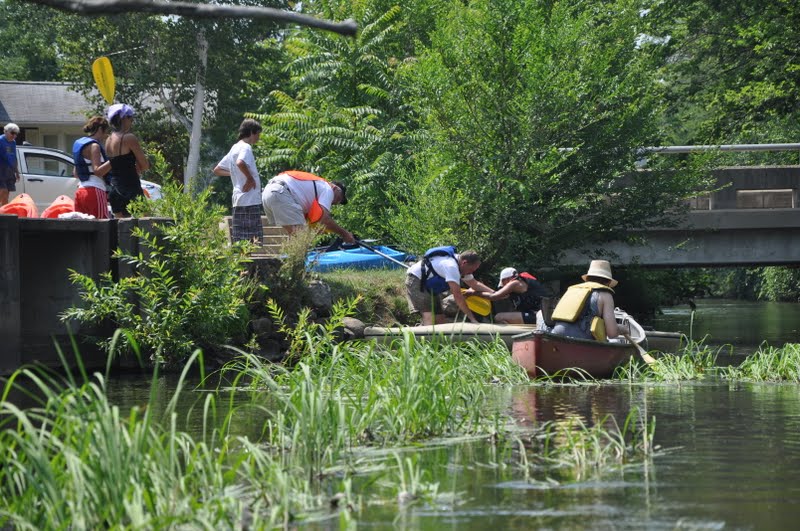
And suddenly, we were at the take out!  How quickly the trip went by.  I didn't think I'd been paddling all that fast, but the current moved us right along, so seven miles passed in only a couple hours or so.


I highly recommend this trip.  It was a very pleasant paddle, and even with the heat and humidity, it wasn't too bad on the water.  Sure, the sweat was dripping off my chin when we took out and began loading boats and gear, but on the river there was just enough of a breeze to keep it tolerable, and with a big floppy hat and my three-liter camelbak hydration system, I was quite comfortable.

Thank you, GREAT, for a terrific trip!  For more information about GREAT, visit their website.  These are good folks who have done a LOT to clean up the Grand River, and who sponsor paddling trips around much of the greater Jackson area.