Showing posts with label skull. Show all posts

Saturday, April 2, 2011

Can One Have Too Many Books?

No, I don't think so.  Those who help me move, however, may beg to differ!

Anywho - when I saw this book for sale (and having some unknown skulls on my desk), well, you can only imagine - I HAD to have it!
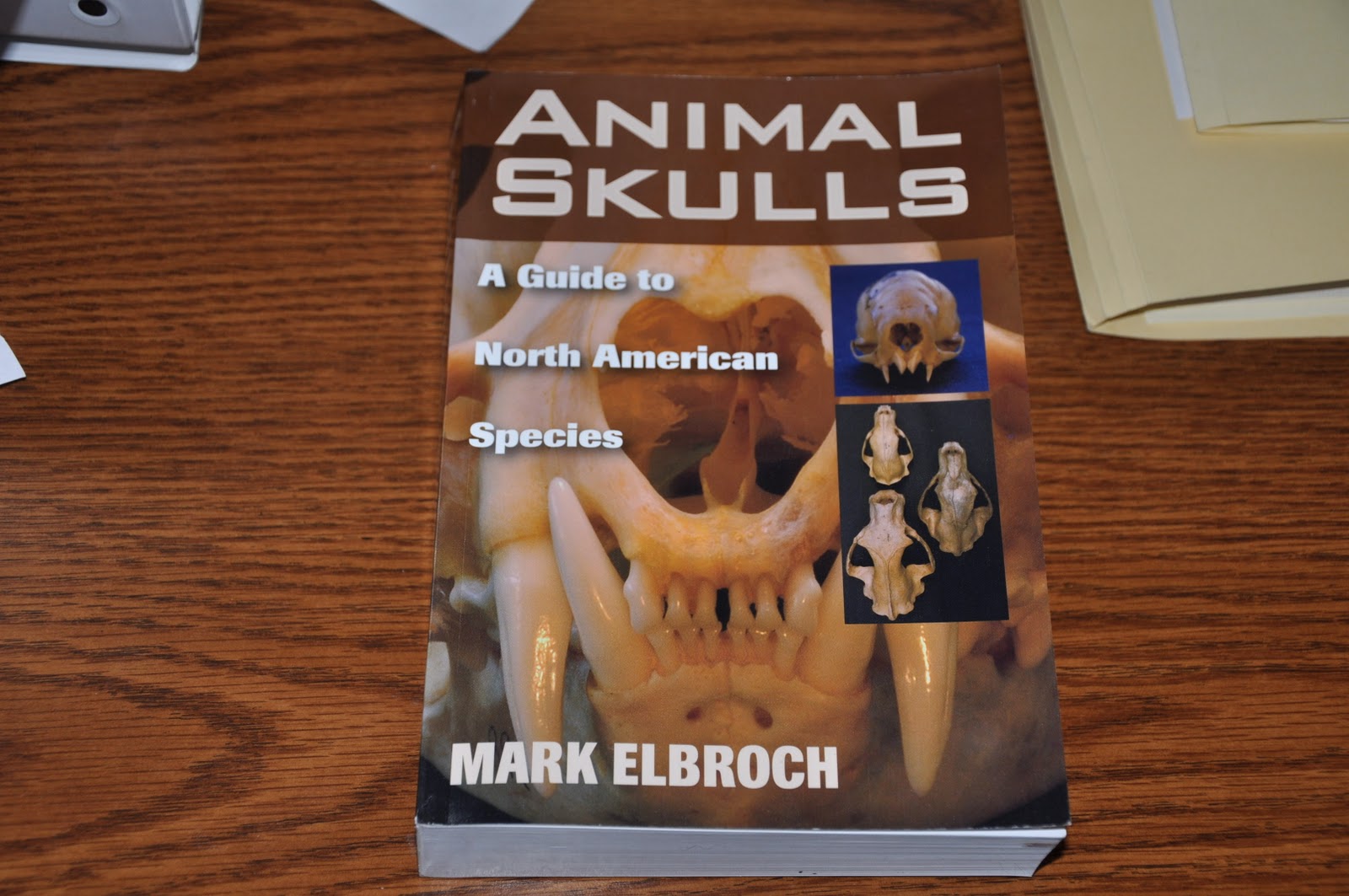

 I have several (okay, two other) of Mark's books - they are terrific for the tracker and outdoor enthusiast.  I highly recommend his Mammal Tracks and Signs, and his Bird Tracks and Signs.  Also in the series, but written by different authors, is Tracks and Signs of Insects and Other Invertebrates.

But, back to the book at hand.  When I took mammology in college, we had a spiral-bound book on skull ID (it's packed in a box somewhere).  I have also added one or two other skull and bone ID books to my collection, but they are really written for scientists, not for the lay person.  What Mark does in his book here is really explain the parts of the skull (and all the jargon that goes with it) so the layperson can understand what is what.


Color-coded illustrations help with initial identification of various parts.  He also shows how to take accurate measurements (sometimes a requirement on more difficult skulls).


And after all the lessons, there is the rest of the book, full of species accounts.  GREAT information, easily read, easy to use.


I immediately applied it to identifying the mystery skulls on my desk earlier in the week (a raccoon, a fox squirrel and an eastern cottontail, the latter of which I should've known had I actually looked at the teeth).  So, when we found the following skull on the prairie yesterday morning, I was pretty sure I knew what it was.  Never the less, I took several photos of all aspects just to be sure when I got back to the office and could check it with The Book.

First, it is a medium-sized skull, so that rules out all the small animals (local snakes, frogs, mice, squirrels, rabbits, sparrows...).


It has teeth, ruling out birds.  It has prominent canines, and no bright orange incisors, ruling out rodents of any kind.  With pointy teeth like these, we know we have a predator.  Could that be fox?  Coyote?  Cat?  Raccoon?  Opossum? 


I knew from reading Mark's book that opossums have fairly uniform teeth - not much variation (canines, molars, etc.).  I also knew from previous experience that they have the most teeth of any land mammal in North America.   This skull, even taking into account the missing teeth, didn't have a lot of teeth, and they were quite varied - not an opossum.


Canines tend to have rather long snouts - their sense of smell is pretty dominant.  This animal's snout was rather short, so that ruled out foxes and coyotes.
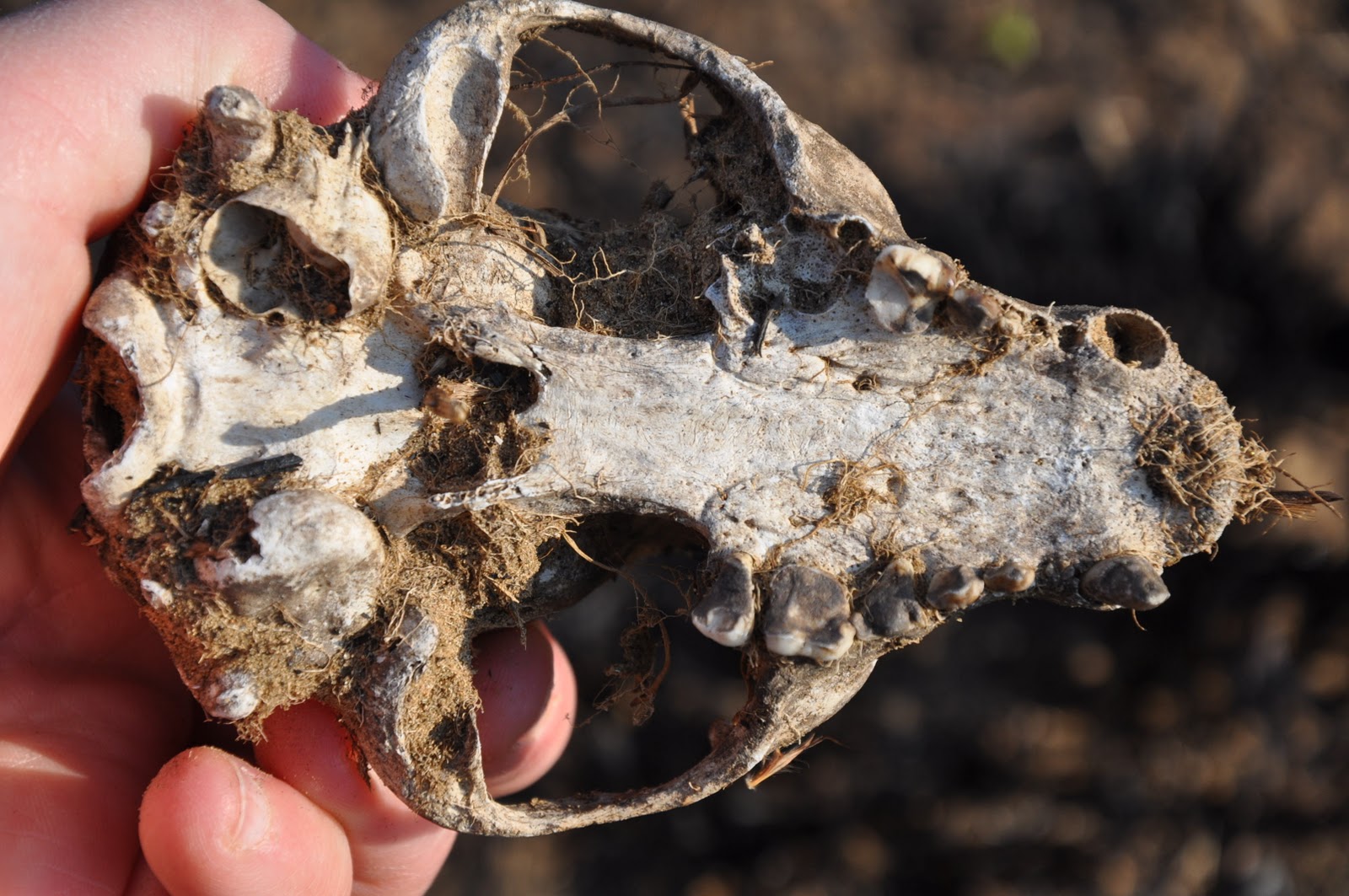

The well-defined ridges on the top and back of the skull, while not completely diagnostic, were helpful clues...


...as were the protrusions (called postorbital procseses) above the eye sockets ( frontal) and from the cheekbones (zygomatic).


What we had here was a raccoon.  My coworker was happy to know this - raccoons are not well thought of in these here parts.  I guess, like the deer, their population is rather robust, making them somewhat numerous and troublesome.  Still, as long as they stay in their place, I rather like raccoons.  They have delightfully clever "hands" and curious personalities.  And baby raccoons are downright cute, although they can easily get into trouble - just ask any wildlife rehabber who has had a bunch of them in his/her care.

Friday, January 8, 2010

How to Age a Deer

This morning I spent some time with Charlotte over at the Adirondack Ecological Center in a crash-course on deer aging. I took along the remains of the deer skull the girls brought in over the weekend (someone from my household discovered it when it fell out of the tree and decided to gnaw on it), but it turns out that in order to age a deer, one really needs the lower jaw, which exhibits all the measureable signs of wear and tear. What we could tell from the skull I have is simply that it is/was an adult.


Charlotte has a great PowerPoint program on deer aging, which we went through. She also has a box of deer jaws, which contains jaws from fawns to old geezers (at least seven years old). She gave me a couple hand-outs to add to my files for future reference.


Here is the basic geography of a deer's tooth:


The tallest part of the tooth (the lingual crest) is the part closest to the tongue. This is white, the color of the tooth's enamel. Next comes a line of dentine (brown), which is the softer inner portion of the tooth. This is followed by the secondary crest, also white, and shorter than the lingual crest. So, what we have here is sort of a sandwiching effect: white, brown, white. This will become important in a bit.


The middle of the tooth, the low part, is the infundibulum. Finally, we end up with the buccal crest, the high part that is closest to the cheek.


When aging a deer, one first looks for any milk teeth - these are the little front teeth and first premolars. Just like any animal, these fall out and are replaced with adult teeth. If you have milk teeth, you have a fawn.


The key tooth to look at is the third pre-molar. On a young deer (up to a year-and-a-half old), this tooth has three cusps. When it is replaced, the new tooth only has two cusps.


Another thing to look for is how many molars have erupted (emerged). If only a few teeth have come in, it is a young deer. If the full complement is in place (six molars left and right, top and bottom), then it is a full adult.


Now we look at the amount of wear on the teeth.


If the cusps are all sharp and pointy, it is a young deer. As the teeth wear, the enamel begins to blunt (the sharp points become more rounded), and the inner dentine is exposed. This means that the brown band that is sandwiched between the white bands of the lingual and secondary crests becomes wider and wider. The more brown you see, the older the deer.


In this sketch, the cone represents the tooth. The white part is the enamel, the red part is the inner dentine. The dashed lines indicate wear. Each year more of the enamel wears down and more of the dentine is exposed.


The cryptic note at the bottom translates thus: if the height of the secondary crest is less than or equal to the width of a pencil point, then the deer is at least 4.5 years old.


Over time, the cusps all wear down, resulting in what scientists call "cupping". The cusps eventually become the same level as the infundibulum, the lowest part of the tooth. In other words, the tooth is virtually flat. When you have a deer with flat teeth, you have an old deer.

I've tried to simplify this as much as possible, but without actual jawbones in hand to look at while going through the details above, it can be a challenge to know what is being talked about. If you are really interested in learning to age a deer by its teeth, I suggest you contact your area's conservation department and see if they have any hand-outs you can use. If you are lucky, you'll find a Charlotte who will gladly share with you her box of jawbones. If not, well, start your own collection, either from finds from the field, or gifts from any hunters you might know. It can be a fun puzzle to add to your naturalist's bag of tricks.

Saturday, January 2, 2010

Cool Findings

Some of you might find this disturbing, so be forewarned.

Yesterday, a pair of young ladies brought in a find from their snowshoe trek around our trails. They knew it was "bones," but beyond that they had no idea. It was packed with snow, but I could tell immediately that it was a deer's skull: the teeth were prominently exposed at the edge of the snowball. Deer do not have incisors on the upper jaw, only molars, so identifying a deer skull is very easy to do. They said there were no other bones around - just this one. I speculated that it might've been carried to the location where they found it by a coyote, who might've been snacking on it.
I put the whole package in the sink in our maintenance closet to melt, and promptly forgot about it until this morning. Because there's still enough flesh on it, I've placed it out on the back deck for the birds to clean, if they so desire.
I am fascinated by just how fresh this skull looks. Normally when one finds skulls (or bones) in the woods, they have been pretty well stripped clean by various carnivores, omnivores and carrion eaters. Scavengers are at their prime when death is around. From birds to small mammals, and in the summer assorted insects, bones are cleaned pretty quickly. The only thing I can guess from the state of this skull is that the deer died (or was killed) fairly recently.
Now, any good field biologist who has studied deer would probably have no difficulty aging this animal. This is done by an examination of the teeth. I've never done it, so I'm not sure what to look for. Our maintenance man, however, probably does have this skill, having worked formerly at the wildlife research station next door (and one of their specialties is deer). I'll have to ask him the next time I see him.
While I was arranging the skull on the deck and snapping is picture, my friend the untidy chickadee flew in to grab a few mouthfuls of frozen bacon fat from the suet feeder. I wonder why this bird's feathers are in such bad condition. If there are any bird experts out there who wish to render an opinion, please do.