Showing posts with label books. Show all posts
Saturday, February 25, 2012
Dust Off Your Bookshelves
I started following Seabrooke's blog a couple years ago (and her mother's blogs, too) - lots of great stuff. So, when a year or two ago she announced she was working on the new Peterson's Field Guide to Moths, I just knew that something good would be coming.
And now, here it is! That's the author, holding her advanced copy. The copies for us, the greater unwashed public, are still floating on a barge somewhere out on the Pacific, but soon they will be arriving at a bookstore near you.
For a terrific preview of this newest Peterson's Guide, check out Seabrooke's blog. If you are like me, you'll soon be placing your order...and maybe even get an autographed copy!!!
Saturday, January 28, 2012
Good Book!
I'm on a roll with books today. This book was loaned to me by a co-worker who thought I'd enjoy it. Boy was he right! Written in the late '50s, this book is a delight to read, and is terribly informative!
The author went to college c. WWI. She became a botanist and ended up working at the Morton Arboretum, in Illinois. Her writing is very readable and just chocked full of information. I was so impressed by this book, that not only did I read it in only a few nights, I went on-line to see if I could order a copy somewhere. Luckily for all of us, it is still in print.
Now, I know what you are thinking - botany, how dull. But it's not just about botany. It's about how plants can tell us about the history of the land around us. Sure, I love the list of native plants found in various types of prairie ecosystems (good reference material), but I also enjoyed the trip along the lakeshore that brought to light the lives of the emergent vegetation, and her walk from the headwaters of a stream, following it down through the gorge is carved in the landscape, opened my eyes to the ways plants colonize the sides of a ravine. Her tale of how she and her friends determined the closing date of an old abandoned schoolhouse is an eye-opener.
I highly recommend this delightful book. No matter where you live, if you are a nature enthusiast you will enjoy reading this volume.
Saturday, June 18, 2011
More Books!
>sigh<
So many books, so little time.
As previously mentioned, I was up at a conference (the No Child Left Inside Summit) up in Midland, MI on Thursday. On my way home, I stopped at the Chippewa Nature Center, briefly, to see what it looked like. I stopped in the gift shop...just to peek at the books...not really intending to purchase anything...not really.
Twenty minutes later I left with four new books and some t-shirts for my friends (they were on sale, after all - a real bargain).
First up, we have a nice little pocket guide of Butterflies of Michigan. This handy little book has just enough information, and photos of adults as well as larvae. It is a good one to add to any field kit.
Next, a Field Guide to Grasshoppers, Katydids and Crickets! The world has been waiting for this book! Or, at least I have. General insect field guides are great, but they are limited. If every insect was to be placed in them, one would need to hire a whole village of Sherpas so carry them around. Not really convenient for a field guide. So, I have usually had to content myself with "it's a grasshopper" and leave it at that. Now, however, I can start to identify one grasshopper from the next, and ditto with crickets! I've only encountered katydids in the tropics, but hey, I am now ready should I see one here in Michigan!
And finally, a two-volume set for identifying grasses. Grass ID guides are few and far between, especially one(s) written for the layperson. These two are still not written for the layperson, but they seem to be pretty comprehensive. With a little studying, I should now have no excuse not to be able to identify grasses.
Look out world - she's armed and dangerous now.
Saturday, April 2, 2011
Can One Have Too Many Books?
No, I don't think so. Those who help me move, however, may beg to differ!
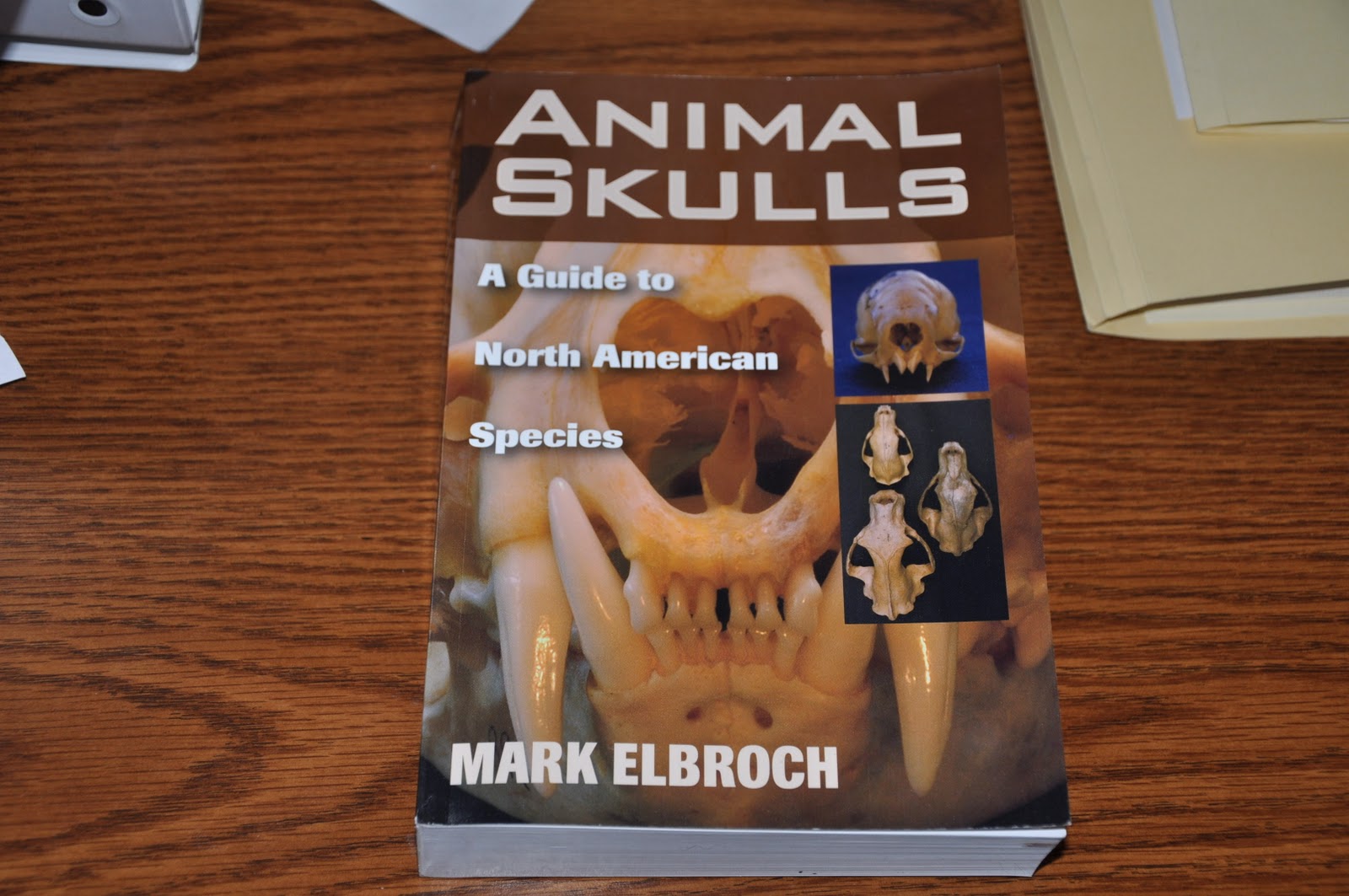
Anywho - when I saw this book for sale (and having some unknown skulls on my desk), well, you can only imagine - I HAD to have it!
I have several (okay, two other) of Mark's books - they are terrific for the tracker and outdoor enthusiast. I highly recommend his Mammal Tracks and Signs, and his Bird Tracks and Signs. Also in the series, but written by different authors, is Tracks and Signs of Insects and Other Invertebrates.
But, back to the book at hand. When I took mammology in college, we had a spiral-bound book on skull ID (it's packed in a box somewhere). I have also added one or two other skull and bone ID books to my collection, but they are really written for scientists, not for the lay person. What Mark does in his book here is really explain the parts of the skull (and all the jargon that goes with it) so the layperson can understand what is what.
Color-coded illustrations help with initial identification of various parts. He also shows how to take accurate measurements (sometimes a requirement on more difficult skulls).
And after all the lessons, there is the rest of the book, full of species accounts. GREAT information, easily read, easy to use.
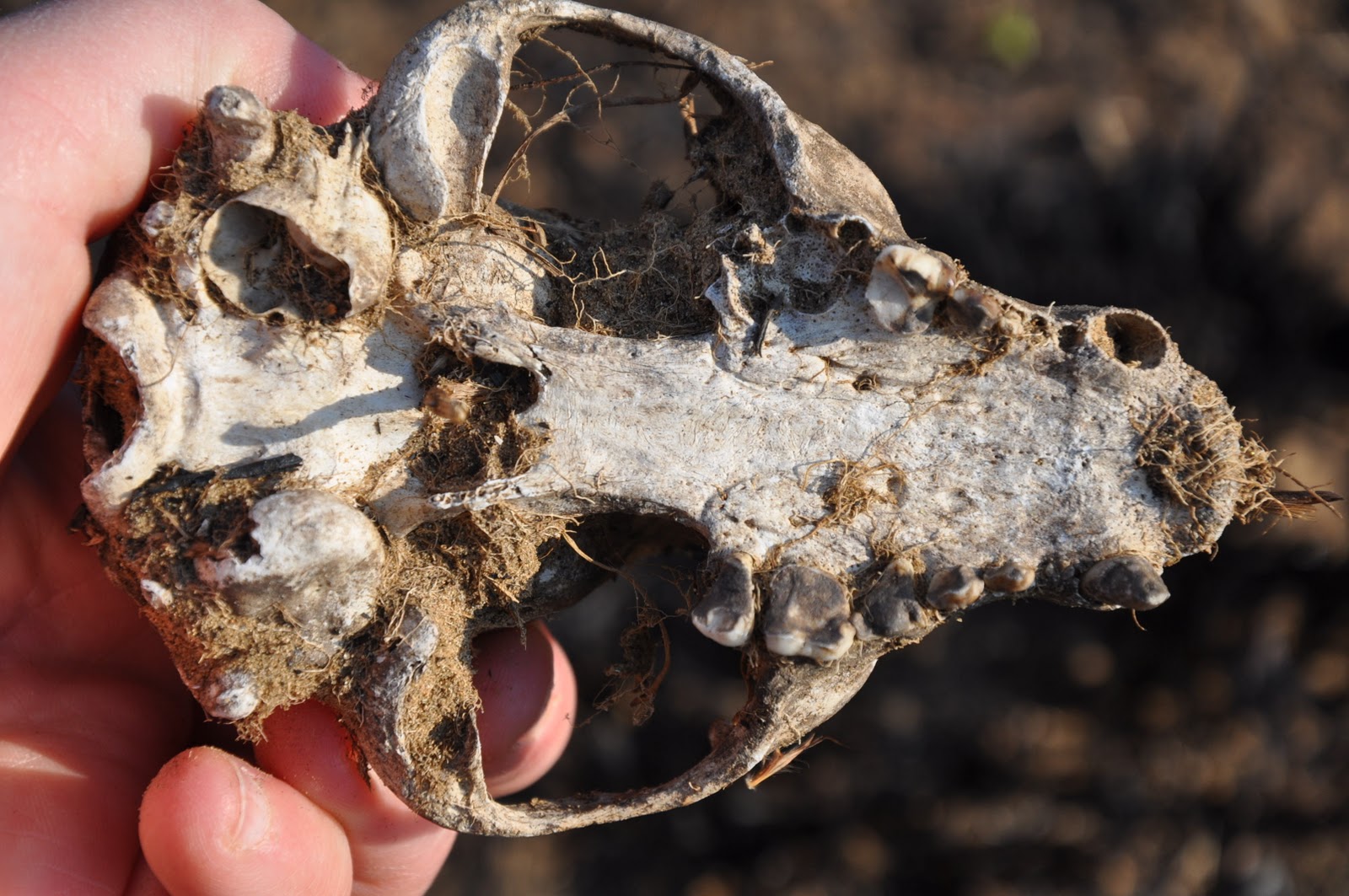
I immediately applied it to identifying the mystery skulls on my desk earlier in the week (a raccoon, a fox squirrel and an eastern cottontail, the latter of which I should've known had I actually looked at the teeth). So, when we found the following skull on the prairie yesterday morning, I was pretty sure I knew what it was. Never the less, I took several photos of all aspects just to be sure when I got back to the office and could check it with The Book.
First, it is a medium-sized skull, so that rules out all the small animals (local snakes, frogs, mice, squirrels, rabbits, sparrows...).
It has teeth, ruling out birds. It has prominent canines, and no bright orange incisors, ruling out rodents of any kind. With pointy teeth like these, we know we have a predator. Could that be fox? Coyote? Cat? Raccoon? Opossum?
I knew from reading Mark's book that opossums have fairly uniform teeth - not much variation (canines, molars, etc.). I also knew from previous experience that they have the most teeth of any land mammal in North America. This skull, even taking into account the missing teeth, didn't have a lot of teeth, and they were quite varied - not an opossum.
Canines tend to have rather long snouts - their sense of smell is pretty dominant. This animal's snout was rather short, so that ruled out foxes and coyotes.
The well-defined ridges on the top and back of the skull, while not completely diagnostic, were helpful clues...
...as were the protrusions (called postorbital procseses) above the eye sockets ( frontal) and from the cheekbones (zygomatic).
What we had here was a raccoon. My coworker was happy to know this - raccoons are not well thought of in these here parts. I guess, like the deer, their population is rather robust, making them somewhat numerous and troublesome. Still, as long as they stay in their place, I rather like raccoons. They have delightfully clever "hands" and curious personalities. And baby raccoons are downright cute, although they can easily get into trouble - just ask any wildlife rehabber who has had a bunch of them in his/her care.
Anywho - when I saw this book for sale (and having some unknown skulls on my desk), well, you can only imagine - I HAD to have it!
I have several (okay, two other) of Mark's books - they are terrific for the tracker and outdoor enthusiast. I highly recommend his Mammal Tracks and Signs, and his Bird Tracks and Signs. Also in the series, but written by different authors, is Tracks and Signs of Insects and Other Invertebrates.
But, back to the book at hand. When I took mammology in college, we had a spiral-bound book on skull ID (it's packed in a box somewhere). I have also added one or two other skull and bone ID books to my collection, but they are really written for scientists, not for the lay person. What Mark does in his book here is really explain the parts of the skull (and all the jargon that goes with it) so the layperson can understand what is what.
Color-coded illustrations help with initial identification of various parts. He also shows how to take accurate measurements (sometimes a requirement on more difficult skulls).
And after all the lessons, there is the rest of the book, full of species accounts. GREAT information, easily read, easy to use.
I immediately applied it to identifying the mystery skulls on my desk earlier in the week (a raccoon, a fox squirrel and an eastern cottontail, the latter of which I should've known had I actually looked at the teeth). So, when we found the following skull on the prairie yesterday morning, I was pretty sure I knew what it was. Never the less, I took several photos of all aspects just to be sure when I got back to the office and could check it with The Book.
First, it is a medium-sized skull, so that rules out all the small animals (local snakes, frogs, mice, squirrels, rabbits, sparrows...).
It has teeth, ruling out birds. It has prominent canines, and no bright orange incisors, ruling out rodents of any kind. With pointy teeth like these, we know we have a predator. Could that be fox? Coyote? Cat? Raccoon? Opossum?
I knew from reading Mark's book that opossums have fairly uniform teeth - not much variation (canines, molars, etc.). I also knew from previous experience that they have the most teeth of any land mammal in North America. This skull, even taking into account the missing teeth, didn't have a lot of teeth, and they were quite varied - not an opossum.
Canines tend to have rather long snouts - their sense of smell is pretty dominant. This animal's snout was rather short, so that ruled out foxes and coyotes.
The well-defined ridges on the top and back of the skull, while not completely diagnostic, were helpful clues...
...as were the protrusions (called postorbital procseses) above the eye sockets ( frontal) and from the cheekbones (zygomatic).
What we had here was a raccoon. My coworker was happy to know this - raccoons are not well thought of in these here parts. I guess, like the deer, their population is rather robust, making them somewhat numerous and troublesome. Still, as long as they stay in their place, I rather like raccoons. They have delightfully clever "hands" and curious personalities. And baby raccoons are downright cute, although they can easily get into trouble - just ask any wildlife rehabber who has had a bunch of them in his/her care.
Wednesday, March 9, 2011
So Many Books, So Little Time
Because of requests, I'm sharing with you some of the books I purchased this weekend at the Wildflower Conference.
As I've stated before, I am an unabashed bibliophile. New books, old books...I love 'em all. Many (if not most) of my books are of an outdoor subject: natural history, gardening, etc. So, as you can imagine, books for sale at a plant conference are to me like red is to hummingbirds - I can't resist and must zoom in for a closer look!
Here are the six that came home with me.
First up, in the Gardening and Landscaping category, we have Landscaping with Native Plants of Michigan (it's all about going native these days), Energy-wise Landscape Design (how to make your house more energy efficient with the proper landscape around your abode), and The Climate Conscious Gardener (the editor of which was one of our keynote speakers - very good).
Then, in the Natural History category, we have The Michigan Roadside Naturalist (to aid me in my explorations this summer), A Guide to Wildflowers in Winter (I have Weeds in Winter, but this looked like a good supplement to that), and the one that I think will become my favorite of this batch: Attracting Native Pollinators.
Now, I should explain that I'm loving this book not so much because it is how to plant gardens (et al) to attract butterflies and bees, but because it has superb photographs of our native bees and terrific descriptions of them and their habits.
This is a terrific thing because a) honey bees, while important to our crops, are not native, b) honey bee populations are in a downward spiral, c) there are lots of native bees that are also very important pollinators, and d) their populations are not doing well, either, mostly because we have supplanted their preferred food sources (native plants) with horticultural varieties, non-native ornamentals, agricultural products that are genetically modified to kill insects or to not need insects for pollination, and the ever-increasing conversion of native habitats to monocultures of lawns and concrete. Therefore, it behooves us to not only learn about our native bees, but also how to encourage their proliferation and their presence in our lives.
And this comes from someone who grew up petrified of bees. Bees are important; native bees are even more so. Get to know them. Get to know how to help them.
As I've stated before, I am an unabashed bibliophile. New books, old books...I love 'em all. Many (if not most) of my books are of an outdoor subject: natural history, gardening, etc. So, as you can imagine, books for sale at a plant conference are to me like red is to hummingbirds - I can't resist and must zoom in for a closer look!
Here are the six that came home with me.
First up, in the Gardening and Landscaping category, we have Landscaping with Native Plants of Michigan (it's all about going native these days), Energy-wise Landscape Design (how to make your house more energy efficient with the proper landscape around your abode), and The Climate Conscious Gardener (the editor of which was one of our keynote speakers - very good).
Then, in the Natural History category, we have The Michigan Roadside Naturalist (to aid me in my explorations this summer), A Guide to Wildflowers in Winter (I have Weeds in Winter, but this looked like a good supplement to that), and the one that I think will become my favorite of this batch: Attracting Native Pollinators.
Now, I should explain that I'm loving this book not so much because it is how to plant gardens (et al) to attract butterflies and bees, but because it has superb photographs of our native bees and terrific descriptions of them and their habits.
This is a terrific thing because a) honey bees, while important to our crops, are not native, b) honey bee populations are in a downward spiral, c) there are lots of native bees that are also very important pollinators, and d) their populations are not doing well, either, mostly because we have supplanted their preferred food sources (native plants) with horticultural varieties, non-native ornamentals, agricultural products that are genetically modified to kill insects or to not need insects for pollination, and the ever-increasing conversion of native habitats to monocultures of lawns and concrete. Therefore, it behooves us to not only learn about our native bees, but also how to encourage their proliferation and their presence in our lives.
And this comes from someone who grew up petrified of bees. Bees are important; native bees are even more so. Get to know them. Get to know how to help them.
Sunday, February 20, 2011
Random Things
"They" said we'd get a winter storm today, and by golly, "they" were right. I was out running errands until about noon, and no sooner did I get home and unload the car, then the first flakes began to descend. A flake here, a flake there, then all of a sudden, a near white-out! It looks like the fat and wet kind of snow...or at least it did. Looking out right now it's starting to look like those small, sharp wet flakes - the kind that might turn into sleet. Bleh. I'd rather have big fat flakes.
Anywho, for lack of anything better to post, here are some random shots from the last couple of days.
First up, a lovely amaryllis.
This gigantic plant, with it's nearly three foot long stalk, was a Christmas gift. It's been taking its own sweet time to come into bloom, though. We've been theorizing that it's probably because my hovel is chilly (58*F) and it's location is rather dark.
Still, it's lovely now, AND, it has, oh, another three buds at least behind this brilliant trumpet.
Next up, a couple new books.
This first one is my new book on galls. It's actually an older book (1940), and I believe currently out of print, but it's new to me. One of my co-workers told me about this book and as soon as I saw it, I knew I had to have a copy of my own.
Even in this modern day and age, it is considered THE book for identifying plant galls.
And not just the gnarly growths on trees, oh no; it also keys out galls on leaves! This book is a must in every naturalist's library.
A bit newer, we have a terrific book for identifying caterpillars - this is the one we used a week or so ago to identify the large yellow underwing larva.
As you can see, it is chocked full of information and sports some pretty nice photographs of the caterpillars. All color-coded, of course.
And, finally, another peek out the Big Window at work. This is a fabulous spot for bird and wildlife watching in general. Now that the snow is melting (well, it WAS melting...now we'll have a fresh layer, which is back to big fat flakes), the little pond is/was visible. Lots of feeders all around, containing lots of different foods: black oil sunflower, nyjer, suet cakes, mixed seed, etc. Seed is on the ground, on platform feeders, in tubes, in hoppers. Not only are there big trees for squirrels to climb and birds to sit in, but there are also some shrubs, and even a snag or two.
I saw a chipmunk out this window yesterday - a sure sign of spring. Add to that the red-winged blackbird I heard yesterday morning (and again this morning), and it was easy to believe that winter was on its way out. Still, it IS only late February. Just because the irises are up 2-3 inches along the side of the hovel, and a chipmunk was scoping out the birdfeeders, that doesn't mean winter is gone. After all, we still have about four weeks until the Spring Equinox.
Anywho, for lack of anything better to post, here are some random shots from the last couple of days.
First up, a lovely amaryllis.
This gigantic plant, with it's nearly three foot long stalk, was a Christmas gift. It's been taking its own sweet time to come into bloom, though. We've been theorizing that it's probably because my hovel is chilly (58*F) and it's location is rather dark.
Still, it's lovely now, AND, it has, oh, another three buds at least behind this brilliant trumpet.
Next up, a couple new books.
This first one is my new book on galls. It's actually an older book (1940), and I believe currently out of print, but it's new to me. One of my co-workers told me about this book and as soon as I saw it, I knew I had to have a copy of my own.
Even in this modern day and age, it is considered THE book for identifying plant galls.
And not just the gnarly growths on trees, oh no; it also keys out galls on leaves! This book is a must in every naturalist's library.
A bit newer, we have a terrific book for identifying caterpillars - this is the one we used a week or so ago to identify the large yellow underwing larva.
As you can see, it is chocked full of information and sports some pretty nice photographs of the caterpillars. All color-coded, of course.
And, finally, another peek out the Big Window at work. This is a fabulous spot for bird and wildlife watching in general. Now that the snow is melting (well, it WAS melting...now we'll have a fresh layer, which is back to big fat flakes), the little pond is/was visible. Lots of feeders all around, containing lots of different foods: black oil sunflower, nyjer, suet cakes, mixed seed, etc. Seed is on the ground, on platform feeders, in tubes, in hoppers. Not only are there big trees for squirrels to climb and birds to sit in, but there are also some shrubs, and even a snag or two.
I saw a chipmunk out this window yesterday - a sure sign of spring. Add to that the red-winged blackbird I heard yesterday morning (and again this morning), and it was easy to believe that winter was on its way out. Still, it IS only late February. Just because the irises are up 2-3 inches along the side of the hovel, and a chipmunk was scoping out the birdfeeders, that doesn't mean winter is gone. After all, we still have about four weeks until the Spring Equinox.
Saturday, November 13, 2010
Ways of the Six-footed
As many of you know, I love books, especially old books (although a lot of new books are very good, too). What I love about old books is the language. In our fast-paced world today, we are quick to get to the point and we waste little time in flowery prose. Not so the nature writers of yore.
A recent acquisition of mine is a small tome published in 1903 by a wonderful naturalist named Anna Botsford Comstock. I've mentioned Anna before, namely for her Handbook of Nature Study. Even back in her day Anna noticed that children do much better in school when nature study is part of the curriculum. Even just time spent outdoors increases students' attention spans and their interest in learning. While Anna's books are often forgotten today, her message is reiterated in the latest outdoor education movement spurred by Robert Louv's Last Child in the Woods.
But I'm not here to pontificate on the merits of outdoor education...at least not today. Today I'm focusing on my new little book: Ways of the Six-footed. As you might imagine, this slim volume (it's less than a half inch thick and only stands about six inches high) is about insects.
I haven't gotten very far in it (page seven), but I had to put it down to share with you Anna's words about the mosquito in her chapter regarding singing insects.
Of all the members of the families of flies, the mosquito has received most personal attention from the poets; perhaps because she has been lavish in personal attentions to them. Bryant has deemed her worthy of a separate poem, in which he recognizes her as a fellow-singer:--
How much we might enjoy the song of the mosquito if it were not associated with the unwilling yielding of blood to the singer is problematical. Perhaps if Beethoven's Pastoral Symphony were always to be played in our hearing when we were occupying the dentist's chair, we would soon become averse to its exquisite harmonies. Therefore it is no wonder that we do not think of music at all when we hear the distant horn of the mosquito; instead, we listen with patient exasperation as the sound grows louder, and we wait nervously for the final sharp "zzzzz" which announces that the audacious singer has selected a place upon us which she judges will be a good site for a pumping station. We do not like her noise a whit better even though it be a love song.
Anna then goes on to describe the male mosquito, with his feathery antennae designed to pick up his lover's song. How beautiful, even poetic, is her near-praise for this small insect that we mostly consider a pest.
A recent acquisition of mine is a small tome published in 1903 by a wonderful naturalist named Anna Botsford Comstock. I've mentioned Anna before, namely for her Handbook of Nature Study. Even back in her day Anna noticed that children do much better in school when nature study is part of the curriculum. Even just time spent outdoors increases students' attention spans and their interest in learning. While Anna's books are often forgotten today, her message is reiterated in the latest outdoor education movement spurred by Robert Louv's Last Child in the Woods.
But I'm not here to pontificate on the merits of outdoor education...at least not today. Today I'm focusing on my new little book: Ways of the Six-footed. As you might imagine, this slim volume (it's less than a half inch thick and only stands about six inches high) is about insects.
I haven't gotten very far in it (page seven), but I had to put it down to share with you Anna's words about the mosquito in her chapter regarding singing insects.
Of all the members of the families of flies, the mosquito has received most personal attention from the poets; perhaps because she has been lavish in personal attentions to them. Bryant has deemed her worthy of a separate poem, in which he recognizes her as a fellow-singer:--
"Thou'rt welcome to the town; but why come here
To bleed a brother poet, gaunt like thee?
Alas, the little blood I have is dear,
And thin will be the banquet drawn from me."
How much we might enjoy the song of the mosquito if it were not associated with the unwilling yielding of blood to the singer is problematical. Perhaps if Beethoven's Pastoral Symphony were always to be played in our hearing when we were occupying the dentist's chair, we would soon become averse to its exquisite harmonies. Therefore it is no wonder that we do not think of music at all when we hear the distant horn of the mosquito; instead, we listen with patient exasperation as the sound grows louder, and we wait nervously for the final sharp "zzzzz" which announces that the audacious singer has selected a place upon us which she judges will be a good site for a pumping station. We do not like her noise a whit better even though it be a love song.
Anna then goes on to describe the male mosquito, with his feathery antennae designed to pick up his lover's song. How beautiful, even poetic, is her near-praise for this small insect that we mostly consider a pest.
Thursday, October 7, 2010
Book Report
It is always good to be humbled. I've been listening to Bill Bryson's A Short History of Nearly Everything, and it is such a good book that I am thinking of getting my own copy, so I can read it again and take notes. I may even give it out for Christmas presents this year.
There isn't (so far) much in this book that is new to me, but what makes it so great is that it is written for the layperson. So far, I have listened to the history of the universe and our planet (including dinosaurs), a good bit of physics (quantum physics, the Big Bang, and all that), and am currently in the throes of learning about the Caldera that is Yellowstone National Park (the stuff of nightmares).
I truly believe that if more people read more books like this, there'd be a lot less strife in the world. We'd all know just how special we (all life on Earth) are. The circumstances that brought around life on this hunk of rock turning in space are mind-blowing. And then to consider just how varied that life is...millions and millions of species over millions and millions of years. And for all we know, we are the only place, ever, anywhere, where life exists. How precious that makes this planet.
The variety of circumstances that had to come together to make it possible for life to occur here are staggering. Just the right balance of gravity, atmosphere, water, geothermal activity, rotational spin, ocean salinity...the components are numerous and still so little understood.
We may laugh at the example from chaos theory where a butterfly flapping its wings affects the weather on the other side of the planet, but its these little things that we take for granted that, if knocked out of balance, can result in catastrophic changes (like decreasing the salinity of the oceans, which affects the thermal movement of the ocean waters, which affects not only the life living in those waters, but also our global climate patterns).
If more people knew all this, then they might spend a little more time taking care of Earth. To threaten to blow up the world over something as small and petty as religious or political differences is the ultimate selfish behavior.
If you haven't read (or listened to) this book yet, put it on your to-do list. You won't be sorry.
There isn't (so far) much in this book that is new to me, but what makes it so great is that it is written for the layperson. So far, I have listened to the history of the universe and our planet (including dinosaurs), a good bit of physics (quantum physics, the Big Bang, and all that), and am currently in the throes of learning about the Caldera that is Yellowstone National Park (the stuff of nightmares).
I truly believe that if more people read more books like this, there'd be a lot less strife in the world. We'd all know just how special we (all life on Earth) are. The circumstances that brought around life on this hunk of rock turning in space are mind-blowing. And then to consider just how varied that life is...millions and millions of species over millions and millions of years. And for all we know, we are the only place, ever, anywhere, where life exists. How precious that makes this planet.
The variety of circumstances that had to come together to make it possible for life to occur here are staggering. Just the right balance of gravity, atmosphere, water, geothermal activity, rotational spin, ocean salinity...the components are numerous and still so little understood.
We may laugh at the example from chaos theory where a butterfly flapping its wings affects the weather on the other side of the planet, but its these little things that we take for granted that, if knocked out of balance, can result in catastrophic changes (like decreasing the salinity of the oceans, which affects the thermal movement of the ocean waters, which affects not only the life living in those waters, but also our global climate patterns).
If more people knew all this, then they might spend a little more time taking care of Earth. To threaten to blow up the world over something as small and petty as religious or political differences is the ultimate selfish behavior.
If you haven't read (or listened to) this book yet, put it on your to-do list. You won't be sorry.
Tuesday, March 30, 2010
More Tracking Books
Following the enthusiastic advice of my blogging pal Squirrel, I ordered a couple new tracking books. I've been eagerly awaiting their arrival - what tracking bibliophile wouldn't? They arrived today - hooray!

I was uncertain at first about getting this book, Stories in Tracks and Sign, but after reading it, I'm glad it did. The author, Diane Gibbons, presents a wide variety of photographs of animal tracks from all over North America, and each is followed by a painting that shows the animal in the process of making those tracks. This is very helpful in learning how to use your imagination to picture how the tracks you see were made (which can often be quite a challenge). Her subjects range from easy (deer trails) to challenging (mole crabs on the beach). A good book to add to one's tracking library (or to borrow from someone else's tracking library).

This book is put out by Stackpole books, the same folks who published Mark Elbroch's mammal and bird tracking books (which is why it looks a lot like them). I can already tell that Tracks & Signs of Insects and Other Invertebrates is going to be a well-thumbed book in my field pack. Not only does it include insect (and invertebrate) footprints where appropriate, but it also includes other insecty (and invertebratey) things, such as eggs, cocoons, and feeding sites. Every curious naturalist should add a copy of this to his or her stash.
Thanks for the tip, Squirrel!
I was uncertain at first about getting this book, Stories in Tracks and Sign, but after reading it, I'm glad it did. The author, Diane Gibbons, presents a wide variety of photographs of animal tracks from all over North America, and each is followed by a painting that shows the animal in the process of making those tracks. This is very helpful in learning how to use your imagination to picture how the tracks you see were made (which can often be quite a challenge). Her subjects range from easy (deer trails) to challenging (mole crabs on the beach). A good book to add to one's tracking library (or to borrow from someone else's tracking library).
This book is put out by Stackpole books, the same folks who published Mark Elbroch's mammal and bird tracking books (which is why it looks a lot like them). I can already tell that Tracks & Signs of Insects and Other Invertebrates is going to be a well-thumbed book in my field pack. Not only does it include insect (and invertebrate) footprints where appropriate, but it also includes other insecty (and invertebratey) things, such as eggs, cocoons, and feeding sites. Every curious naturalist should add a copy of this to his or her stash.
Thanks for the tip, Squirrel!
Saturday, December 26, 2009
Bibliophilia Strikes Again
Been an awful good girl, Santa, baby,
so hurry down the chimney tonight.
Santa, cutie, a '68 natural history, too, Oo-oo
And an out-of-print tome, Santa, baby
so hurry down the chimney tonight.
Think of all the fun I've missed
Thing of all the insects that I must've "dissed"
Next year I could be more knowledge'ble
If you'll check off my Christmas list (I'll be adding more books to it).
Santa, baby, I wanna lot, but never a yacht for two
Been an angel all year, Santa, baby,
So hurry down the chimney tonight.
Santa, honey, there's one more thing I really do need
A weed
Identification book
Santa, baby, so hurry down the chimney tonight.
Okay - the spoof can only go just so far, but it was fun to try and stick in something for each of my new books! Some of these I purchased for myself this month, but others were birthday and Christmas gifts.
I'm especially looking forward to putting the Guide to Common Freshwater Invertebrates to use. My dad had a copy of this book to help with his new fly-fishing hobby, and when I saw it I knew I had to have a copy, too. Think of how much more interesting I can make our aquatic studies programs at work once I can tell one stonefly nymph from another, and can relate some nifty factoids about them as well!
All of this bodes well for future blogs, too. One can never have too many reference books - that's my story and I'm sticking to it!
Subscribe to:
Posts (Atom)