Showing posts with label native plants. Show all posts

Friday, October 4, 2013

September Come and Gone

It was a rather gloomy Sunday in September when I decided on a whim to go check out Seven Ponds Nature Center east of Flint.  I'd heard great things about this facility and decided to go check it out.

By 11:00 AM it was already extremely warm and humid.  The two-hour drive yielded one cloudburst, but it didn't clear the air.  It was the kind of storm that merely made the humidity worse.

When I pulled into the parking lot, there was only one other car there - probably that of the girl who was working at the front desk.


It's a very nice facility - lots of open space and some great exhibits.  This beaver exhibit, for example, has a space underneath where kids can crawl inside and see what it is like to be a beaver.


They have a large bird-viewing window with comfy chairs lined up in front.


I just loved the expression on this raccoon's face!


Heading out on the trails, one passes two nice gardens:  The Herb Garden,


and The Butterfly Garden.  Bees were out in good numbers, but I didn't see too many butterflies.


I chose to take the trail that went through the woods and on out to the grassland.  Along the way, I passed a third "garden" - the Woodland Wildflower Garden, which is completely surrounded by an 8-foot fence - the only way to protect woodland flowers from hunger deer. 


Pine plantations might be dull, species-wise, and rigid in their layout, but they sure make for nice photos down a trail!


In less than 15 minutes I was at the edge of the grassland.  This field was part of a major habitat project.  I hesitate to use the term "habitat restoration" because historic Michigan did not have many grasslands.  Oak-hickory forests and oak savannahs were the primary habitat types in the lower part of the lower peninsula.  Oh, and wetlands (fens) - most of which have been drained.


Still, it is nice to see native flowers in non-garden settings, growing to their full height and splendor, like this silphium.


It was prime time for many native sunflowers, coreopsises (coriopsi?), black-eyed Susans, and the like.


I was surprised to find wild bergamot still hanging in there!  I have recently learned there are two strains of wild bergamot:  one blooms early in the season, and the other later.  I believe the eastern variety is the earlier bloomer.


A few purple coneflowers were in bloom.  To me these will always be garden flowers - they just seem so out of place in the wild!


Ironweed - the best of the purples!  This tall native wildflower is so purple you can almost taste it.  It is one of my favorites.


Grasslands are by nature rather flat, so it is great that they have put in this viewing platform for visitors!


And here is the view.  As you can see, lots of green and yellow.  But on foot one sees the patches of other colors.


Like boneset - patches of white.


And pale purple obedient plant - another one that I'm only used to seeing in gardens!


The native grasses were just getting going.


And there were one or two spikes of blazing star (Liatris).


Here we can see the tall waving heads of big bluestem grass,


and Indian grass.  Indian grass becomes so colorful in the fall - it is just glorious.


Blazing star comes in several varieties, but I believe this is rough blazing star.


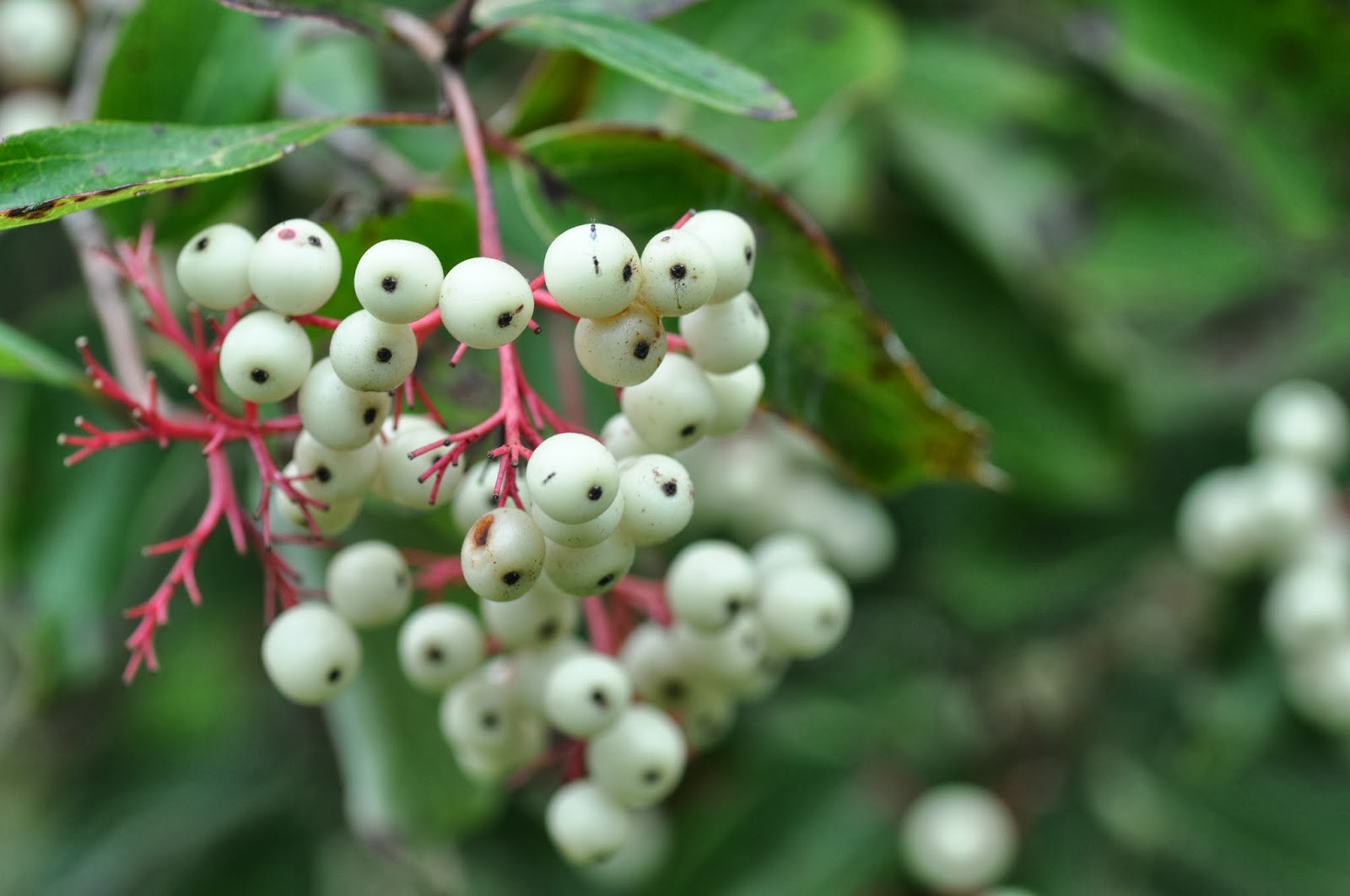
The dogwoods have been just loaded with berries, and they were at Seven Ponds, too. 

Beautiful mountain mint was still in bloom.


The trail system at Seven Ponds is divided into two chunks, one on either side of the road that drives through the property.  I was wandering around the chunk on the north side of the road.  You can see three of the seven ponds here.


Continuing from the grassland and through the woods, I shortly came out at a mowed field, with a lovely oak standing sentinel. 


Hard by the oak was the largest of the ponds.  I could see the railings of the bridge, but no sign of water.  Must be this pond is quite aged, I thought - all filled in with vegetation.


Like these white turtleheads!  I watched a bumblebee for a while as she slipped in and out of the blossoms in search of nectar and pollen.  They must've been pretty well picked over because she didn't seem to be having much success.


Where there's a bridge, there must be water!


And so there was - a winding channel that was being filled in by cattails and other wetland plants.


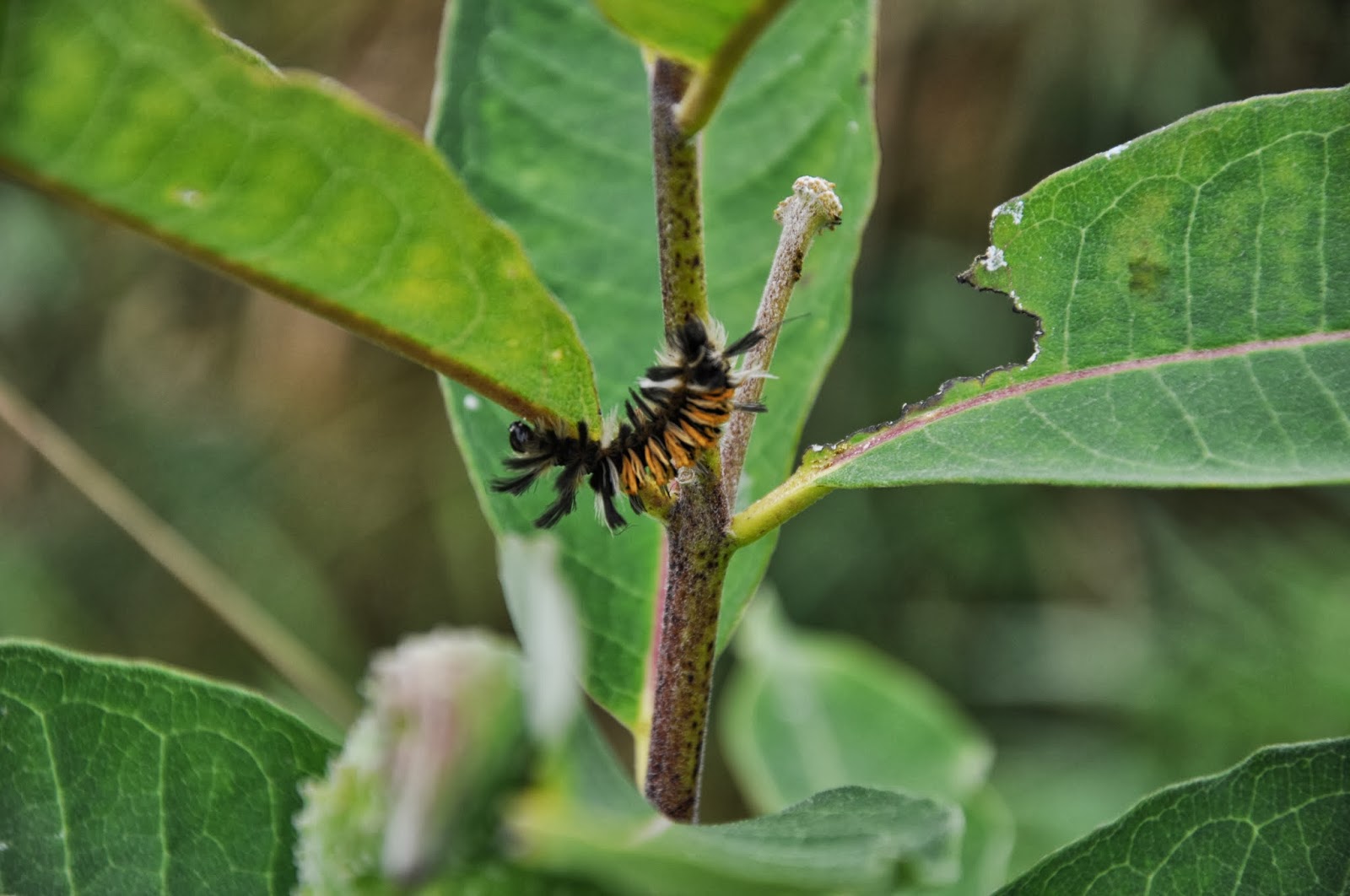
Monarchs were few and far between this summer, but this milkweed tussock moth caterpillar seemed to be doing just fine.  Unlike the monarch caterpillars, these fuzzy caterpillars are just as happy to gnosh on the older milkweed leaves as they are the younger, more tender ones.  This helps spread the wealth, as it were - it allows the monarch to capitalize on the younger leaves without the tussock moths going hungry.

At long last, I saw the pond.  There was an observation tower here, but the view was narrow.


Much better was the view from the dock a short way down the trail.


The heat and humidity seemed to have put a damper on wildlife at the pond, though.  It was still and quiet.


This fenced in area caught my attention, though.  What could they possibly be fencing off here?  I still have no answers.


A spidery flower that I've only rarely seen was in full bloom here:  wild cucumber.  The plant is not rare, but usually I only see its fruits - spiky cucumbers about the size of a small plum.  


Once more back in the woods, and on my way back to the visitor center, my eyes were drawn to these brilliant berries.  Prickly ash!  This is another MI native that continues to fascinate.  I still don't have the plant memorized to the point where I can recognize it at 100 paces, but a close-up look usually yields enough clues that I recognize, like the distinctive thorns, and, in the right season, the berries.


The highbush cranberry was also in peak fruiting mode!  What glorious colors - and it looks like plenty of food for the birds this winter.


Overall, Seven Ponds was a nice enough place - but from the small bit I saw, I must say I like Dahlem better.  Maybe it was just the weather, but there didn't seem to be a lot there that spoke to me.  Views were limited, and the landscape has a lot of obvious  "unnatural" aspects:  plantation, non-natives, mowed fields.  never the less, it is worth a trip and I'll go back sometime on a cooler, sunnier day!

Monday, May 20, 2013

Nuts for Natives

Two Sundays ago I went native plant shopping with a couple friends from work.  We drove out to Kalamazoo to the native plant sale being held by Hidden Savanna Native Plant Nursery.  What a cold and dreary day it was.  As you can see, though, I came home loaded down with goodies:


My purpose for this trip was to stock up on native milkweeds.  Now, perhaps, like me, you know of the common milkweed, and the butterfly weed, and you may even have heard of swamp milkweed.  BUT!  There are a whole passel of milkweeds out there, many of which are in serious decline.  So, I added to my stash three poke milkweeds (they like wooded areas or edges), whorled milkweed (I had this one in my gardens in Newcomb - the monarchs loved it), green milkweed, tall green milkweed, sand milkweed and purple milkweed (extremely rare).

Also in the mix were early and late figwort, smooth blue aster, white prairie clover, purple prairie clover, leadplant (haven't had any luck with this species yet...these are my 3rd and 4th ones), pale purple coneflower, green dragon (thanks, Paul!!!), jack-in-the-pulpit, blazing star...and a couple others that my memory fails to recall at the moment.

Some have already gone in the ground, but a few have yet to be planted.

Meanwhile, I was excited to see some of my prairie smoke getting ready to bloom:


They don't seem to have done much more than this (these photos were taken 2 weeks ago).  It's when they to to seed that they look like puffs of smoke.

The honey locust.  Native or not?  I've always thought it was not, but around these here parts it is considered native.  Hm.


I was also out about a week ago checking my nest boxes.  Full of house sparrow nests (aliens).  Chucked them out.  But then I found this in one of the boxes out in the field:


I'm fairly sure these were baby bluebirds.  The nest was indicative of a bluebird nest, but built on top was a messy nest - house sparrows.  They built on top of the bluebirds...and these little ones died.

Never had problems with house sparrows in Newcomb.  All my bluebirds did well (except when the heat or cold rain did them in).  My boxes here all end up housing the dang sparrows.  Grrrr.  May have to get a bit more aggressive.

Wednesday, May 8, 2013

What a Difference a Week Makes!

Last Tuesday, I made a promise to one of our volunteers at work to take her out to NanWeston Preserve this last weekend to see the wildflowers.  It was the least I could do for someone who gave up a guided tour with one of our naturalists to help me out with a school program.  I suspected there would be one or two new things blooming since the previous weekend, but I wasn't prepared for quite the change I saw!

When we first reached the entrance, where last week bloodroot was a common as dandelions in my yard, there wasn't a single bloodroot flower to be seen!  The spring beauty was still hanging in there, though,


as were the rue anemone.


Many more violets had poked up their cheery heads.  My friend Jackie, who knows violets like the back of her hand, would easily identify all the ones we saw.  All I could do was take a stab at it.  I believe this one is downy yellow violet.


And this one most likely is the common blue violet.


A week ago the mayapple was juuuuust poking up out of the duff, each umbrella-like leaf still closed down.  Today they were all wide open, although the flower buds were still tightly closed.  With the warm weather we are having again this week, however, I don't imagine it will take too much longer for them to be in bloom.


The spicebush peaked, and now their leaves were starting to open.  A yellow haze still remained in the understory, but it was nowhere near as pronounced as it was last weekend.


And all the leatherwood flowers had also been traded in for new green leaves.


I found one blue cohosh that still sported purplish flowers, 


but most were greenish yellow by now. Update:  It appears that botanists have now determined that these are actually two separate species of blue cohosh.  The purple one above is listed as Caudophyllum giganteum, and the yellow one below is C. thalictroides (whereas my Newcomb's lists just the latter species name and refers to it having either purple or yellow flowers).  Seems like birders are not the only ones to fall into the categories of lumpers or splitters when it comes to determining species!  Thanks, Jackie!


As we crossed the long boardwalk, we noticed just this one grass in bloom, and its flowerhead was simply writhing with insects!


One lone beetle was out on a leaf.  It reminded me of a tiger beetle, but I suspected that wasn't it.  I sent the photo off to BugGuide.net, and in less than three minutes I had an ID:  Donacia, a genus of long-horned leaf beetles.  There are about 29 species of these in northeastern North America.  What a handsome fellow it is.


Solomon's seal isn't not ready to bloom yet - it was still unfurling its leaves.  But which Solomon's seal is this, the "real" one or the "false" one?  And if it is the "real" one, which real one is it:  great, hairy, smooth?  Maybe it's twisted stalk, which is a bit of a look-alike.  The zig-zaggy stem rather suggests the latter.  And if it is a "false" Solomon's seal, again, which one?  There's more than one?  Indeed.  There are three false Solomon's seals:  false Solomon's seal (aka Solomon's plume or wild spikenard), star-flowered Solomon's seal, and three-leaved Solomon's seal.  The latter grows in bogs and wet woods, so that one is probably out, as is the star-flowered, which is also a denizen of wet banks, shores and meadows.


Moving on, we found large-flowered bellwort just starting to open. These were barely leaves a week ago.


As predicted, the dwarf ginseng was blooming nicely by now.


Sadly, the Dutchman's breeches had peaked and gone, but we did find some squirrel corn now in bloom.  


And whereas last week cut-leaved toothwort was all over the place, this day we only found regular old ordinary toothwort, the leaves of which reminded me of strawberry leaves.


We hit the trillium bloom right on the money, though.  All throughout the woods were vast patches, carpets of these lovely white flowers.  Ahhhh.


The wild blue phlox was just starting to appear.  We found maybe a dozen plants this afternoon.


And one of my favorites, miterwort, was also just starting to open.  The delicate white flowers look like snowflakes if you see them up close.  Go ahead and zoom in on the photo if you can.


We also saw our first oriole of the year this afternoon, and, as if it was a sign of good things to come, a small red fox trotted across the road in front of my car as we drove out to the preserve.  It was a good omen.

Having seen so much change in just one week, I am sorely tempted to go back again this weekend!  I will be in Kalamazoo on Sunday at a native plant nursery (Hidden Savanna), looking to add some rare treasures to my property at home, namely milkweeds.  Rare milkweeds?  Have I got the right word there?  Indeed.  Michigan used to be home to several species of milkweed, some of which are so rare they are hardly ever found any more.  I am going to do my bit to try and reestablish them in my field.  So stay tuned...