We had another prescribed burn at work last weekend - the first of the year. Here are a couple videos I shot during the burn. This took place after 7 PM, so the low light made the flames stand out beautifully.
Showing posts with label fire. Show all posts
Showing posts with label fire. Show all posts
Friday, March 30, 2012

Thursday, November 10, 2011
Burn, Baby, Burn!
As I sit here this afternoon and watch the snow fall in great big flakes that are only just starting to turn the grass white, I think back to this weekend, when it was sunny and warm. I was putting up the last of the harvest (sweet potatoes, carrots), getting the garden ready for winter, and hanging out laundry, when the call came: they were going to do a burn at Haehnle Sanctuary - be there at 12:15. I still had a load of laundry in the washer, but as soon as it was hung, I grabbed my camera and drove north.

The burn was done by the same crew that did the burn last spring at work. Because of this, there was a chance that I might get to help out again.

However, because I was running a little late, the burn had already started. This was fine - I was able to kick back and just take photos.

There were two burns scheduled for this day. The first was this patch of prairie. The wind was quite strong all day, so the burn was started on the downwind side. Gary had been out the day before and mowed the firebreak, which served not only as a path for us to walk, but also as a barrier to help keep the fire under control.

There's nothing quite like watching a burn. The crackle of the flames when they hit of patch of fuel is really quite something.
This fire moved along quite quickly, leaving a smoking, charred field in its wake.


Next year, the native flowers and grasses should be great here.

Once all the smokers were put out and the site deemed safe, the crew loaded up and headed for the second burn site along the western edge of the sanctuary.

This site was a bit different. It started off along the edge of a wetland, where reed canary grass is invading the marshland. Fire won't do much to remove this invasive, but it will help keep it in check. High water levels are much more effective in controlling it.


As the fire burned southward, it entered a small patch of woods, bordered on one side by the road and on the other side by a small pond.

It was interesting to see just what didn't burn, like this pile of trash,

and the matted plants of this deer trail.

Occasionally the wind would gust and send billows of smoke across the road. This didn't slow down the traffic, though. It was such a glorious day that many folks were out for a Sunday drive. Lots of shiny, clean sports cars passed us, no doubt wondering what in the world we were doing.

As the fire passed through the woods, it gobbled up the ground cover.


A couple trees also caught fire. These were old snags, trees that were long dead and whose hollow centers acted like chimneys. The fire crew had to put these out.

Once on the other side of the woods, the fire came to another open field. Several lines of fire were set here to speed the burn along.
Prescribed burns are an important tool in maintaining open grasslands. They help rejuvenate fields and prairies, stimulating new growth in the spring and summer, and they can help keep some invasive species in check. Fire is one more tool in the arsenal of land stewards, and its one I never get tired of watching.
Sunday, March 20, 2011
And How Did YOU Spend the Spring Equinox?
The call came in this morning - today's the day - 1:00. We were going to burn the prairie.
Fire used to be a natural part of the prairie landscape. Before people dotted the plains, prairie fires were probably ignited by lightning strikes. The native peoples learned that fire renewed the prairies, and soon man-made fires were used to keep the trees at bay and to help renew the soils and fields.
As Europeans took over the continent, and their subsequent development, fire became the enemy of the people, so it was suppressed at every opportunity. It is only in the last few decades that we have learned a hard lesson: fire is important (vital) to maintaining many natural ecosystems.
So, as part of our land stewardship program at the Dahlem Conservancy, we hold prescription burns on our property to renew and maintain our patches of prairie. Gary told me this week that he was planning to schedule one sometime in the next few weeks. On Friday he said it might be sooner rather than later. Suddenly, yesterday we hear it might be today. And, at 8:30/9:00 this morning, the call came.
Of course, I couldn't wait to go and play. Years ago, when I worked in NJ, I got to participate in a prescribed burn. I was eager to be a part of one again - even if it was just on the sidelines taking photos.
Soon the official Burn Crew arrived and began unloading gear: driptorches (full of fuel - used to ignite the fire)...

...Indian tanks (these are the water packs used to put out stray flames and sparks)...
 ...and radios, radio harnesses, fire resistant clothing, hardhats, etc. Hooray! We were asked if any of us wanted to play...um...participate. I jumped at the opportunity and donned a yellow shirt, radio and harness, hardhat and indian tank.
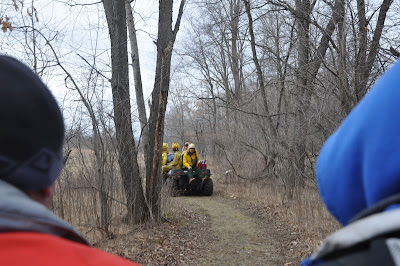
And we drove off to the site.
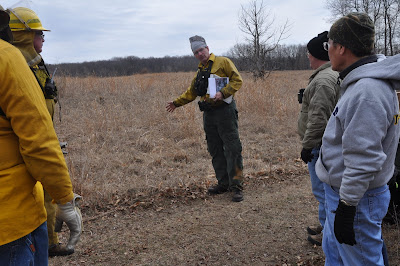
Gary reviewed the map with Dave so everyone knew what was actually supposed to be burned.

Dave, the burn leader, explained that we were going to light a back burn on the downwind side of the site. The trail would act as a natural barrier, and the fire would burn into the field, upwind. The wind would work in our favor, helping to keep the fire under control.
His crew lit a small test patch just to make sure.

And we were off!

Most of the staff who participated were strictly there to keep the stray flames from getting out of control - we had our Indian tanks on our backs (40-60 pounds of water) and hand-pumped nozzles to squirt errant sparks.

Once a good buffer of 20-30 feet was burned, we didn't have to worry too much about sparks jumping the trail.


Sometimes, when the fire hit a good source of fuel (lots of dead vegetation), or when the wind gusted, we'd get some pretty robust burning.
Our crew went around the northern edge of the field, while the other crew headed around the southern edge.

Here we've turned the corner of the patch we were burning and Andy started to set the head fire - the one that would burn with the wind and into the back burn we'd just done.
There it goes!

In this pan you can see "our" fire creeping across the field toward "their" fire. Soon the two would meet in the middle...

...and whoosh!

The burned landscape:

Doing the burn on a chilly day put odds in our favor that snakes would be below ground - a concern here because we have massasauga rattlesnakes, which are protected. The only wildlife I saw was a vole making a hasty retreat into a woodchuck hole, and some birds flying overhead.

After the fire burned itself out in the first patch, the crew walked over to check out a second, smaller patch that Gary wanted torched as well. It was kind of like watching astronauts crossing the moon.

The second patch was significantly smaller, but also covered with last year's leaves. Dave wanted a line blown clear of leaves before we started, just to make doing the back burn a little easier and to cut down on the chances of some sparks setting the wrong side alight.

We refilled our tanks with water.

And soon we were off again! The fire burned pretty hot in here, but the area also resisted burning. The fellows with the drip cans had to continually lay down lines of flame. Later, Gary explained that the patches that resisted the fire were spotted knapweed, an invasive species. In order to affect these plants with fire, they have to be burned later in the season when their rosettes are above ground.

Someone is in for a rude awakening! (Man - I went to bed in a field, and today I wake up to find the whole landscape has changed!)

It was a good thing things were coming to an end, because as the last flames were dying out, it started to sleet...then rain. It was 37*F, and with the fire mostly out, things started to get chilly. We loaded the gear back on the various vehicles, sat on the wet seats, and headed back to the farm, putting out any smoldering logs, stumps, and clumps of vegetation along the way.
Fire used to be a natural part of the prairie landscape. Before people dotted the plains, prairie fires were probably ignited by lightning strikes. The native peoples learned that fire renewed the prairies, and soon man-made fires were used to keep the trees at bay and to help renew the soils and fields.
As Europeans took over the continent, and their subsequent development, fire became the enemy of the people, so it was suppressed at every opportunity. It is only in the last few decades that we have learned a hard lesson: fire is important (vital) to maintaining many natural ecosystems.
So, as part of our land stewardship program at the Dahlem Conservancy, we hold prescription burns on our property to renew and maintain our patches of prairie. Gary told me this week that he was planning to schedule one sometime in the next few weeks. On Friday he said it might be sooner rather than later. Suddenly, yesterday we hear it might be today. And, at 8:30/9:00 this morning, the call came.
Of course, I couldn't wait to go and play. Years ago, when I worked in NJ, I got to participate in a prescribed burn. I was eager to be a part of one again - even if it was just on the sidelines taking photos.
Soon the official Burn Crew arrived and began unloading gear: driptorches (full of fuel - used to ignite the fire)...

...Indian tanks (these are the water packs used to put out stray flames and sparks)...

And we drove off to the site.

Gary reviewed the map with Dave so everyone knew what was actually supposed to be burned.

Dave, the burn leader, explained that we were going to light a back burn on the downwind side of the site. The trail would act as a natural barrier, and the fire would burn into the field, upwind. The wind would work in our favor, helping to keep the fire under control.

His crew lit a small test patch just to make sure.

And we were off!

Most of the staff who participated were strictly there to keep the stray flames from getting out of control - we had our Indian tanks on our backs (40-60 pounds of water) and hand-pumped nozzles to squirt errant sparks.

Once a good buffer of 20-30 feet was burned, we didn't have to worry too much about sparks jumping the trail.


Sometimes, when the fire hit a good source of fuel (lots of dead vegetation), or when the wind gusted, we'd get some pretty robust burning.
Our crew went around the northern edge of the field, while the other crew headed around the southern edge.

Here we've turned the corner of the patch we were burning and Andy started to set the head fire - the one that would burn with the wind and into the back burn we'd just done.
There it goes!

In this pan you can see "our" fire creeping across the field toward "their" fire. Soon the two would meet in the middle...

...and whoosh!

The burned landscape:

Doing the burn on a chilly day put odds in our favor that snakes would be below ground - a concern here because we have massasauga rattlesnakes, which are protected. The only wildlife I saw was a vole making a hasty retreat into a woodchuck hole, and some birds flying overhead.

After the fire burned itself out in the first patch, the crew walked over to check out a second, smaller patch that Gary wanted torched as well. It was kind of like watching astronauts crossing the moon.

The second patch was significantly smaller, but also covered with last year's leaves. Dave wanted a line blown clear of leaves before we started, just to make doing the back burn a little easier and to cut down on the chances of some sparks setting the wrong side alight.

We refilled our tanks with water.

And soon we were off again! The fire burned pretty hot in here, but the area also resisted burning. The fellows with the drip cans had to continually lay down lines of flame. Later, Gary explained that the patches that resisted the fire were spotted knapweed, an invasive species. In order to affect these plants with fire, they have to be burned later in the season when their rosettes are above ground.

Someone is in for a rude awakening! (Man - I went to bed in a field, and today I wake up to find the whole landscape has changed!)

If the weather weren't so miserable out now, I'd be tempted to go back to the field tonight. It has been my experience that freshly-burned fields are great for owling. The mice and voles have nowhere to hide, so it's easy pickings for the raptors. Gary said that woodcocks also visit freshly-burned fields - must be the worms have nowhere to hide either! Maybe some night later in the week, when the rain stops.
So, Happy Spring, y'all!
Monday, May 31, 2010
Smoke in the Air
When I stepped out of the house this AM to walk the dog, I noticed the distinct tang of woodsmoke in the air. I thought nothing of it since it is a holiday weekend and many seasonal folks are up visiting their second homes.
But as I headed towards Glens Falls, the air became hazier and hazier, and the scent lingered. While the temps are to hit the 80s today, this wasn't humidity, it was smoke.


But as I headed towards Glens Falls, the air became hazier and hazier, and the scent lingered. While the temps are to hit the 80s today, this wasn't humidity, it was smoke.

It turns out there are something like 50 forest fires burning north of Montreal, eight of which are still listed as "out of control."

Because the winds are blowing to the south, we are all enjoying the side effects of these fires: smoke.

I'm currently sitting in a parking lot in Wilton and while I can no longer smell the smoke, I can see the haze to the north. Even in Glens Falls the scent lingered.

I'm currently sitting in a parking lot in Wilton and while I can no longer smell the smoke, I can see the haze to the north. Even in Glens Falls the scent lingered.
Remember, folks, it is VERY dry out there - we haven't had rain in weeks. If you are camping, think twice about that campfire. If you are in the High Peaks Wilderness Area, by the way, no campfires are allowed, period.
They may call the Adirondacks the Asbestos Woods, but when it's dry, it can still burn.
Subscribe to:
Posts (Atom)