Showing posts with label bogs. Show all posts

Thursday, June 26, 2014

Day Six - Adirondack Musuem, Bloomingdale Bog (again)

Monday morning we were expecting rain.  The rain never materialized, but the humidity was high.  Because we had flip-flopped a couple days, today was going to be a museum day, starting at the Adirondack Museum in Blue Mt. Lake and visiting the Wild Center in the afternoon.  Plans change.

Our morning started with a wonderful sighting of a pair of luna moths on the side of the motel.  For some of our group, these were life list insects.  We watched the pair mating for quite some time, and finally we had to be on our way.  The next morning all we found were two wings in the grass.  Hopefully the female was able to lay some eggs somewhere.


Because the Blue Ridge Falls had been such a hit the day before, I decided to swing by Buttermilk Falls in Long Lake on our way to the museum.  Water levels were a bit low, so the rush over the rocks was not as impressive as it could be.


Gary and Paul pose next to the river just above the falls.


The Adirondack Museum is known internationally, and for some folks requires a full three days to visit.  We, however, only had about three hours to spend here.


Of course, I had to have the group sit in the big chair.


I think every time I visit I take a photo of Gordon the Guide - it's just such a great sculpture!


One of our group was very excited about the first boat he saw.  As soon as I saw the name on the motor, he said, I knew what it was!


This motor was made in Jackson, MI - where we had all come from just a week before!


I confess I left the group to wander on their own - see what they wanted to see - while I checked out some of my favorites.


Glaucous honeysuckle - a stunning native plant, and one of my favorites, which I now know thanks to my friend Jackie introducing it to me about five years ago.


View of Blue Mt. Lake from the cafe.  Probably one of the most photographed views in the Park.


After we left the museum, there were decisions to be made.  By now the day had cleared - it wasn't going to rain.  Did we want to try Bloomingdale Bog again for the boreal chickadee, or go to the Wild Center?  Six of our group chose the natural history museum, while the rest of us headed back to the bog.


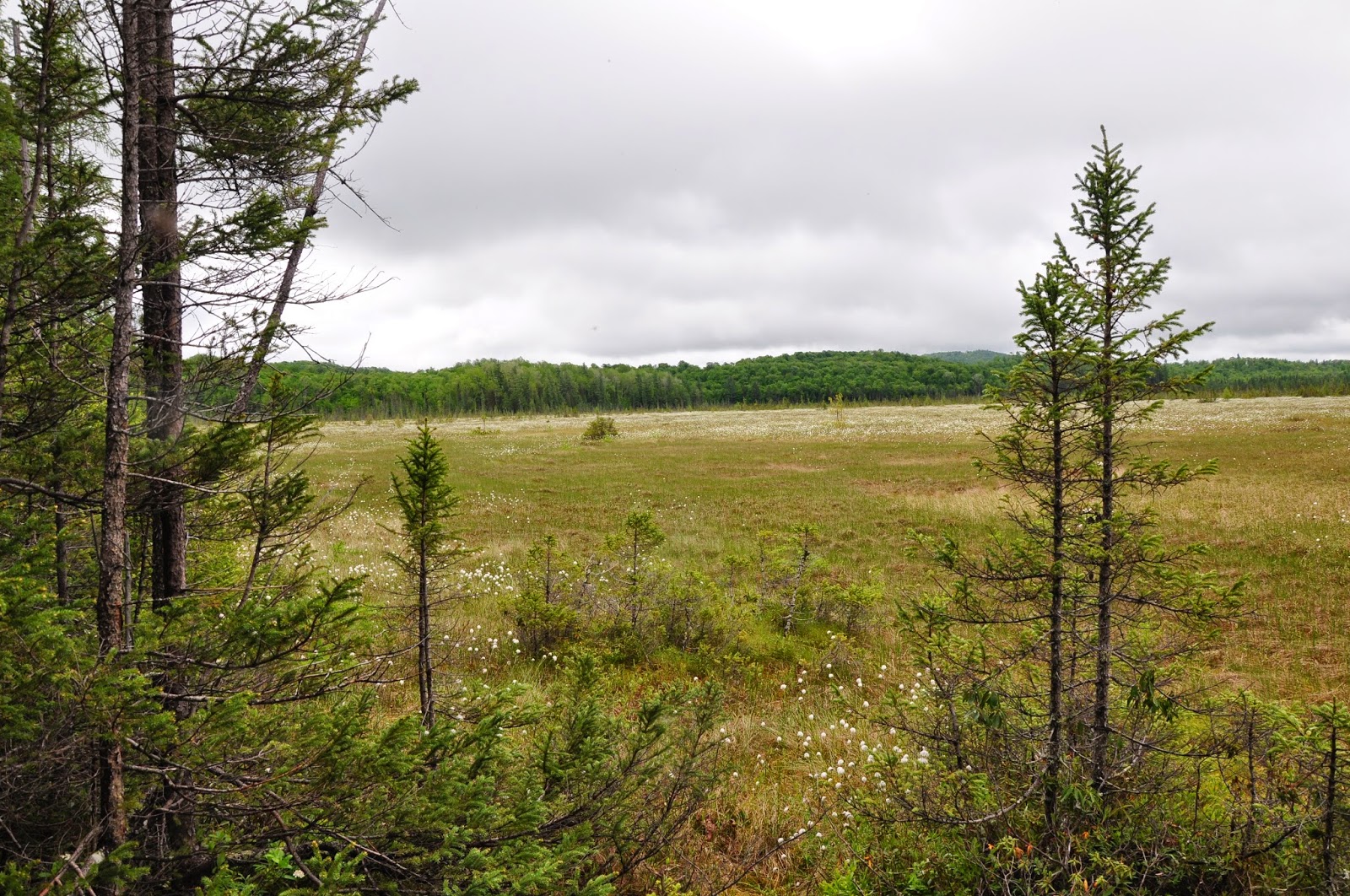
Again, lots and lots of cotton grass in bloom!


The group that came out here on Saturday got some amazing photographs of the gray jays feeding from people's hands.  I sooooo wanted to do this.  Gary had some really high-end trail mix which he put out on the feeding station some people have put along the trail.  And we waited.  And waited and waited and waited.  It was about 2:00 in the afternoon...down time for birds.  Nothing was happening.  After we walked back down the trail, a crow finally flew in a grabbed a nut - that was as exciting as it got.


I did see some lovely dragonflies though, like this painted skimmer, 


and this harpoon clubtail (thanks to Don Henise for ID help).


Now, if you very closely just slightly left of center in this photograph, you will see a small splash of yellow-orange.  That is the crown of a golden-crowned kinglet.  It was flitting around in the trees above us, back and forth across the trail, agitated by the call one of our group was playing of a kinglet.  This bird thought his territory had been invaded.


We left the trail and drove through Bloomindale to another road that crossed the trail a bit to the north - more wooded.  Here was where the boreal chickadee could "always" be found.  So far our seeker was 0 for 2.  This was his third and final try to find the bird.


We played the boreal chickadee's call; we played a recording of chickadees mobbing a screech owl.  We listened, we looked.  We thought we heard a boreal, but never saw it.


We drove further up the road...there was rumor of a black-backed woodpecker.  The road was VERY challenging (as hard as it is to believe, it was worse than the one into Spring Pond Bog), but we found the log that supposedly pointed to the bird's nest, and sure enough, we found not only the hole, but the female was at home and two or three times poked her head out to see what all the fuss was about.  You can just make her out at the center of this photo.


On our way back out we tried once more for the boreal chickadee...for Paul.


All we got was a few black-capped chickadees, which were doing their best to sound like boreals.


We had to admit defeat.


On the way back to Tupper Lake, we stopped at the newly reopened Casa del Sol in Saranac Lake for dinner - another item checked off my Bucket List.  In 1983 I worked at a camp in Lake Placid for the summer and the staff (sans yours truly - I wasn't in the In Crowd) often ate here on their days off.  I heard about it, but never went.  Before leaving NY in 2010, I stopped by to try it, and it was closed.  But this spring I read in Adirondack Life Magazine that it was reopening, and we were there the week they opened!  I hope they can make a go of it.

Day Three - Spring Pond Bog, John Brown's Farm

Friday morning dawned chilly and foggy.  Our original plan had been to visit the various Olympic venues, but the group seemed a bit lukewarm about that, so I had contacted The Nature Conservancy about getting permission to go into their property at Spring Pond Bog instead, which is the second largest bog in New York State.  The bog proper is over 500 acres in size, while the preserve is over 4200 acres.  The group expressed interest in visiting this site, so after breakfast we were on our way.

The drive to the bog wasn't long, distance-wise, but time-wise was another matter.  The road became more and more unimproved as we went along, resulting in our creeping along at speeds barely registerable on the speedometer.

Partway in, we stopped at a pair of fog-shrouded ponds to listen for birds (and for me, to photograph spider webs).


We got a few warblers, but everyone was thrilled to watch a pair of loons swimming in the mists.


When we finally reached the parking area, everyone took some time to put on insect repellent and protective clothing.


Once prepared, we headed in to the Bog.


The woods were dark and damp, as the trail climbed steadily up the esker that runs alongside the bog.


Before too long, there was a fork in the trail - to the left was the boardwalk that would take us out into the bog.


Again, it was a bit early for many of the open area plants to be in bloom, so no orchids.  We did see lots of cotton grass, 


and Labrador tea, however.


The boardwalk is not long, but it does bring visitors out to the only place here where they can get close to the peatlands.


As one might expect, the usual cast of characters included some beautiful pitcher plants.  We even saw one with a flower bud, although we were too early for it to be in bloom.


Pale laurel was in bloom, which lent a nice splash of color to the landscape.


This plant was new for me.  I puzzled and puzzled over it, having no luck keying it out in Newcomb's.  I sent copies of the  photos to my friend Jackie, who immediately wrote back that it was three-leaved Solomon's seal.  Never heard of it.  Went back to Newcomb's and there it was...with the other Solomon's seals.  I have no idea why I was unable to key it out.


The boardwalk spur trail connected back to the trail that was running across the top of the esker.  The morning's heavy fog/dew (and the previous night's rain) left some lovely drops that just begged to be photographed.


Bunchberry was starting to blossom, so we had the opportunity to see several of these ground-dwelling dogwoods.  The white portions are not the actual petals.  The flowers from the center cluster nestled inside the white bracts.  They are very small, and each has a hair that when brushed by a fly or other visiting insect triggers the release of pollen in a small explosion. 


The literature for Spring Pond Bog states that visitors can view the bog's expanse from the top of the esker.  Well, it's really a very "filtered" view through the trees, which does not leave one with a sense of just how vast this wetland is.  I confess I followed a small herd path down the side of the slope to the wood's edge so I could get a view beyond the trees.  All the white you see out there is cotton grass - its quantity was impressive.


Three cheers for the sporting nature of our group.  While most of the trail was pretty easy to traverse, there was this one awkward log across the path.  Some of us had to sit on it and swing our legs over, but the gentleman you see on top is 89 years young and look at him just walk right over it!


Every pink lady's slipper we encountered during our Adirondack adventure had its photo taken.


Here is a view of some of the road we had to navigate.  Some of the rocks in there were 8-10" across!  Makes one wonder what this section looked like before they filled it in.  Other areas had virtual canyons where "significant precipitation events" had eroded channels right where tires would normally roll...made for some fancy driving by our brave chauffeurs.


By the time we got back into Tupper Lake, it was noonish - time for lunch.  We stopped at Larkin's Deli/Bakery/Gas station (a Diesel Bakery, according to the sign below) to try their famous sandwiches.  It's a busy place, and there were 13 of us, plus other customers.  When everyeonfinally got fed, all expressed satisfaction in the fare.


Then we were off to Lake Placid to visit John Brown's Farm.  John Brown was the abolitionist who was famous for his failed raid on Harper's Ferry.  He was hanged for this and within a week his body was shipped back to North Elba where it was interred here at the farm.  Two of his sons, who also participated in the raid, are buried here as well.


It's a very peaceful place, this farm.  John's wife and children did not remain here long after John's death - she took the family out to California, where one can imagine it was much warmer and the growing conditions superior to what they were here in the High Peaks of the Adirondacks.


If you take the tour of the house, you will see a few pieces of the original Brown furniture, but most of the furnishings are pieces from the period that were purchased (or donated) to lend a feel of authenticity to the home.


We were all quite taken by this left-handed grain shovel.  The handle has just a slight turn to it that makes this shovel comfortable to use only left-handed.  Ingenious.


On our way back to Tupper Lake, we stopped at the Lake Placid Pub and Brewery to pick up a couple growlers.  Several of the women in my car pool have a thing for visiting old cemeteries, and each one we passed received a "oh...can we stop there?!?"  So, as we cruised back through Saranac Lake we hit the Pine Grove Cemetery to visit the graves of the Norwegians seafarers who are buried there.


When Hitler invaded Norway, those who were out to sea sought refuge where they could.  Some came to the US, and those who were diagnosed with TB were sent up to Saranac Lake to take the cure.  Of these, 15 did not survive, and they are buried here, where, to this day, they are lovingly cared for by the people of this community.


After dinner, we went to The Wild Center for an astronomy program and star gazing with the Adirondack Public Observatory, which officially opens in July.  The program turned out to be less about astronomy than geology ("Pregnant Rocks and Mystic Crystals), but it was interesting.  Clouds had moved in, so the APO staff said that we were still welcome to come out to the observatory, but they weren't expecting clear skies until about 2:00 AM.  Our group opted to return to the motel.  As it turns out, the clouds cleared by 9:30 and we could've had some good star gazing after all.  Live and learn.