Video Four: Is it Love or War? What's with all the bouncing butterflies? Is it a "you're on my turf" display or is it amore? I just don't know. Any butterfly experts out there?
Video Five: An Orange with Wings
Showing posts with label butterflies. Show all posts
Showing posts with label butterflies. Show all posts
Saturday, April 28, 2012

Tropical Beauties...the Movies
Video One: In the Nursery
Video Two: The Amazing Bouncing Butterflies
Video Three: More Bouncers
Video Two: The Amazing Bouncing Butterflies
Video Three: More Bouncers
Meijer Gardens and Sculpture Park Part II - The Flutterbys
We went out the exit from the orchid room, down the hall and through some plastic sheeting, and there they were...

Butterflies are notoriously difficult to photograph. They aren't particularly interested in holding still and posing for you while you fiddle around with settings and focus on your camera.

This is probably why I prefer to photograph plants: unless the wind is blowing, they aren't going anywhere.


I wasn't the only one feeling the challenge of getting a good shot.

The stars of the tropical butterflies are, of course, the blue morphos. Those are the very large (big as your hand) metallic blue beauties you see in movies and National Geographic magazines. And here it is...Ta-Da!:
 Doesn't look too impressive does it? That's because when at rest the blue morpho closes its wings and becomes a drab brown butterfly, looking like a piece of dead vegetation. This one sat here on the rock face with its wings closed the entire time we were here...and we were in here chasing butterflies for, oh, the better part of an hour.
Some butterflies we caught in flagrante.

There was a case full of chrysalises, all organized by species. Inside were several adults that had emerged that afternoon.


And there were more orchids.

Such beautiful variety. I saw one of these (below) while I was in Peru about 12 years ago.


But I wasn't the only one enjoying the flowers - many of the butterflies were nectaring on them.
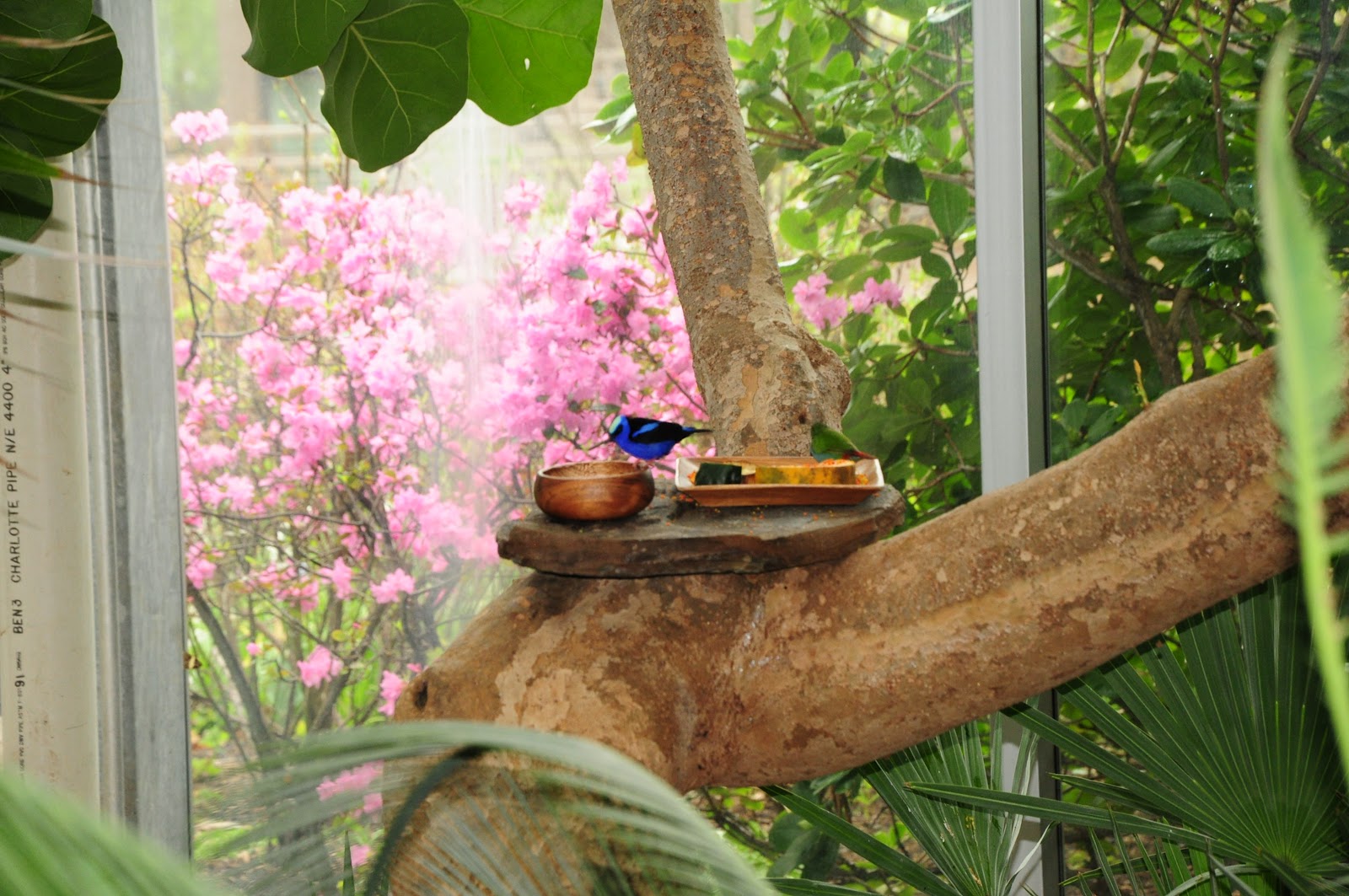
There were even some tropical birds in the room. This orange beauty was holding on to this dangling vine - I had to look straight up to take its photo - nearly fell over dizzy!


The butterfly chase continued.


Around and around us flapped these two morphos: the blue and the white. I was DETERMINED to get a photo of them.

But they just were not cooperative.

Not like this lovely orange Juliana, which sat very patiently while I took shot after shot. Still, I was unable to get a good focus on it. Should've brought a tripod!

A chocolate tree! Saw one of these in the Amazon - some of the most beautiful flowers are those of the chocolate tree - tiny white blossoms all along the trunk. The orange pods are the fruits, from which the cocao beans are harvested.

Not all butterflies are attracted to nectar. Some are drawn to rotting fruits, like this morpho, while others seek out rotting carcases and feces. Glad I'm not a butterfly.


Finally it was time to call it quits, and as we approached the exit, there was a blue morpho, sitting on the floor, exhausted and tattered, near the end of its life. At last I got my photo.

Stay tuned...I will next post some video images taken of these butterflies...and a bird.

Butterflies are notoriously difficult to photograph. They aren't particularly interested in holding still and posing for you while you fiddle around with settings and focus on your camera.

This is probably why I prefer to photograph plants: unless the wind is blowing, they aren't going anywhere.


I wasn't the only one feeling the challenge of getting a good shot.

The stars of the tropical butterflies are, of course, the blue morphos. Those are the very large (big as your hand) metallic blue beauties you see in movies and National Geographic magazines. And here it is...Ta-Da!:

Some butterflies we caught in flagrante.

There was a case full of chrysalises, all organized by species. Inside were several adults that had emerged that afternoon.


And there were more orchids.

Such beautiful variety. I saw one of these (below) while I was in Peru about 12 years ago.


But I wasn't the only one enjoying the flowers - many of the butterflies were nectaring on them.

There were even some tropical birds in the room. This orange beauty was holding on to this dangling vine - I had to look straight up to take its photo - nearly fell over dizzy!



The butterfly chase continued.


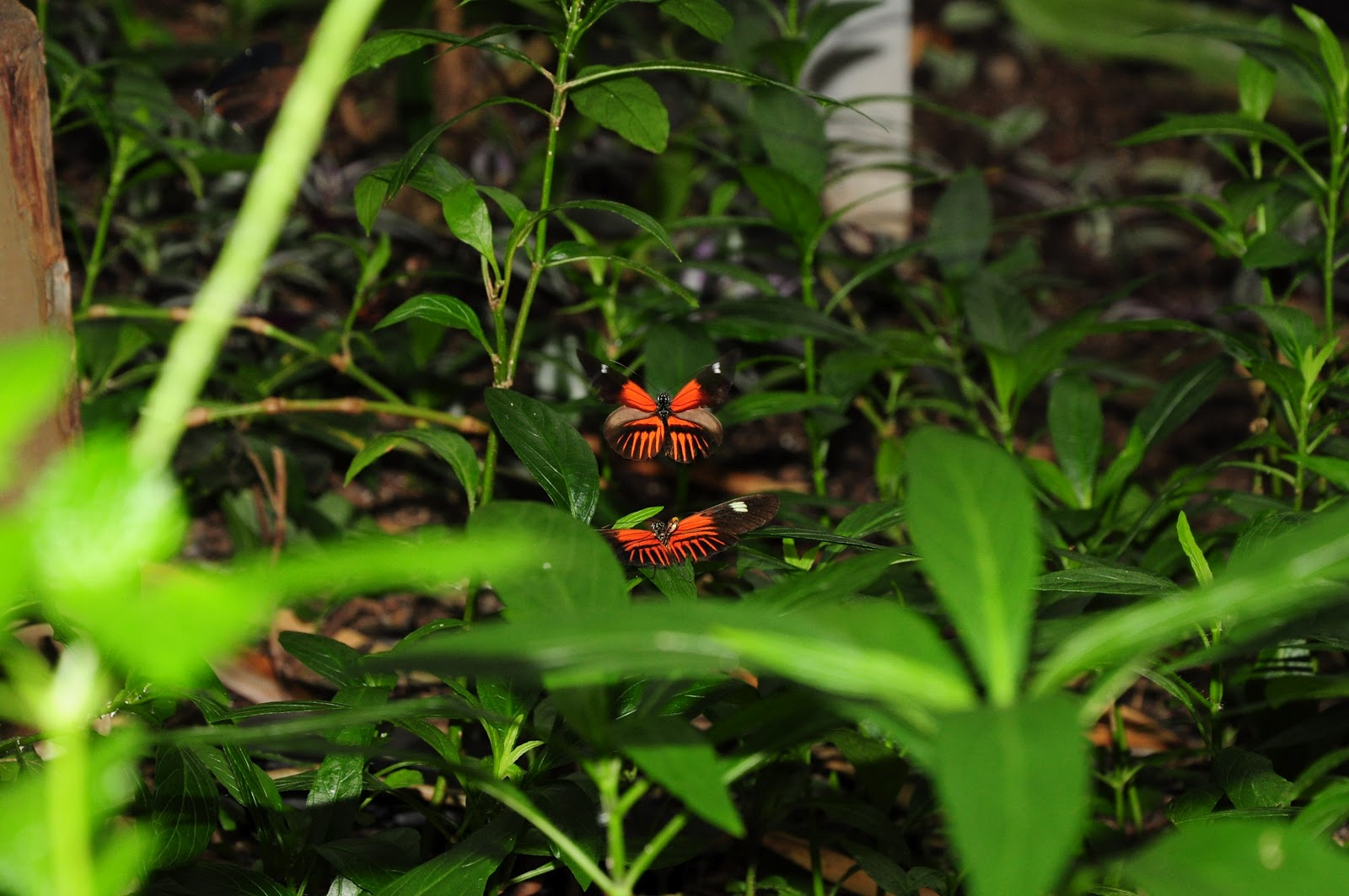
Around and around us flapped these two morphos: the blue and the white. I was DETERMINED to get a photo of them.

But they just were not cooperative.

Not like this lovely orange Juliana, which sat very patiently while I took shot after shot. Still, I was unable to get a good focus on it. Should've brought a tripod!

A chocolate tree! Saw one of these in the Amazon - some of the most beautiful flowers are those of the chocolate tree - tiny white blossoms all along the trunk. The orange pods are the fruits, from which the cocao beans are harvested.

Not all butterflies are attracted to nectar. Some are drawn to rotting fruits, like this morpho, while others seek out rotting carcases and feces. Glad I'm not a butterfly.


Finally it was time to call it quits, and as we approached the exit, there was a blue morpho, sitting on the floor, exhausted and tattered, near the end of its life. At last I got my photo.

Stay tuned...I will next post some video images taken of these butterflies...and a bird.
Thursday, March 15, 2012
Sunny Day and the Bugs Come Out
Nearly 80 yesterday, and 77 the last time I checked today. Unreal. But it brought the early insects out to feed on the oozing sap from recently cut trees.
Here we have the Grey Comma nectaring away...
followed by some flies keeping the butterfly company. I just love watching the different ways insects eat.
You can read more about this encounter over at my work blog: here.
Here we have the Grey Comma nectaring away...
followed by some flies keeping the butterfly company. I just love watching the different ways insects eat.
You can read more about this encounter over at my work blog: here.
Saturday, September 17, 2011
Random Stuff
Earlier this week, while on our evening walk, I noticed a sulphur buttefly deceased along the side of the road. I didn't think much of it - we often find butterflies and moths who had terminal encounters with vehicles.


And groups of them!

I only found two survivors, and this one I'm not sure actually made it. What in the world happened? On the way home, I counted 44 bodies in about a quarter-mile stretch. This was not normal. The only thing I could think of was puddling. This road is a dirt road, and we'd recently had a fair bit of rain. Could all these butterflies have been puddling, and then gotten run into by vehicles that either didn't see them or didn't care? I can think of no other explanation.

On a cheerier, note, however, we also saw this kestrel! It really liked this oak tree (lots of birds do, especially starlings, which nest in its many cavities). It soared around a bit, then came to rest in the tree. Took off, flapped around, returned to rest. I'm glad to see this bird - I haven't seen a wild kestrel for many years - just the merlins in the Adirondacks.

Meanwhile, at work, we had someone bring us this mystery caterpillar:

We looked and looked in our caterpillar ID books, but to no avail. I finally sent this shot off to BugGuide and the answer came back "dogwood sawfly." Not a moth or caterpillar at all! It turns out that this larva is quite a pest of dogwoods. The adult is a fly, but looks somewhat like a wasp, but it's the larva that does the damage. Now, I didn't see it listed as a non-native insect, so, although it does damage to dogwoods, it must be a native insect, and therefore, part of the circle of life for our native plants. If you have ornamental dogwoods, well, that's something else. Go native - the plants and their associated critters are used to each other. You will get some damage, but that is natural! Plants are food - not museum specimens.
Wednesday, June 29, 2011
Morning Walk
We have had just a string of glorious days - temps in the '70s, nice breeze, low humidity. It's been wonderful.
So, of course, Toby and I took a long walk "around the block" Sunday morning. Lots of things are in bloom, some of which are old friends, and some of which are new ones.
First up we have what I suspect is purple giant hyssop (another case of uncertain ID because I didn't have my field guide in hand on the walk, and photographs don't always do the trick). I've only seen purple giant hyssop once, so I can't rely on memory. I will take my book home today, however, and have it on hand for my next foray. Update: my botany buddy back in NY (who is originally from MI) identified this as hoary vervain (Verbena stricta), which amazingly is is a native plant!


The first flush of yellow goatsbeard has come and gone,

but the next generation is coming in strong.

'Tis the season for mullein, and here we have moth mullein, a mullein about which I have heard (it is considered up and coming on the list of bad invasives), but have never seen until moving here to Michigan. It's been in Michigan since about 1840, so it's hardly a new plant, but these last few years it has been on the list of unwanted alien invaders.

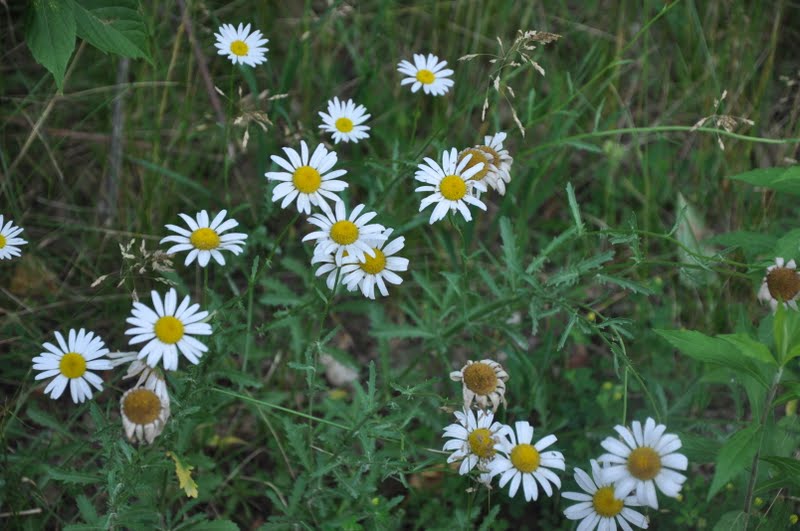
Another non-native, ox-eye daisy has naturalized across much of the country. We like it, so we don't think of it as an invasive, but, well, there it is. Sometimes the truth hurts.
Spiderworts were in full swing in this field. And they are a native!!! Happy day. I am simply tickled pink by these flowers, for I had them planted in my gardens in Newcomb, and it is a joy to discover they are a native wildflower. I will be trying to gather seeds from the plants in my neighborhood later this season, collecting them for planting in my field after I have it burned. Local genotypes, don'tcha know.

Okay, back to non-natives, we have the first Queen Anne's lace in bloom.

I smelled them before I saw them: wild roses. So much nicer than the invasive multiflora rose, and they add such a lovely color to the landscape.

Catalpa trees are in bloom, although they peaked a week or two ago. The somewhat orchid-like flowers are really quite lovely, and they stand out next to the giant heart-shaped leaves. Catalpas are not native to Michigan, but they are native to North America. A more southerly species, they were planted here by early settlers for use as fence posts (after they grew up and were chopped down).

And it is milkweed season. The flowers are only juuust starting to bloom, and soon the air will be filled with their cloyingly sweet scent.

Butterflyweed, a member of the milkweed family, is also just starting to flower. Monarch butterflies will utilize both of these plants, so I've begun flipping over leaves in search of eggs and larvae. So far I've found one caterpillar (another post for another day).

There's one plant that is growing and blooming everywhere, and it is a thistle. Back in the Adirondacks I was familiar with Canada and bull thistles, both non-native species. This thistle didn't match either description. It turns out it's nodding or musk thistle (Carduus nutans). It is, of course, a non-native species. Here is a series of photos of its flower in different stages of blooming.


Flowers weren't the only things we saw on our walk. This striking butterfly posed for quite a while, a welcome change! An eastern comma (one of the punctuation butterflies), it is a member of the brush-footed clan. And for those who wonder what good nettles are, here is an animal who needs them: nettles are one of the host plants for its larvae.

Now, this butterfly I did not see on my walk. This one was hiding in the shrubbery yesterday as I walked along one of the trails at work with a string of 4th graders behind me. I believe it is a little wood satyr (Megisto cymela), a fairly common and abundant species that likes open woodlands, which is exactly where I found it.

Summer is now in full swing. I've discovered sassafras growing in tree form (I've only ever seen it as a shrubby thing), smooth sumac growing as full fledged trees (with dbh of 10 or more inches), indigo buntings nesting down the road from me, meadow larks singing in the nearby fields, and whip-poor-wills calling in the fields at night.
This morning I watched a pair of sandhill cranes in a neighbor's hard - one of which was dancing and jumping in front of its companion - either a defensive posture meant to intimidate me and the dog, or a courtship display intended to impress its friend.
And two nights ago, just as I was about to step in to the shower, I saw a brownish blob in the tub. I wasn't wearing my glasses, so my first thought was that one of the cats had left me a reminder that the litterbox needed changing. However, as I bent over to get it into focus, it resolved into a grey tree frog! How in the world a tree frog found its way into my house and tub, I have no idea, but a few moments later it was back outside where it belonged.
Add to all this the hundreds of fireflies that sparkle across the landscape each night, and it is easy to say that this move is turning into a very pleasant path of discovery.
Subscribe to:
Posts (Atom)