Wednesday, July 15, 2009

Here Comes the Sun (doot do do do)...

...and I say, "It's alright."

Oh, yeah - blue sky and sunshine! It's our one sunny day for the week, so I took advantage of it and hit the trails. Found some plants new to me, some plants that were old friends, and an old friend who was out doing her Bti treatments.


First, the plants.


We've had folks coming in and reporting one-flowered pyrola (Moneses uniflora), but this was the first time I've seen it myself. It was a pretty drooping thing,

but it was even more lovely when the flower head was turned up so I could see its face.

Fringed loosestrife (Lysimachia ciliata) was another new one for me. I thought at first it was some strange St. Johnswort. After I got this nice closeup, I started to see these plants all along the canoe put-in at Belden Pond.


Small sundrops (Oenotera perennis) I have seen before, but not enough times to be immediately familiar with it. All I knew was that it was something I'd seen before. These were high and dry at what had been a beaver pond at one time.

Boneset (Eupatorium perfoliatum), aka Thoroughwort, is one of my favorite plants, simply because I love the leaves. This is one of those great Doctrine of Signatures plants: it was once believed that this plant could heal bones simply because the leaf grows around the stem. They had some good imaginations in the Middle Ages.

Indian pipes (Monotropa uniflora) were only just starting to emerge. These ghostly saprophytes are also, rather appropriately, called Corpse Plant.


I just caught a glance at this rather pathetic specimen of Swamp Candles (Lysimachia terrestris) as we were walking through the beaver meadow. I passed it by at first, since it wasn't a stellar example, but decided to get its photo in the end since it was the only one I saw. Swamp candles are also called Yellow Loosestrife. It is a native plant, so don't let the name fool you. The fringed loosestrife above is also native. Not all loosestrifes are alien invasives (just the purple ones).


Spotted Joe Pye weed (Eupatorium maculatum) is another favorite. As you can see, the flowers aren't open yet, but they should be soon (if we get some more sun). Swamp milkweed (Asclepias incarnata) is also budding but not blooming, so I'll save that for another day.


I had some animals visit me:

a weeny little frog, which we think is a spring peeper (Pseudacris crucifer) - at least it was small enough to be a peeper and it had a very faint "X" on its back;

and a very upset red squirrel (Tamiasciurus hudsonicus) - but they're always upset.


It was while getting the shot of the squirrel that I startled Edna (I was off the trail in the woods and she'd been watching the ground for rocks as she walked along). She practically had a coronary right there when I moved! Then she couldn't stop laughing!

Edna is our local Bti agent - she goes around to area bodies of water in search of blackfly larvae. When they are at the right stage, she douses them with Bti (Bacillus thuringensis israelenis). She has a great deal of knowledge of blackflies, so I tagged along with her to see her in action.


She examined the Little Sucker Brook, looking for signs of larvae clinging to the rocks.


She found some (what amazing eyes) and showed me the critters as they writhed on the rock. She said they are a bit small still, so she was going to wait a day or two before coming back to check. If she treats them too soon, the rest of them hatch and are not affected by the Bti. If she gets them too late (after they form the histoblast and then pupate), they are impermeable to the bacterium. It's kind of like the potato beetles - you have to hit them at the right stage of development.


We checked another spot further upstream. This time she found large larvae as well as itty bitty ones (smaller than a comma in 10 pt print); it reinforced her decision to hold off treatment. One of these days I want to go out with her in the spring when the larvae are at their highest numbers and get the whole process recorded. Her tales of larvae masses are the stuff of nightmares!

And now it is 3:00 and the sun is still shining. A good day all around.


Saturday, July 11, 2009

Unexpected Guest

When I get home from work at the end of the day, Toby greets me at the door, bouncing and happy. We usually head right out the back door to toss and chase a few balls, etc. Sometimes I stop to change out of my uniform first, as I did last night. And it's a good thing I did for there in the bedroom was an unexpected guest: a female hummingbird flying madly about the ceiling!

Who knows how long the poor thing had been trapped in the house! I had left the back door open so the dog and cat could go out and enjoy the sunshine if they do desired, and she must've zipped in.

The first thing I did was shut the bedroom door - it wouldn't do to have to chase her through the whole house! Then I opened a window. I tried guiding her towards it, but she was having no part of it. Around and around she flew. She'd rest for a couple seconds on the ceiling fan (which, thankfully, was off), then she'd take flight again.

At a loss for a solution, I called our rehabber, who came up with the answer! I quickly mixed up some sugar and water and put it in one of my hummingbird feeders (which I never put out this year). I set the feeder on the window and it only took a few seconds for the bird to see the bright red and land for a drink, which I have no doubt she desparately needed! Once there in the open window, and refueled, she lifted off and disappeared into the yard.

I guess I'll have to think twice now about leaving that door open when I'm not home!


Friday, July 10, 2009

A Perfect Day


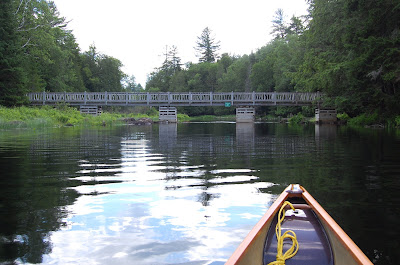
Ah, the rigors of the job: I had to lead a canoe paddle on Rich Lake today. The sun was out, the sky was blue, a few puffy clouds blew about on the wind. It's a tough job, but someone's gotta do it.


We followed a flotilla of Canada geese, and watched as a loon made a perfect landing.


Pickerelweed (Pontederia cordata) was only juuuust starting to bloom - this was the only one we saw.
A handful of swamp candles were barely holding their heads above the water and were not photogenic. Instead, we had a distant view of some swamp milkweed (Asclepias incarnata).


Swamp roses (Rosa palustris) had us scratching our heads for a few moments. Detailed Correction: When Terry and I were looking at this plant there in the wetland, my first reaction was "rose," but as I looked at the leaves, my reaction became "cinquefoil." I didn't have my field guide with me, so we hemmed and hawed and finally went with rose. I should've looked it up before posting it, but my friend Jackie caught the mistake. It is indeed Marsh Cinquefoil (Potentilla palustris) - the purple flowerheads should've been the big clue. Thanks for the heads-up, Jackie!

We took a leisurely paddle through the wetland,


picked up a few passengers,


and then headed down the Outlet.


Other floral treasures included fragrant white water lily (Nymphaea odorata),


spatterdock (Nuphar variegatum) with yellow center,

spatterdock with red center,


water smartweed (Polygonum amphibium),


and, the best find of the day, large cranberry (Vaccinium macrocarpon).


We also had some other nifty finds, but getting photos from a moving boat was impossible! They included the flowers of native floating heart (Nymphoides cordata), flowers on the rushes (I don't know what species), and newly emerged damselflies clinging to said rushes. Dragonflies and damselflies, of all colors and styles, flitted about, singly and in pairs (I tried really hard to get a shot of an ebony jewelwing, one of my favorites, but it just wouldn't land and stay put in one place long enough). Spider webs clung to vegetation, and I even saw one spider making good headway across the water. We saw fish (small and smaller), and fish nests. Overhead we heard and saw a pair of broadwinged hawks catching some updrafts, and in the woods we heard wood peewees, winter wrens, song sparrows, black-throated blue warblers, and a blue-headed vireo.


Moquitoes? Nil. Blackflies? Nada. Deerflies? Only a few in the Outlet.


Overall, a perfect day. (Until I got home, that is, and found the massive sunburn on my legs!)


Monday, July 6, 2009

I'm Blue...

Well, one of my readers couldn't read the text on the black layout. :(

After cruising through all the options, only one other caught my fancy, but it cut my sidebar photos in half - that's no good - so I'm back to the blue.

Still, it's a nice layout and it's worked for me for a year and change. If it ain't broke, don't fix it, eh?

Here you are< Swampy! Happy reading!

Saturday, July 4, 2009

Change is Good

I've never quite been 100% happy with the blue background, so I thought I try a change today. You can't beat basic black, eh? We'll see how this goes for a while.

Yesterday saw me in my canoe for the first time this year. It was a rainy day, but the folks signed up for the Rich Lake Paddle were not about to be deterred by a little rain, so off we went. (Because of the pending precipitation, I did not bring the camera.)

Our wildlife sightings were not many: a deer in the distance browsing in the wetland along the shore; two loons; a bunch of damselflies emerging from their nymphal cases, standing out like banners at the tips of the rushes as they rested and dried their wings before taking flight; and a whole mess of deerflies.

Flower sightings were even fewer: some of the rushes had flower tufts at their tips; one steeplebush was in bloom in the wetland at the end of the lake; and that was about it.

Rumor has it that the clouds and rain might clear out this afternoon (says she, listening to the rain pattering on the leaves outside her window). While we really haven't gotten a lot of rain in Newcomb, it has been enough to keep things damp. We would all like to see some sun and blue sky.

Wednesday, July 1, 2009

A Face Only a Mother Could Love?

A friend of mine is a wildlife rehabilitator (a rehabber), and you just never know what animals she might have under her care when you visit. Birds are one of her specialties, but she also does small mammals like minks, squirrels and raccoons.

Well, recently she acquired this little guy:


Check out those enormous feet!


Here is a close up of that wonderful face (don't you just love the "bad hair day" and the way he peers at you around that upward-pointing beak?):


This is a baby American bittern, a member of the heron family. Someone brought it in, claiming it was "found abandoned." Because bitterns are difficult to locate, finding a nest and plunking this little guy into it in hopes that it would be adopted wasn't an option, so the rehabber had to take it in.


Too often a well-meaning person sees some baby animal and thinks it is abandoned, when in fact the parents are likely nearby, waiting for the human to go away before they move in to continue their care for Junior.


If you find yourself in such a situation, you should follow this dictum: If you care, leave it there. For example, let's say you found an "orphaned" baby robin sitting in your yard. You should leave it alone, but keep an eye on it. Chances it fledged early and the adults are waiting nearby with food. They will continue to care for it. If you have been watching it (continuously) for two or three hours, and no adults show up, then you should place a call to your nearest rehabber for advice and a possible pick up.


If you want to read more about bitterns, zip over to the Adirondack Almanack and check out the piece I wrote for them:
www.adirondackalmanack.com/2009/06/american-bitterns-groovy-little-heron...

Ammendment: It seems the Almanack's archive for June (the bittern piece was 3 June) doesn't go back beyond the 23rd. So....I will reprint it for you here:

American Bitterns – Groovy Little Herons
(From Adirondack Almanack, 3 June 2009)

You just never know what will dash in front of your car up here in the Adirondacks. The other day I was driving towards civilization, cruising past a couple marshlands, and a bittern flew across the road in front of me. The American bittern (Botaurus lentiginosus) is one of those really cool birds that few people get to see, thanks to its solitary nature and its stupendous blending capabilities.

A member of the heron family, the bittern stands about two feet tall. Like all herons, it has long skinny legs and a long, spear-like bill, which it puts to good use catching its prey. Chances are, if you see a bittern it will be busily hunting. Not that you can tell, for it will be standing stock still, waiting for food to come by. When a fish, frog, snake or yummy-looking insect gets too close, the bittern’s long neck snakes down quick as a flash and the unlucky food item is snared. After a killing bite, or a vicious shake, the food is swallowed head first.

If, however, the bittern sees you first, it will likely go into its blending act. Bitterns are denizens of wetlands (bogs, marshes, wet meadows), and they hang out where emergent vegetation is tall (cattails and bulrushes). When they feel slightly threatened, these small herons thrust their beaks straight up towards the sky, exposing their striped necks and breasts. Now, instead of seeing a bird-shaped thing, you see a collection of plant stems, for the stripes are tan and blend right in with all the surrounding vegetation. If you look closely, you may see the two bright yellow eyes peering back at you around the sides of the beak – a bizarre sight if ever there was one.

But the best (and strangest) thing about this bird, in my humble opinion, is its vocalizations. Pliny, that great philosopher of old, thought the bittern (that would be the Old World bittern, not the American bittern) sounded like the roar of a bull, which in Latin was/is boatum taurus. From this we get the genus name of bitterns everywhere: Botaurus. I’ve listened to bittern calls, both recordings and in the wild, and to me they don’t sound at all like a bull. For me the sound brings to mind the soundtrack accompanying a slow motion drop of water hitting a pond. Others claim it sounds like congested plumbing. Some of the bittern’s additional common names are suggestive of the sound: thunder-pumper, mire-drum. In order to make these strange sounds, the bird’s throat/neck goes through some stunning contortions; a friend commented to me that when he witnessed this he thought for sure the bird would give itself whiplash. To hear the bittern’s call, follow this link http://www.allaboutbirds.org/guide/American_Bittern/id and look down the left side of the website for the button that says “Typical Voice”; press play.

If you want to hear (or see) a bittern yourself, hie ye to a nearby wetland with tall emergent vegetation around dawn or dusk (take your bug shirt). Find yourself a comfortable spot near some cattails and water, and wait. If bitterns are around (and they are fairly common), you are bound to hear them “booming” before too long. If you are really lucky, you may even catch sight of one as you peer into the cattails. Beware; it might just be peering back at you.


And Now, the Weather...

Just a quickie.

Everyone has been complaining about all the rain in June, and admittedly we've had many overcast days that certainly threatened rain. Friends downstate have been (figuratively) drowning in all the rain (over 9" in under a week). But here in little ol' Newcomb we didn't even make 4" in all of June! Nope, our grand precipitation total was (drum roll please): 3.83"!

Newcomb seems to be situated in a weather bubble. It's like we have an invisible dome over us that shunts the weather to the north or south of town. Not that I'm complaining too much, for it does reduce shovelling in winter, and it may help us avoid some of the really strong storms that cruise through in the summer, but it would be nice to get a bit more rain sometimes.

And if it's not going to rain, then we could use some sunshine! At this rate my corn isn't even going to come close to "knee high by the Fourth of July" this year! Well, maybe to a grasshopper...