Thursday, April 1, 2010

Spring Tidings from the Rich Lake Trail

It was in the '70s by afternoon, so I had to go out and walk a trail. I wanted to see if we had any signs of spring flowers yet (I know, I know...it's only April 1st, but hope springs eternal). Didn't find any, but I did find some nice things.


The elderberry by the birdfeeders is getting ready to burst.


All along the lake shore the ice is melting. I stared and stared at the open water in hopes of finding a defrosted newt or frog swimming about, but nada.

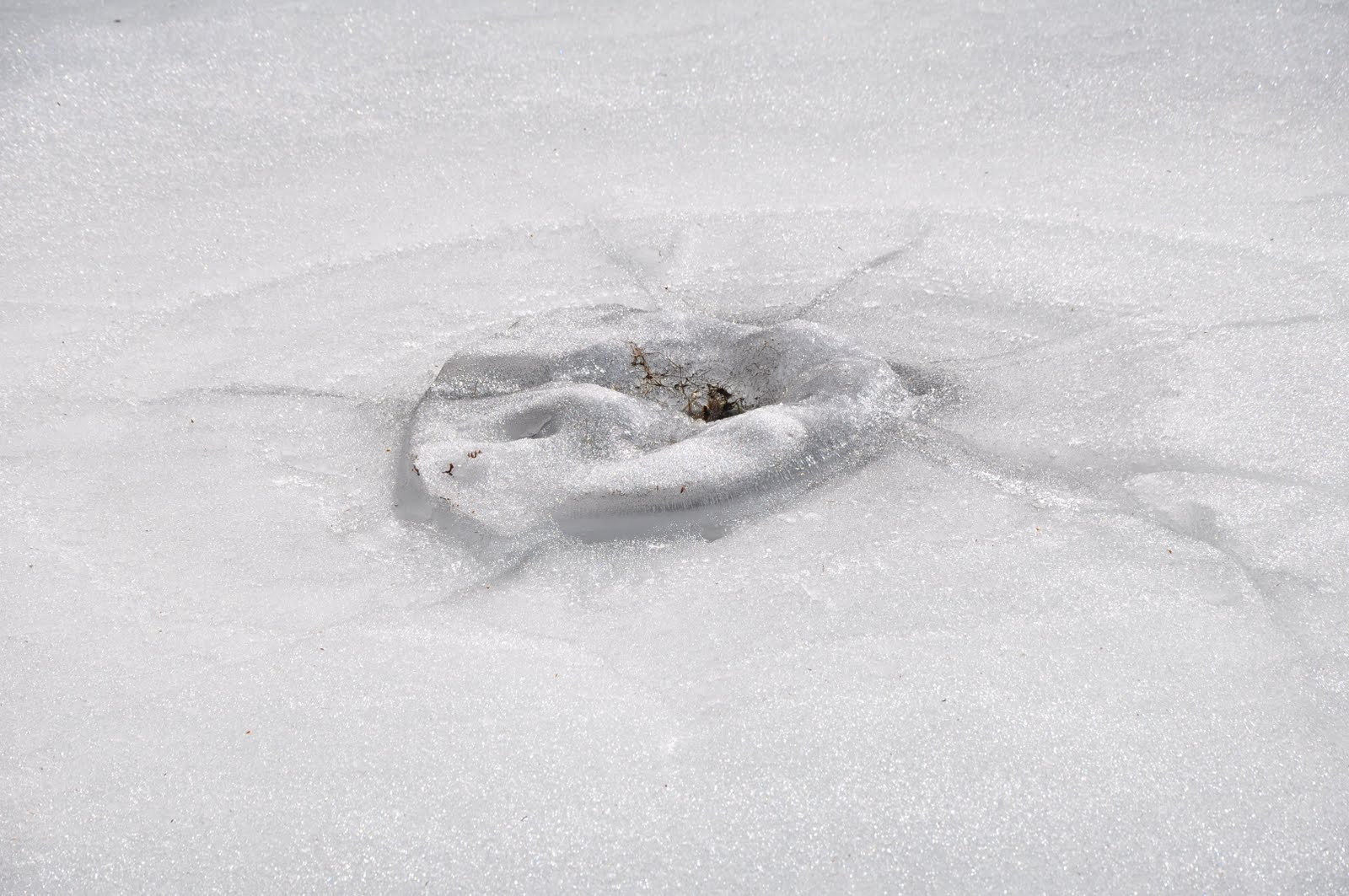
There was this interesting blemish on the ice:


Zooming in, it looks like the ice heaved around a branch or stump that is mostly submerged. I'll have to watch as the ice melts to get a confirmation on the cause.


I love this twisted bit of old cedar. It's the closest we get to drift wood.


The ol' glacial erratic came through the winter just fine...what rock wouldn't?


The far side is covered with all sorts of moss and lichens, like these enormous rock tripes (Umbilicaria mammulata). Right now they are greenish-grey and very pliable.


Towards the end of the walk, I came across this lovely scat nestled in some ice. I believe it is from a mink. Note the folded back and forth structure - like toothpaste from a tube.


And finally, this terrific artist's conk (Ganoderma applanatum) that grew partially inside a woodpecker's food hole:


Now I'll go home and see what's happening in the yard - the daphne in bloom? How about the hazelnuts? Can't wait to see who's enjoying the sun!


Waterfalls Large and Small

What a GLORIOUS day today is turning out to be! When I got up, the fog was settling in nicely. I had to drive out to North Hudson to meet my Bluebird Society County Coordinator to pick up bluebird nestboxes for this weekend's workshop (Saturday, 3 April, 1:00 PM - come on out), so I took my camera with me, just to make sure no moose stepped out of the fog and into the Jeep. It worked - no moose.

But moose aren't everything. Today's star turned out to be waterfalls.

First, I was treated to these these splendid twin waterfalls that were tumbling merrily down the rock outcroppings. I was driving eastward on the Blue Ridge Road, and they were to my left, just beyond the bison farm.

After picking up my nestboxes, I knew I had to stop and check out Schroon Falls as I headed back to the office.

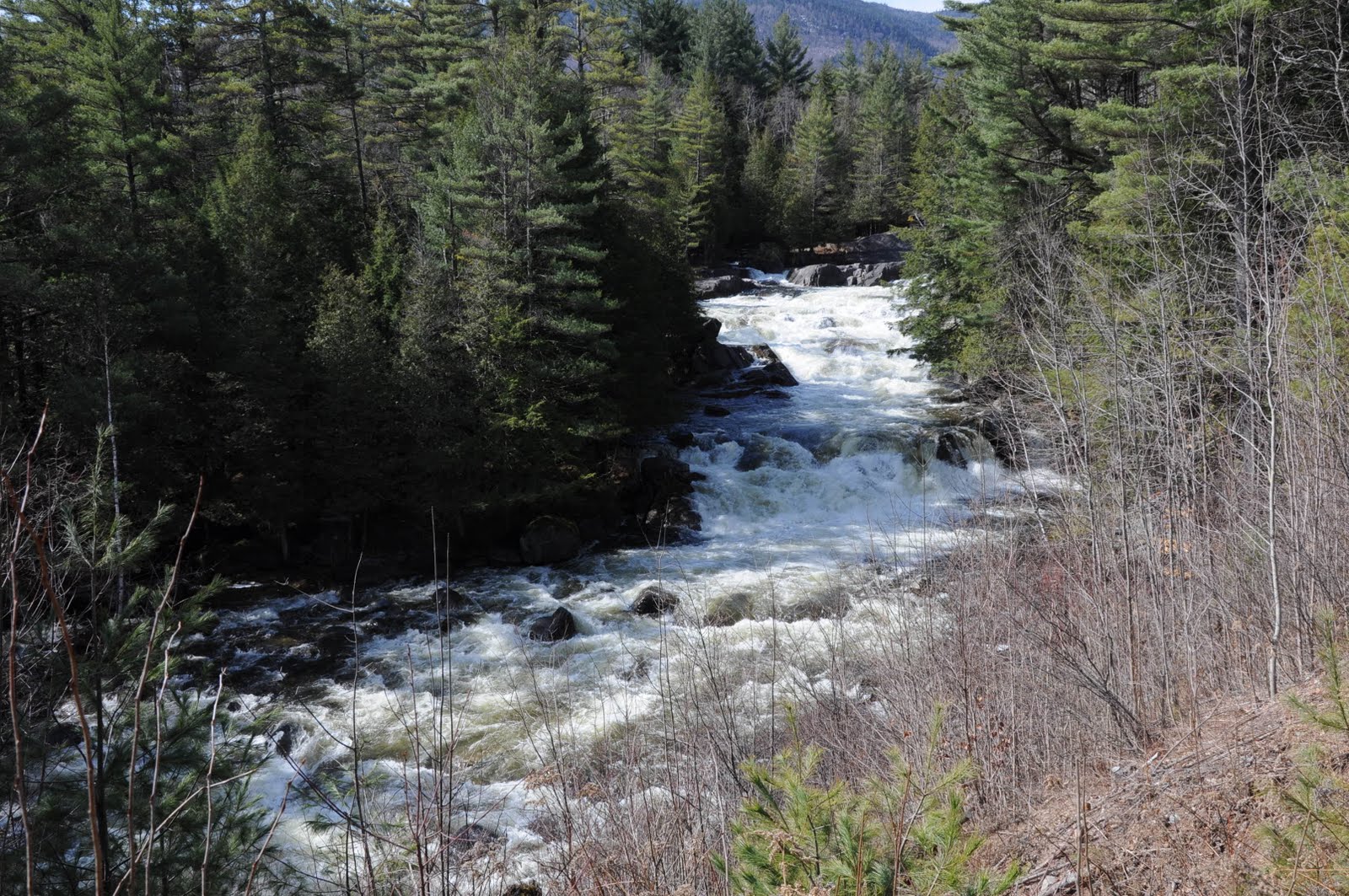
If one is headed westward on the Blue Ridge Road, and if one is looking to one's left just as one drives past the Blue Ridge Campground, one will see a pull-off next to the guardrail, and way down below one will see Schroon Falls. (It's harder to see it if you are driving eastward.)

With the winter run-off and spring rains, the water is flowing very nicely right now.


And while it was oh-so-beautiful to look it, it was tough as the dickens to photograph. The sunlight was just too bright, so if I exposed for the brilliant water, everything else was black as pitch. If I exposed for the trees and rocks, the water was a glare of white. The Happy Medium was not putting in an appearance at the Falls today.

There's a footpath that runs upstream from the "parking area," which I've never taken before. Since it was such a beautiful day, and I had the camera with me, I decided to see how close I could get to the falls without killing myself.

The answer is right down to the water's edge!

There are lots of water-worn boulders along the edge that were high and dry today, so I could get pretty darn close. In fact, I could've dipped my toes in the rushing water if I'd had a mind to. I didn't...I'm smarter than that.


I really wanted to catch some of the sprays as the water pounded downstream and slammed into the rocks. Mostly I was unsuccessful, but even so, one can still feel the power of the river.


Here's a glance down-river:


Something about the sunlight, the water, and probably the geology, made this one swell of water an amazing bottle green.


I took about 900 shots of this rock with the water splashing up against it, trying to get ONE that captured the action and feel of it.


I think the monochrome shows the drama best.

Lots of summer folks stop by the VIC and ask for directions to waterfalls. If the summer is dry, even our most spectacular waterfalls can be rather non-descript. But if you come in the spring, you can almost be guaranteed a good show at Schroon Falls, and also at Buttermilk Falls over in Long Lake. These are the two waterfalls closest to Newcomb that are easily accessed by vehicle, and well-worth the show.

Tuesday, March 30, 2010

More Tracking Books

Following the enthusiastic advice of my blogging pal Squirrel, I ordered a couple new tracking books. I've been eagerly awaiting their arrival - what tracking bibliophile wouldn't? They arrived today - hooray!


I was uncertain at first about getting this book, Stories in Tracks and Sign, but after reading it, I'm glad it did. The author, Diane Gibbons, presents a wide variety of photographs of animal tracks from all over North America, and each is followed by a painting that shows the animal in the process of making those tracks. This is very helpful in learning how to use your imagination to picture how the tracks you see were made (which can often be quite a challenge). Her subjects range from easy (deer trails) to challenging (mole crabs on the beach). A good book to add to one's tracking library (or to borrow from someone else's tracking library).


This book is put out by Stackpole books, the same folks who published Mark Elbroch's mammal and bird tracking books (which is why it looks a lot like them). I can already tell that Tracks & Signs of Insects and Other Invertebrates is going to be a well-thumbed book in my field pack. Not only does it include insect (and invertebrate) footprints where appropriate, but it also includes other insecty (and invertebratey) things, such as eggs, cocoons, and feeding sites. Every curious naturalist should add a copy of this to his or her stash.

Thanks for the tip, Squirrel!

Thursday, March 25, 2010

An Early Blackfly Season?

I was talking to my friend Edna the other day and learned that the blackfly larvae are already active. Edna is one of our local Bti agents - folks who apply Bti to the streams and waterways as part of an on-going effort to control blackfly larvae. You all got to meet her last year here.

I had stopped by Edna's two days earlier to drop off photos of the beaver pond, so she could see how it had changed since last summer when she treated it (before beavers). At that point she said that the larvae they were finding were still torpid - not active. But two days later she was telling me that they (the larvae) were squirming and wriggling in massive clumps to beat the band. Treatment had begun.

Does this mean an early blackfly season? Or a longer one? Only time will tell.

Saturday, March 20, 2010

Set Your Clocks

Next Saturday (27 March), from 8:30 PM until 9:30 PM, is the Fourth Annual Earth Hour.


What is Earth Hour? It's an international "event" designed to bring our (the people of the developed world) attention to our ever growing energy needs. The Event started in Australia in 2007 and has since grown to cover the planet, with millions of people participating. The goal is to increase our awareness of climate change, but I also think it could have an impact on night-time light pollution - it could be part of the Dark Skies movement.


During this one hour, on this one day of the year, people are encouraged to turn off all their lights. Just think of what the global energy savings might be from just this one small action.

If you want to learn more about this movement, visit the Earth Hour Website.


Then set your clocks for 8:30 PM next Saturday and sit in the dark for an hour with your friends and family. Who knows...it might even be fun.

They're Heerrre

Overslept again, so Toby and I were on a quick walk this morning. We were cruising by the rescue squad when I heard it. Could it be? Again. Cheerily Cheerily. It must be. A robin.

And sure enough, as we were coming back down the home stretch, a bird with an unmistakeable chunky brown body and yellow bill flew up into a tree. Then another flew across the street. The next thing I knew, I was seeing robins everywhere.

And it's the first day of spring. How appropriate.

Thursday, March 18, 2010

Wearin' o' th' Green

Saint Paddy's Day found me outside scouting the trails for animal tracks. We had a school group coming the next day, and I knew recent conditions were less than ideal for making, not to mention finding, tracks. Almost two weeks of mild weather, lots of sunshine and a wee bit of rain, plus some pretty strong winds, were bound to make things interesting.

Here's what the trail looked like:

Between the debris and hard, icy snow, it was going to be interesting!

Of course, I found myself distracted my all sorts of naturey things. Who could resist this fungus? Look at all the tiny wee holes on the underside - fitting that it is a polypore, eh? I believe this is Fomes fomentarius, the tinder polypore.


Despite questionable conditions, I was able to find a few tracks. As one might suspect, mouse and squirrel tracks were non-existent, but heavier animals, like deer, left pretty good tracks behind.


Along the sunny shore of a wetland, I found wild iris starting to emerge.


And the sphagnum moss was looking quite thick and juicy. I'm wondering if this is the "cat sphagnum" I learned about from Evelyn last fall.


This small shrubby plant was also along the side of the wetland. It's stem was fuzzy - almost downy. The buds look familiar, but I must be having a senior moment because I can't place it.


Here's some of the bright green that the Earth was wearing just in time for this Irish holiday. The leaves are even shamrocky in shape. Of course, this is goldthread, not shamrocks, but even so, it was nice to see on St. Patrick's Day.

This jumping spider was one of several I saw traversing a mossy rock in the sunshine next to the beaver pond. Here it is modeling for us a very nice little pixy cup lichen - I suspect it is a mealy pixie cup (Cladonia chlorophaea).


And right nearby was the tiniest British Soldiers lichen I've ever seen (Cladonia cristatella). Although it could be Gritty British Soldiers (C. floerkeana) - I didn't look closely enough to note the difference and I can't tell from this photo. Reading the habitat requirements of each may give a clue: the former is "equally at home on wood, soil, or even bark (tree bases)", while the latter is found "on earth, rotten logs, or soil-covered rocks, usually in the open." Hm...this was on a rock, in an open spot along the beaver pond. The rock had a healthy population of mosses and lichens, so some soil build-up was present. Both species can grown on soil. Guess habitat wasn't too helpful. Better observations and some chemical testing are in order.


As I sat there enjoying the sunshine and watching the wildlife crawl around the rock, this tree-, plant-, or leaf-hopper dropped in for a visit. I'm waiting to hear back from BugGuide.net for confirmation on what it is. Update: It turns out that this is a diamondbacked spittlebug (which are related to leafhoppers) - Lepyronia quadrangularis. It seems that these insects, which are commonly found in meadows and open spaces, where the young feed on grasses and other plants, safe within their foamy spittle homes, will overwinter as adults. When they do, they move to lower, swampy areas where the microclimate is less harsh and varied. This explians why I found this individual in the woods next to a beaver pond!


Ditto on this little guy. Lots of these were flying about (and landing on me - that's my hand it's crawling across, not Mars). Update: when I sent in my ID request to BugGuide, I mentioned that the back end of this insect had two "tails" like those on a stonefly. The response I got was "That's because it is a stonefly." Well - there you are, then. I looked it up in my Kaufman's Field Guide to Insects of North America and there, on the bottom of page 61 is a tiny little stonefly of the genus Allocapnia. These are "small winter stoneflies" (as opposed to "winter stoneflies") that can be out and about in temps a chilly at 20*F. Since it was well into the 50s, it's no surprise they were out and about. According to my Guide to Common Freshwater Invertebrates of North America, the adults emerge between December and April. As larvae, these insects are shredders, or detritivores, chowing down on decaying leaves that land in the water, consuming up to 30% of their weight in leaves each day.


So, here we are at the beaver pond. Water was rushing through one small opening, but mostly the dam was holding up.


The shallow parts of the pond were still covered with ice. I just loved the soft green of the ice in this section.


On the far side, the beaver lodge was quite visible. Last fall it was a little more difficult to see, but the barren landscape of spring, combined with the bright sunshine and a winter's worth of sticks thrown on the roof, made the bank lodge stick out like a sore thumb. I eventually made my way around to that side of the pond, but couldn't get close enough to see more than a few of the sticks. The beavers picked a good, safe location.


Here's what the slope above the lodge looks like. If these beavers were people, the APA would hit them with a major fine for clearcutting the woods!


Not only was the slope covered with sharp, pointy "stumps," but it was striped with several trails, where the beavers went up the hill to harvest some trees and then dragged them back to the pond. Some of these trails were quite deep and eroded.


Often when beavers cut down trees (saplings) for food, the stump left behind resprouts, sending up numerous new shoots. This one, however, is not likely to do so, for the beavers actually dug out the roots and cut them off as well!


Nearby, an old yellow birch had finally given up the ghost, and the beavers were having at it. The little black spot on the end is a fly. Two of these flies were sponging up the moisture oozing from the end. Sap?


Another old yellow birch, this one perched precariously at the top edge of a steep slope overlooking the pond, also showed signs of sampling by the beavers. I'm going to keep an eye on this one because I'm curious to see if the beavers plan on taking it down, or if this sample is the extent of the damage they'll do.


Although the "pond" part of the pond (to the left in this photo) is still frozen, the "stream" part is open and flowing right along.


Another portrait of my left hand. Have you ever noticed how many left hand photographs naturalists take? Seriously, though, this is a beaver track next to my hand. I had nothing else for scale, and I was simply impressed by the size of the thing. While to the untrained eye this looks like a track left by one of those giant prehistoric beavers, it is in fact merely the melted-out track of an average modern day beaver. Melting snow makes even the smallest tracks look huge.


My scouting trip turned up an additional raccoon track, some otter trails, and a grouse scat, so when the students arrived the next day, we had plenty of animal signs to look for.

Just as new green shoots are a sure sign of spring, so is the lack of trackable snow. It's these conditions that sharpen the observer's eye. We know the animals are still out there, but the signs of their passing are more subtle and we must be more alert if we want to find them.