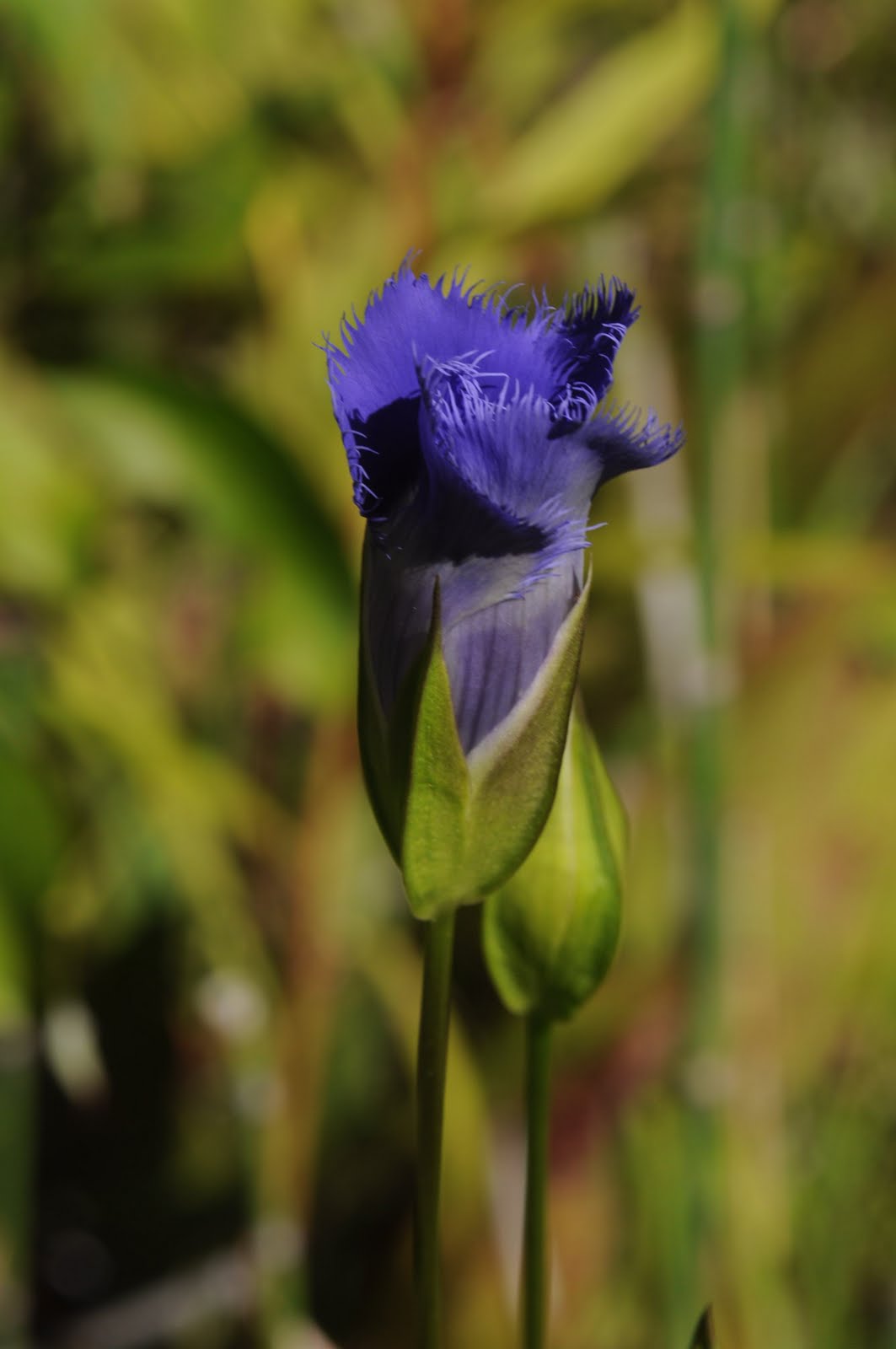
Our target plant this time was Fen Grass of Parnassus, Parnassia glauca. This plant is listed as exploitivly vulnerable in NY, and Jackie's friend Sue found it growing along the shore of the river. I was dying to see it - it's been on my "must see list" for some time.
So, we headed upstream, and before long I spotted it, peeking out from behind a small boulder at the water's edge. We parked the boat, clambered out, and starting taking photos.


Since Jackie had been here the day before, she wandered upstream a bit to see what other treasures she might find.
 Celery grass was growing in profusion in the water. Nifty water plant. The coils hold the female flower just at the water's surface, spreading out or contracting as needed with the water's level. When the flower is pollinated, the coils retract and the plant shoves the fertilized flower into the ground at the river's bed. Amazing biology.
We continued paddling upstream and found another clump of the grass of Parnassus. The flowers are a lot larger than I had expected.
 Some were growing singly in the cliff face, while others...
were growing in huge colonies! We must've seen hundreds of these plants, all clinging to the rock wall. It was a wondrous sight!
 The back of these flowers is just as lovely as the green-striped front.
 Between the two of us, we must've taken over a hundred photographs.
This wonderful orange lichen was also decorating the rock wall. I know I've seen it in my massive lichen book, but that's at work and I'm "on vacation" again this week, so give me a few days to ID it.
Update: This is, in fact, neither moss nor lichen, but an alga! My other brilliant botanical buddy, Evelyn, contacted Jackie to tell her that it is Trentepholia aurea. I don't think either of us expected this! I did a quick search on-line about this, and for a good site, visit here.

For the geologists in the crowd, check out this terrific rock formation. It was almost as if bricks had been layed (laid?) in the cliff face.

We followed the progression of this layer until the vegetation covered it. As you can see, it started by the water's edge (above) and continued to rise - an incline (below).

Spikenard (Aralia racemosa) fruits were ripening along the cliff, too. This isn't a plant I've seen before, but it's one I've wanted to add to my gardens - great native plant, often suggested as a substitute for some of those invasives people like to put in their gardens.
 As we headed back downriver, we saw this enormous stream of water shooting out from the trees on the opposite shore. What could it be? After some fun speculations, we decided to see what it was.
Our least-exciting theory proved true: it was the local fire department practicing using their hoses up on their extension ladder. Fun, but not as much fun as a giant peeing from the trees.

We continued to a little cove; Jackie wanted to see if we could find any turtles.

We watched a great blue heron for a while. Have you ever tried sneaking up on a GBH? It's well-nigh impossible. Just as we started to get close, it took off (I have a whole series of shots of this). It landed just a little further along and we tried sneaking up again. It looked like it caught something here - see the extended throat?

Finally we were too much for it, so it took off again and disappeared.

I love wetlands. They are so beautiful. Once seen as pestilential places only good for draining and filling in, today we know just how important they are to not only their immediate ecosystems, but to ecosystems further downstream as well.
 Jackie pointed out water marigold, another Bidens. When I lifted it up, I was amazed at its underwater leaves. Looking from above into the water, I thought the plant was coontail, another aquatic plant, but no, it was water marigold. Underwater they look a lot alike.
 Earlier in our paddle, I had asked Jackie: "Have you ever actually seen a frog ON a lily pad?" "No." "Neither have I - I think it's all entirely fictional."
Lo! and behold! Guess what we saw?!?!
 We also found two painted turtles sunning themselves. It was very hot by now (my car thermometer, when I picked up my car about an hour later, read 93*F), so I was surprised these two were out basking.
They didn't stick around for long, though - like the heron, they don't like to be watched.

We also talked about bladderworts. I was trying to remember the name of one I wanted to see, but couldn't. It was late and I needed to get my car, so we headed back to the town beach from which we had launched. "Oh, look," I said. "Bladderworts."
Jackie decided we should stop and see which ones they were, because this late in the season she couldn't imagine what would be blooming.
I reached down and plucked one from the water. "OH! This is the one I wanted to see!"

This is Utricularia inflata, which, according to Newcomb's is a coastal plant. We were very excited. It was a new plant for each of our life lists. Actually, it isn't. We now believe it is U. radiata, which is a threatened species in NYS. Read more below in the update.

The species name, inflata, refers to these "pontoons" that keep the plant happily afloat in the water.

Here you can see some of the tiny bladders that grow on the underwater portion of the plant.

And this is a close-up of one of the "pontoons."
 We were both so excited with this find. I went on-line at the library after picking up my car to see what I could find out about this plant. According to the USDA site, it is not only an endangered species in NY, but is only listed as occurring in one county downstate.
I immediately emailed Steve Young, the state botanist, to tell him of our find. I went on and on about how I'd be happy to go back and get a GPS reading for it.
Today I had an email back from him. "It has been found in the ADKs, leaves only, in the Raquette Lake area but not in the Hudson. Seems to be spreading more and more and acting as an invasive." I've been crushed.
Still, it was a new plant for me, and an interesting one at that.
Update: I just read Jackie's blog of this trip and apparently she sent an email off to Steve as well. Because she is a regular correspondent with him, she got a much more detailed answer from him. Here's what she wrote:
I heard from NY State Chief Botanist Steve Young that Utricularia inflata has not only been removed from New York's endangered plant list, it is now considered a dangerously invasive plant in certain areas where it is crowding out other native species. That's the bad news. The good news is that the bladderwort in the photo above is more likely Utricularia radiata, or Small Inflated Bladderwort, since those radiating arms are only a little longer than an inch and branch out only at the ends. Another distinguishing feature is that the flower petal's lower lip has three distinct lobes. U. radiata is indeed a rare plant in New York, and as far as I can tell, has never been reported in Saratoga County. Until now.
Well, I guess it wasn't a total wash after all!
 My day full of adventure didn't end once I picked up my car. I was running late, and it was rush hour, so maybe that explains the final adventure. I'd gotten my groceries, and wanted to find the cheapest gasoline, so I headed back into Glens Falls. I don't know how it happened, but apparently my attention drifted for a moment and WHAM! I hit the curb. Whap whap whap. Uh-oh.
Flat tire.
Pulled in to a pizza place and called AAA. Their guy came about a half hour sooner than they said, and before long I had my spare on. He didn't recommend driving back up to Newcomb with the spare. It was 7 PM - who would be open now? Try Wal-mart. (UGH). They couldn't help me, but Sears could, so off I went.
The dog! Called my boss - could you let the dog out in the yard?
It was after 9:30 when I finally got home, with my new tire and my melting groceries. The dog was very happy to see me - he'd raided the compost bucket and had eaten another pair of underwear. >sigh<
I'm still waiting for the underwear to reappear.