Tuesday, September 15, 2009

A Perfect Adirondack Day

My friend Woodswalker invited me for a paddle yesterday at her personal paradise - a privately owned lake in the eastern Adirondacks (she doesn't own it - it's held by a church group). We met at 9 AM, just as the sun was burning off the fog. Spider webs in numbers uncountable graced the wetland near the entrance to the property.


The fog cleared in next to no time while I got the grand tour of cabins and the immediate property. Being nature nuts, we were both drawn to the wildlife:

Mr. Toad (or it could've been a Ms. Toad - I didn't see the enlarged "thumbs" that are usually associated with males) put up with our photography obsession for quite a while,


but even he eventually tired of the attention and left for less crowded environs.

We launched our boats and headed out along the shoreline, paddling widdershins.
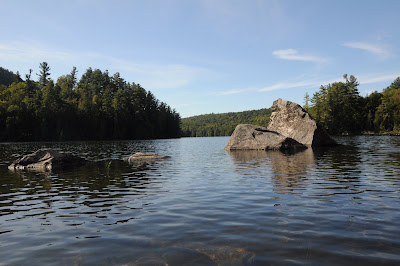


The air was mild, the sky blue with but a few wispy clouds, and the colors were just starting to change in the trees. A more perfect day couldn't have been had if we had placed an order.

The highlight of the paddle was a pair of loons - an adult and a juvenile. As soon as we saw them we stopped paddling so as not to disturb them. They seemed completely unfazed by our presence and continued fishing all around our boats.


The water on this lake is so clear that when the juvenile dove and swam underwater along the side of my boat I could see its every stroke. Very cool.

I missed the money shot, though, when the adult stood up and shook its wings - I was busy repositioning my canoe when the bird rose and flapped. I did, however, get a shot of the juvenile with a small fish in its beak.


The lake has two wetlands that we poked around, each with old abandoned beaver lodges. We followed a channel into the depths of one of the wetlands. I wonder if it was an old beaver channel.

The waterlilies were still in bloom, which sort of surprised me. I tend to think of them as flowers of July and August.


One of the more puzzling things we encountered were these little green balls.


There were hundreds of them floating in the water of one of the wetlands (they didn't photograph well in the water).

They were soft and squishy, and came in varied sizes, from teeny tiny to almost a centimeter in diameter. Does anyone know what they might be?
UPDATE: My paddling buddy got an ID confirmation on the Little Green Balls. Soon after I published this post, my friend Evelyn emailed me that a friend of her's thought they were Nostoc, and then later ammended that to Volvox. Well, this just goes to show you should never change your answer; they are Nostoc, a cyanobacteria. For Jackie's excellent write-up, visit her blog at http://saratogawoodswaters.blogspot.com/2009/09/green-ball-mystery-solved.html.

We found a couple types of burreed. This one reminded me of medieval maces.


These wetland plants have triangular stems filled with a spongy pith (as seen in this cross-section); the are very much like the leaves of cattails.


By 1:00 the wind had picked up, almost blowing whitecaps up on the lake's surface. We headed back towards the beach and took out our boats. It was a delightful way to spend a day - next time I will have to clear my calendar for the whole day so we can linger longer.
Thanks for the invite, Jackie!

Wednesday, September 9, 2009

Thank Goodness for Small Favors


Take a good look at the face (mouth) of this longhorned beetle.


Kinda' makes you glad that you are at the top of the food chain and
so much bigger than insects, doesn't it?

Death and the Blues


I know this garter snake looks alive, but in truth, it is deceased. I found it on the roadside last night while Toby and I were out for our walk. When I found it, it was only mostly dead, which, according to Miracle Max, means still partly alive.

Not seeing any visible injuries, I picked it up, hoping it was mostly alive, but aside from the tip of the tail twitching back and forth, the animal just lay there. I suspect the nerves were the only things still firing. Ever hopeful, I brought it home, but by then it had completely expired. Still, it was in fine shape for photographing, so I took several pics.

It seems that all of a sudden there are a lot of deceased snakes on the roads. I suspect the weather is ultimately the culprit. Although the days have been sunny and mild, no doubt in the woods it is cool, and for a reptile heat is necessary for mobility and survival (if you are too cold to move, you cannot hunt). So the snakes are probably slithering out onto the pavement, where the radiating heat of the day warms them right up; toasty warm.

Unfortunately for the snakes, though, the roads host traffic, and traffic doesn't look out for snakes.

Most of the deceased (and flattened) snakes I've found, all of which have been garter snakes, btw, have been a lovely shade of turquoise. This is odd, since garter snakes are not blue. I've often wondered why they change color in death, and I've finally found the answer.

If you look at a live garter snake, its scales are brown, yellow and green. There is a lot of variation on the theme, but these are the basic colors. Going back to kindergarten, we all know that green is made by mixing blue and yellow. Well, it turns out that the yellow pigments are not stable, so after death they readily break down and disappear. The result is that the blue pigments are now totally exposed, turning the snake blue in death.

Fascinating.

Still, if you are out and about these days when the sun is baking the roadsides, please watch for sunning reptiles. Do your best not to run them over - they are important cogs in the wheels of our ecosystems.

Tuesday, September 8, 2009

An Evening Stroll Along the Hudson River

You know how it goes: you head out for a walk thinking you'll go one way, but on a whim you turn left instead of right, and then you think, oh, just a little bit further, and before you know it, you are miles from home! But Toby greatly enjoyed this unplanned trek we took a couple nights ago - sights and smells we've not encountered for many months. It was only later on that I had second thoughts, as the poor pup could barely hobble upright and across the floor. Aging isn't a plus no matter what your species!

Anyway, off we went, headed across the golf course. Our first find of the evening was this fuzzy-antlered buck on the 5th hole (I think he was eye-balling your plants, Lorraine).


He stuck around long enough for about three photos, and then Toby spotted him and he (the deer) took off.


Taking that left-hand turn into the woods, we headed down towards the Hudson River. Afterall, it's been almost a year since we took this route, the evening was mild, the sun was out...the river was high.


Normally we can stand out on those rocks that are submerged to the left of the photo.

The trail we were on is part of the local snowmobile trail in winter, although in the summer ATVs apparently use it now, based on the ruts made by tires and the wallows in the mud. Still, if it's not too wet, it is a nice walk. Along the way we found four piles of scat:


bear scat #1 - apples


bear scat #2 - blackberries


old coyote scat - snowshoe hare on the menu


mystery scat


The last one was just an enormous pile. Not only was the quantity impressive, but so was the diameter of some of the sections. Here's another view, with my boot for rough scale:


I've sent the images along to Vince Walsh of Kawing Crow Awareness Center in Greenfield to see if he knows who might have left it. I suspect a really, really large coyote, but I could be wrong.


This paper wasp (or maybe bald-faced hornet) nest has seen better days. Could a bear have made a meal here?


Beavers had been hard at work, blocking up the drainage from the swampy area. Their industriousness flooded the trial in more than one location. With some judicious tip-toeing, Toby and I were able to get through without getting too wet and muddy.


What looks like an oil slick is likely gases oozing out from the wetland and mixing with the water.


The Hudson River at twilight.


We reached the end of the trail shortly after the sun had set. Now we had 2+ miles to walk along the roads back home. The only signs of life we encountered were a beagle on guard duty and a couple carloads of campers headed for the Lake Harris Campground. Not a bad way to spend an evening in early September.

Cougar!

There we were, walking along by the Scenic Overlook in town, when along the back edge, where the grass meets the unmowed verge, a large buffy-orange feline with a long, strong tail was trotting.


The first thing that went through my mind was "Cougar!"


Then reality set in.


"That's too small to be a cougar."

Sure enough, it was merely a house cat, albeit, a rather large housecat.

It is easy to see how people can confuse common household animals for rare wildlife, especially when these people have never seen real wildlife in real situations.

Black panthers (or "painters," as they are called where I grew up) often turn out to be black house cats, or even fishers. And cougars are often (very large) house cats, too. Harmless milk snakes are transformed into venomous rattlers or copperheads.

Still, it can be fun to be caught up in the moment and let one's imagine run rampant for even a few, brief seconds.

Thursday, September 3, 2009

Stumped

I was going to use this for an Adirondack Almanack article, but simply could not find the information needed. So, I put it out there for you readers to help me out.


A visitor found this monarch chrysalis in our garden. As you can see it is all black and is sporting a good-sized hole.

The question is, what did it?

I called our other VIC and asked the staff there, for they have the Butterfly House and just might know. The answer I got was "a wasp parasitized it."

But what kind of wasp? Did it parasitize the caterpillar, or the pupa?

Armed with "wasp, monarch, chrysalis, parasite" I did a search on-line. Actually, I've done several searches over the last few days. I've called butterfly folks in other states. I've submitted the photo to BugGuide.net, and I'm still left without answers.

There is a Tachnid fly that commonly parasitizes monarch caterpillars, but when it emerges from the chrysalis, it leaves a white string dangling behind. There's no string here.

There is a Braconid wasp that is a parasitoid of monarchs (parasitoids, btw, lay eggs on the host, and the eggs hatch into larvae that consume and eventually kill the host; parasites, on the other hand, live in the host and may weaken it, but rarely kill it, like tapeworms). But all I could find out about this was that the female lays one egg on the caterpillar, which divides into five eggs and yields up to 32 larvae (every site stated this; it was as though one person wrote it and everyone else just copied and pasted it). Another dead end.

A phonecall to Cleveland Metroparks and a naturalist I know there who "does" butterflies ended up with a suggetion that a Trogodor wasp, which parasitizes swallowtail butterflies, might also parasitize monarchs? I looked it up - no such thing exists. I finally found mention of Trogus mactator, which is an Ichneumon wasp that does parasitize swallowtail butterflies, but there's no mention of monarchs.

So, if there are any butterfly people out there, especially monarch specialists, do you know what did this?

In the meantime, I still need a topic for Saturday's article...