Some of you may recall that I found these canid tracks while walking the dog one day down to the river.

They are canid tracks, and due to the number of tracks all over the place I suspected coyote. This was reenforced by the fact that I've heard coyotes in this area quite often over the last few years. Still, I wasn't convinced they weren't fox.
The conundrum was the pattern: a straight line of tracks with a set of four footprints set off to the side, like the animal had been beamed down and then beamed back up. What had happened?
So, when I was at the tracking workshop this last weekend, I showed these photos to Vince. He said it was a pretty good find, not something one will see too often.

According to him, multiple coyotes were using this trail (foxes don't travel in groups like this), each walking (or trotting) in the exact same tracks, making it look like a single animal (how to fool your prey). Then, something caught the attention of one (or two) of the animals, it/they stepped out of the trail to listen or sniff, and then got back on track (no pun intended) and disappeared with the others.
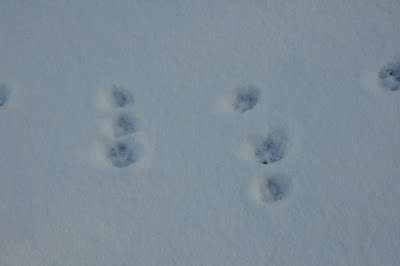
Now, of course, I wish I could take another look at the tracks, not just photos of them. I want to note which way toes are facing, and see if I can pick up where the animal first left the trail and where it joined back up. But, all I have are the photos, so I do my best to decipher with what I have.
Take a close look at the trail just before the offset tracks. See the footprint by the arrow?
This footprint has already left the trail, so this might be where the animal(s) began its (their) detour.
OR...

Note that the footprints marked with the red arrows are darker and better defined than the others. Could these have been made by multiple feet? Is this perhaps the trail they were all on, and the others in the cluster are the side steps?
Well, at least we know that it was more than one coyote and that at least one stepped out of the trail, even if we can't be sure which footprints are the abberant ones.
Isn't tracking fun?

 Of course, I shouldn't have been surprised. The turkey has visited the yard more than once, picking up scraps at the base of the feeders, so it is only logical that a deposit be made from the other end. In fact, I found three turkey scats as I made my rounds.
 For some reason, my track photos just didn't come out - all they picked up was the blinding white of snow (and the sun wasn't even out). Still, a click on the old "quick fix" button and voila! the tracks were suddenly visible.


 The tallest part of the tooth (the lingual crest) is the part closest to the tongue. This is white, the color of the tooth's enamel. Next comes a line of dentine (brown), which is the softer inner portion of the tooth. This is followed by the secondary crest, also white, and shorter than the lingual crest. So, what we have here is sort of a sandwiching effect: white, brown, white. This will become important in a bit.


