Tuesday, August 18, 2009

Tour of Tahawus

On Saturday, during Rock Fest, I was lucky to get assigned to follow along on Paul Hai's Tour of the Tahawus Mine. I've been up to the Upper Works several times, and have looked at the old blast furnace that sits by the road, but this was nothing compared to actually getting a guided tour by someone who knows (and is passionate about) the mining history of the area and what all the bits and pieces are.


A caravan of close to 30 people followed Paul up the road to the mines (County Route 25, off the Blue Ridge Road, about six miles east of the Newcomb VIC). We consolidated people in vehicles and drove the rest of the way to the Upper Works, the trailhead parking lot for the southern entrance into the High Peaks Wilderness Area. This parking lot, by the way, was where the old charcoal kiln was located. The early mining operations made charcoal from the local trees to fuel the fires in the various furnaces.


From here you'd never know it, but just a short distance into the woods are the remains of the first blast furnace that was built in this area (c. 1844). It was a cold blast furnace.


This furnace had been preceeded by a bloomery forge, but I don't know if there is any evidence of this left in the woods.


A bit further into the woods you find the remains of the wheel house that drew water from the Hudson River and used it to force cold air into the furnace, providing the necessary oxygen to get a good fire going to melt the ore. No ore pit or evidence of digging has been found in the area; they suspect that the ores were mined/found near the surface.


In a few short years, this furnace was obsolete (or perhaps too small to handle the growing operation). A new one was built up the road - this is the one that has been preserved and sits right along the roadside.


On top of the furnace is the hot blast stove, which is now protected under a plexiglass roof. This is what produced the hot air to help stoke the fires below.

Apparently this furnace is a bit of transition technology: it was built using technology for coal fired furnaces, but it used wood (charcoal) as a fuel source instead. It's also a hot blast furnace, another advance in technology - using hot air instead of cold air made the operation more efficient. Ore was brought in from across the road via a bridge to the top of the furnace (you can see the bridge foundations on the other side of the road) in ore carts. It was then crushed by a set of ore stamps, the crushed rock falling through grates and into the furnace. The furnace was kept packed full of ore, and as it heated, it separated out to its constituent parts. This furnace was commissioned in 1849 but wasn't completed and operational until 1854. In 1857 the whole operation was abandoned.


From the back of the furnace, you can see the opening through which the finished product emerged (you can see this better below, next to the STNR/TOOTS artwork).


No one knows what this bit of "artwork" means or what is it from. SNTR? TOOTS?

Anyway, the molten iron flowed from the hearth into a channel called a sow, and from there into molds on either side, called pigs (apparently someone thought this resembled piglets suckling from a sow). The iron filled these troughs (the pigs) and formed bars, which were subsequently called pig iron.

Paul actually had a piece of the original pig iron; even though it is only about a foot and a half long, it is very heavy.


Around the site you can also find bits of slag left over from the ore separation process.


This is a shot I got looking up the chimney of the furnace. I simply stuck my camera into the opening (seen above) and pressed the shutter release. It came out pretty well.


If you walk, carefully, behind the blast furnace you come to wheel house that operated the furnace. Several times larger than the original outfit, this wheel house had a dam and flume that dropped the water down over massive wheels which powered the the machinery. The water then flowed under the works and down a raceway back to the river. Paul talked about lots of things here, but the only bit that stuck in my mind was the driveshaft they made, with a 90-degree bend, that went up the hill to the furnace to operate the ore stamps.


Between the "new" and the "old" furnaces, several buildings in various stages of decay line the road and dot the woods. These are the remains of the old town of Adirondac. Adirondac (aka: McIntyre) was actually a ghost town twice... it's a rare thing for a community to flourish, become abandoned, and then flourish again before being abandoned for the final time. Why was it repeatedly abandoned? The iron produced at this site was of very high quality, but not reliably so. There was an impurity in the ore that made the iron hit or miss. That impurity turned out to be titanium dioxide, which became important during WWII, and in 1941 Tahawus was reopened as a titanium mine.


The McNaughton House has been stablized. There are plans to preserve it as part of the historical preservation of the area.


In between times, when the mines were not in operation (roughly the 1860s through the mid-1890s), the area was taken over by the Tahawus Club, a hunting and fishing club that became a resort for the affluent. The Tahawus Club still exists, but it has relocated to the other end of the road to the Upper Works.


From the Blast Furnace we drove on up into the mine proper, which is officially called Tahawus. This is not open to the public. We had special permission to be there as part of Rock Fest. Tahawus was the titanium mine...and this is where the money was.


The lake seen in this shot is actually the mine pit. The mine closed in the 1980s and with the operation no longer operating, water filled the pit, creating what is likely the deepest lake in the Adirondacks.
The village of Tahawus waas up along the southern "shore" of the pit (as seen on the left of this photo), and it was these houses that were moved, via flatbeds, to Newcomb when a line of ore was found underneath them. I actually live in one of these relocated mine houses. The "shore" is made from the tailings from the mine.

One of the biggest obstacles the mine faced was transportation. The quality of the titanium was (and still is) some of the best in the world, and they say there is still plenty down there. The problem, however, is getting it from the mine to the real world. Newcomb (and Tahawus) is in the middle of nowhere, the railroads no longer run, and trucks would have to drive a long way (at least the road is now paved and product would no longer have to be transported on sledges by horses). It turned out to be a whole lot cheaper to ship raw titanium from Africa to the States for processing than it was to bring it out from the Tahawus Mine. Hm...fuzzy economics, IMHO.

The buildings associated with the Tahawus Mine, and the mining equipment, have mostly been removed now. As you can see from these photos, very little is left.

If you are interested in a more detailed account of the Tahawus operation, and its future, you'll want to read the write-up at the APA website: http://www.apa.state.ny.us/Press/OSI_Tahawus.htm. We also have literature and architectural drawings of the furnace and wheel house available at the VIC.

Buggy Shots for a Muggy Day

There's just not enough time in the day to post everything! Between this blog and the posts I do for Adirondack Almanack, I find I spend much of my time these days on-line! So, instead of a lot of words, today I'm just going to put up some insect photos I've taken lately with the new camera.


Bald-faced Hornet or a look-alike?


The humble bumble (or a real close look-alike)


A lovely spider (the best we can come up with is that this is an orb weaver spider, family Araneidae; it seems that to get further ID I needed to photograph the top, or dorsal, side - live and learn).

Al Hicks Talks About New York's Bats

Saturday I was able to attend the early bird program at the Nature Conservancy's Annual Meeting here in Newcomb. I wanted to go because it was a presentation by Al Hicks, the DEC biologist who is heading up the White-nose Syndrome studies here in NY.

The program was enlightening (although much of it I already knew), but likewise depressing. Some of the photos he shared with us I hadn't seen before, especially one of an eastern pipistrelle (Pipistrellus subflavus) with the white fungus completely covering its face, like a death mask. The images of bat bodies, several deep, on the floors of caves was heart-breaking. He had before and after shots of the same stretch of cave wall, the former covered with bats, the latter bat-free (well, I believe there were actually two bats left). Even if you are not a bat enthusiast, the impact of these photos was devastating.

I took pages of notes, but here's what it boils down to:

1. They are pretty sure now (not positive yet, but pretty sure) that the fungus is the cause, not merely a symptom.

2. When the outbreak first occurred and they sent emails around the world, looking for clues. Some folks in Europe (Hungary, Switzerland, Netherlands, Romania) reported they had seen white fungus on the snouts of bats there, but they weren't concerned. It turns out that Europe has many fewer bats than we have here in N. America. Speculation now is whether this fungus wiped out bat species in Europe years ago (before studying bats and recording populations was considered important) without anyone knowing it.

3. The fungus from Europe is morphologically the same as the WNS fungus, and so far the genetics suggest is is the same. It is possible that this fungus is an alien invasive from Europe.

4. The cumulative decline of NY's little brown bat (Myotis lucifugus) populations in the last 2+ years is about 95%.

5. There is no evidence of resistance.

6. NYS DEC has been most concerned about the status of Indiana Bats (Myotis sodalis), which are a Federally endangered species; NYS is home to a significant winter population (7th largest in the world). What the scientists know is that Indianas and little browns share winter hibernacula and often cluster together. But, in adjoining clusters the little browns can have over 50% affected with the fungus, while the Indians right next to them have fewer than 5% affected. Somehow Indianas seem to be a bit more resistant. Also, it seems Indianas tend to prefer caves that have a lower humidity; caves with lower humidity have less of the fungus, and therefore bats in these caves are suffering a significantly smaller mortality rate.

7. During the winter, the bats' immune systems are not functioning. No one knows if this is normal during hibernation or if it is another symptom of WNS. When spring comes, the immune systems kicks into action and it encapsulates the fungus in a pustule. If this is on the wing (or tail) membrane, the pustule "burns through" the membrane, leaving a hole. This in turn impacts the bat's ability to fly and forage, and likewise decreases its reproductive success.

8. If the trend continues (the spread of the fungus and its associated wake of death), we can expect WNS to be in most of eastern North America in the next few years. It's possible our cave bats can be wiped out within ten years. This is significant!!!

9. The bats affected: little browns, Indianas, small-footeds (Myotix leibii), eastern pipistrelles (Pipistrellus subflavus), northern long-earred (Myotis septentrionalis), and big browns (Eptesicus fuscus). We don't know yet if the solitary tree-dwelling bats, which are migratory, are affected: red bats (Lasiurus borealis), hoary bats (Lasiurus cinereus), and silver-haired bats (Lasionycteris noctivagans). So far, of the bats known to be affected, big browns seem to be faring the best.

Al's big take-home message, however, was that as devastating as this is, it is a drop in the bucket when compared to global warming. He said "forget the bats - worry about global warming." Current studies are showing that the "worst case" scenarios that Al Gore talked about in his book and movie are not even close to what is really happening. Global climate change is happening as a faster rate than expected/predicted. Something must be done now or it will be too late; it's not a problem we can put off any longer. He said "write to your congressmen, write to your senators..."; do whatever you can to make global warming the priority in your life, because if we don't change the way we do things, the catastrophic results could be worse than we ever imagined. It's not just about humans. Everything on this planet is tied together...we have to step back from our petty problems and think of the big picture. Should the entire planet, with is millions of lifeforms, pay the ultimate price for one species' arrogance?

Friday, August 14, 2009

Nature - Available to Everyone

It used to be that only those who were physically fit could gain access to the Adirondack backcountry. People with limited mobility were confined to limited outdoor experiences: the town park, the back yard, maybe a neighborhood nature center.

A couple years ago, however, a new opportunity opened in the Adirondack Park: The John Dillon Park. Located just a couple miles north of Long Lake, right off Route 30, Dillon Park provides a backcountry experience for people who might otherwise have never had the opportunity.
While on my vacation, I decided to check out Dillon Park for myself. Although it was designed specifically for people with diabilities, it is open to anyone who wishes to visit, whether overnight or for a day trip.


It was a sunny, breezy morning as I drove down the two mile dirt road to the small welcome center, a cozy log cabin with a toasty fire crackling away in the wood stove. Stephen Cobb, the manager, greeted me at the front desk and provided me with a map and directions to the park's offerings. I decided to walk along their beautifully groomed trails and take in the sights, to see for myself the lean-tos, fishing dock and boat access.


The trails are plenty wide and have a crushed gravel surface. This is perfect for those with wheelchairs or strollers.


The campsites, however, are the centerpiece of the offerings at Dillon Park. Each site had two lean-tos,


an outhouse (with a real toilet, not a hole in the ground),


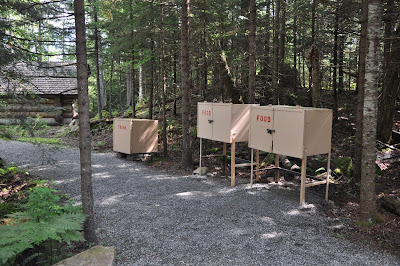
and bear-proof boxes for food and trash.


The lean-tos are nice and roomy. Most have a fold-down sleeping shelf (which can also be used for a table), as well as ample space for those who want to use sleeping mats and bags.


They are equipped with ramps, perfect for campers who use wheelchairs to get around.


In front of each lean-to is a stone fireplace with castiron cooking racks and swing arms. Wood is provided, dry and ready to go, in a sheltered stack nearby.


One of the campsites has a beautiful filtered view of Grampus Lake.


Continuing down the path, one crosses a boardwalk over a wooded wetland. A bit buggy, but it has the potential to expose the visitor to some interesting wetland plants.

Along the way there is a fishing dock. Covered with outdoor carpeting, this slip-free platform is perfect for trying to catch fish or simply getting out over the water to enjoy the view. While I was here I saw four loons: two adults and two juveniles.


Near the welcome center is the boat dock. The facility has a small pontoon boat for taking campers on leisurely trips around the lake, but visitors are also welcome to bring their own canoes or kayaks and launch them here.


The trail I took was a nice easy loop, running from the Welcome Center, out past the campsites, and then back along the lakeshore to the docks, ending back at the Welcome Center. There is, however, a second trail, which runs for about two miles out the other direction. This one is not currently a loop, but I got the impression it is a work in progress. I did not take this trail, for I had other places to go that day, but if it is anything like the trail I did take, I'm sure it is well worth the stroll.

Dillon Park is managed by Paul Smiths College for International Paper. They are opened only during the summer, so if you want to visit this year, your time is limited. For more information, visit their website at http://www.johndillonpark.org/.


Thursday, August 13, 2009

Rockin' in the Adirondacks

While on my vacation, I took advantage of the time off to visit one of the Park's popular attractions: Natural Stone Bridge and Caves, located just north of Pottersville (exit 26 from the Northway).


The day I went it was sunny and warm, and the crowds were making the most of it. Once I made it through the entrance line at the gift shop and onto the grounds, I began my self-guided tour of the rocky formations carved out by Trout Brook.


The tour takes you first through many family-friendly exhibits, like this one about petrified wood. While interesting, these exhibits don't necessarily have a lot to do with local geology (like the nearly four-foot-long cluster of amethyst crystals); they are obviously put together by someone who loves geology in general.


The paths are pretty well marked, consisting largely of narrow wooden stairs and walkways. Many bring you out to rocky prominences, or take you to spots where you can look back on the formations created by thousands of years of sculpting by water.


The Stone Bridge is one of the big draws. According to the signs, this is the largest naturally occuring stone bridge in the eastern US. The large slab of rock in front of the bridge fell from the ceiling of the bridge back in the 1950s. As a result, they say, the bridge is now stronger and safer than ever before (thanks to the loss of all that weight). Can you imagine the sound it must've made when it parted company with the parent rock?!?


Winding along the paths, you can peek into a small cave and, if water levels are just right, you can see the water rushing through. Piles of foam flecked the walls, lit by strategically placed colored lights. Very difficult to photograph.

In one spot you get to walk through a short tunnel. Follow the light!


As I was leaving Peter Pan's Peephole (a tiny hole in a tiny cave through which you can see the water rushing through the cave below, and which didn't show up at all in any shots I took), I saw two very large spiders guarding their very large egg sacs. I wonder how many visitors never saw them. Probably a good thing.


The river comes crashing along over rocks and boulders and disappears into the caves. Most of its underground journey seems to be pretty short, for it's only a few feet (20 to maybe 100) later on it reemerges, sometimes in a rush,


and sometimes in a gentle swirl.


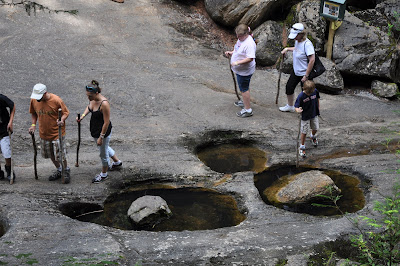
The potholes, made by the grinding action of the rocks that now sit in them, are pretty neat. I've seen some nice potholes along the Mohawk River near Little Falls, but the ones here are the largest I've seen. And every kid who went past them carrying a walking stick had to plunge his stick into the water to see how deep it was.


If You Go: Be sure to wear appropriate footwear! I can't tell you how many visitors I saw with flipflops! They won't let you in unless you have rubber-soled shoes on; if you don't have any, they will gladly rent you a pair. Also, bring your money. The entry fee is about $13 for adults (and I think about $8 for kids, but it could be less), but you may also find yourself drawn to all the beautiful rocks and minerals they have for sale in the rock shop. I was tempted by the cave bear teeth (very cool), but reason won out (what would I ever do with one) and I left with only memories and some nice photos.


Advertisement: This Saturday (15 August) the Newcomb VIC is hosting the Second Annual Rock Fest (10:00 AM - 4:00 PM). Geared towards real rock hounds, this program features lectures and field excursions by New York State Geologist William Kelly (Geology in the Park), Steve Potter of the DEC's Division of Mineral Resources (Rocks as Resource), the Adirondack Museum's Christine Campeau (Mining History of the Adirondacks), and Paul Hai from the Adirondack Ecological Center (Of Mines and Men - a Tour of the Tahawus Mines). We will also have exhibitors in the lobby: Natural Stone Bridge and Caves, High Falls Gorge, the Adirondack Museum, the Adirondack Park Institute, the Department of Environmental Conservation, and the NYS Geological Survey. Free and open to the public.

Tuesday, August 11, 2009

Botanizing by Boat

For part of my vacation, I went paddling with my botany buddy Jackie and her friend Sue along Jackie's favorite part of the Hudson River in Glens Falls.


To really appreciate a paddle, one should take time to cruise the river (lake or pond) banks in slow motion, for only then can one really see the life along the river (lake or pond). In this case, it was the plant life. Jackie has been keeping track of what's blooming here, and when, for about fifteen years! Her knowledge of the local flora is astonishing; she practically knows each individual plant. You can tell, when you go botanizing with her, that she views these plants as long-time friends, and when one turns up missing, the loss is as palpable as it is for the loss of any human friend.


Some of the plants we encountered are old favories, like pickerelweed (Pontederia cordata)


and Common arrowhead (Sagittaria latifolia)


while others were entirely new for me:

Monkey flower (Mimulus ringens) - I love the name! Someone must've thought the flower looked like a monkey's face. Hm.


Golden hedge hyssop (Gratiola aurea) - a delightful little mat of a plant, growing along rocks at the water's edge. The golden trumpets really glow in the sunshine. Jackie's also seen clammy hedge hyssop (I love that name) along the river, but we didn't see any today.


Sweetflag, or calamus (Acorus calamus) - there are two patches of this plant growing along the river. Many native people used the plant for medicianl purposes. Jackie had me taste the flower head (that green spikey thing) - it has a definite piney taste to it. Not great, but then not as bad as some medicines I've had to choke down.


Jackie should be commended for the lengths to which she will go to eradicate invasives like purple loosestrife!


Two trees grow along here that seem out of place this far north:

Black Tupelo (Nyssa sylvatica)


and Sassafrass (Sassafrass albidum).

Thanks to some interesting geology and its affect on local microclimate, these typically more southern trees are able to survive along the river's banks. Unfortunately, the local beavers have for some reason taken exception to the tupelos and have made it their personal mission to girdle just about every single one! This is a shame, for they are beautiful trees, especially in the fall when their leaves burst into a flaming scarlet unmatched by any of our other native trees.


I was fascinated by the enormous snails we saw inhabiting just about every underwater rock and boulder in the still waters of the river's bays! There were so many of them (hundreds and hundreds...possibly thousands) that I began to wonder if they are an introduced species. Hm. Does anyone know?


We also encountered some skittish dragon- and damselflies.

This dragonfly may be a Blue Corporal (Libellula deplanata).


I think this one is a Widow Skimmer (Libellula luctuosa).


These might be Azure Bluets, members of the Pond Damselfly Family (Coenagrionidae).

It is difficult to photograph insects from a boat because both you and the insects are moving!

Oh, these are all shots from my new camera! I bought a Nikon D90 mere minutes before we started this canoe trip and I have been playing with it while on vacation these last two weeks. I need a lot of practice getting the light balance right. And because it doesn't have mostly plastic parts, it is a heavy camera, and therefore holding it still is a bit more difficult than it is with lighter cameras. Practice, practice, practice!

More Bat Stuff

For a really good overview of white-nose syndrome (WNS), follow this link: http://www.vimeo.com/5671164 . This is a link to a slide show a gentleman put together about the disease, including commentary from Al Hicks, the DEC biologist who is a key player in tracking the disease. It poignantly shows the devastating effects of WNS at several caves in NY and VT.

If you want to see some great footage of bat foraging behaviors and the avoidance behaviors of potential prey moths, you want to check out the video at http://www.sciencefriday.com/videos/watch/10229 .