Saturday, May 8, 2010

Bringing Friends Around

Our rosy-fronted friend was back again today, and not only did he bring his lady-friend with him, but apparently he brought the neighbors, too, for another male and female were in the trees and on the feeders as well.


I tried for some more photos, but without much luck, except this one image:


Who knew that rose-breasted grosbeaks also had rosy wingpits? As long as they keep their wings down you'll never see them, but when they flap, there they are.

The females, which look like large female purple finches (that is to say they are brown and streaky), have yellowish stains around their wingpits, again only visible when they flap.


The yellowish blur in the photo, by the way, is a goldfinch.

Friday, May 7, 2010

Oooo! What a Treat!

I was walking by the window and happened to glance out. What did I see but this very handsome fellow feeding on the platform feeder:


Every once in a great while we are treated to the stunning colors of a rose-breasted grosbeak at our feeders. They are very attractive birds, even if they look like they've slopped punch down the fronts of their tuxedos.

A couple of times we've had mutant rose-breasted grosbeaks whose punch stains were yellow instead of red.

Regardless, they are a delight to see, adding an extra splash of color to our feeders.
David Sibley tells us that these are mostly solitary birds who prefer to lurk near the tops of trees rather than coming down closer to earth with the rest of us "low" lifes. When they sing, they sound a bit like a robin with a cold - kind of harsh and raspy.
Note the large (gross) beak - a classic feature of this group of birds. It is ideal for opening hard-husked seeds and makes very short work of black-oil sunflower seeds.
And in the background, drifting through the newly emerging leaves, was a distant bee-buzzzz: a black-throated blue warbler, the first I've heard this year.

It's a bird...

...it's a plane...


...it's a frog (a frog?)


No, you were right the first time: it's a bird.


And not just any bird - it's the bluebird of happiness. Yes, the bluebirds are back and they are lookin' to set up house. At this point, they are a bit skittish, so I was having a terrible time getting them to pose for photographs. I followed this pair all around my yard twice over the course of about half an hour and these are about the best shots I got. As the season progresses, though, and they settle in, photo ops will be easier.


In the meantime, if you haven't cleaned out your nest boxes yet, you'll want to do so. Unless, of course, the box already has a mossy nest inside, which will be the nursery of this happy little bird:


...who was also difficult to photograph, which is unusual for chickadees, but I blame the wind this time, which kept blowing not only the tree branches about, but also the birds. Yes, Virginia, it was a VERY windy day.

Wednesday, May 5, 2010

Holy Scats, Batman!

I was tickled pink last night when we left work to find a small pile of scats out front.


To the unknowing, these might look like mouse scats. In fact, to the knowing they look like mouse scats, but the are, in fact, bat scats.


This means our bats are back. Most likely, we have big browns (Eptesicus fuscus), which have always been a very common house bat, but with white-nose syndrome taking its toll on little browns (Myotis lucifugus), the odds of these being LBB droppings is now pretty slim.

A couple years ago I rescued a baby bat that had fallen from its maternity roost out front. With the help of our maintenance man, I scaled a ladder and put the little fellow back up by the roost entrance so it could return to safety and its mother.


If you want to read more about the rescue of this bat, visit my post at here.

Monday, May 3, 2010

Nature on the Run

I may never get to see a moose, but this morning I saw my fourth fisher - second one this year, third along this particular stretch of road.

I was driving eastward out of Newcomb, on my weekly jaunt to The City to run errands, when zip - beautiful fisher dashed across the road not twenty feet in front of my car. It was the best view I've had of this rather secretive forest dweller, despite its speed.

The tail was stretched straight out behind as itbooked with all possible haste to cross the blacktop. What was that gait? I want to say a 2x2, but it really wasn't doing the hunched back thing we associate with weasels. I'd be willing to say it was a lope, if not a full out gallop. Of course, there is no way to know, since pavement makes a really poor tracking medium.

A great way to start the morning.

Viological Inventory of My Yard

When I finally got going yesterday morning, I decided I'd take advantage of the sunshine (lots of rain is in the forecast) and get at least some of the lawn mowed. As I trudged along behind my electric mower, thinking it really felt more like July than early May, I found myself dodging patches of violets. I just can't bring myself to cutting down these cheery little flowers. Finally, the heat and humidity got to be too much (my kitchen thermometer, which, admittedly, isn't the most accurate thing in the world, was hovering a little too close to 100*F for my taste), I decided to grab the camera and do a photo inventory of the various violets scattered about in the grass.

Without further ado, here they are, some wild, some feral, and some domestic:


Saturday, May 1, 2010

Inventory at the VIC

The sun was out and we had a full complement of staff in, so I hit the trails this morning - wanted to get a full accounting of what was currently in bloom. Here are my findings, in no particular order.


Ferns - fiddleheads galore, of all species and wooliness. These first two are some species of wood fern. I love how the first image looks like a head and two arms outstretched as if to welcome the sunshine.


This fern, which may be a bracken fern, looked to me like a bunch of fists all bunched up.


And these extremely woolly fiddleheads I think are cinnamon ferns, but I could be wrong. Until they are fully unfurled, my fern ID skills are pretty poor.


The red, or purple, trilliums have been in bloom for over a week now,


but the painted trilliums have only just started to open. This one has to be about the smallest trillium flower I've ever found.


It will be a while yet before the starflowers open, so I was surprised to see a bud already formed on this plant.


At first I thought this was a pile of scat, but a second glance told me they were mushrooms. There were about a half dozen of these brown knobbly 'shrooms along the side of the trail. False morels? This was my guess, and when I got back to the building I looked 'em up. False morels indeed - Gyromitra esculenta. Poisonous. According to my mushroom book, many people can eat this mushroom with no ill effects, but in Europe hundreds of people have died from doing the same. The effects from eating it are delayed, occuring 4-6 hours after ingestion. Even those who have eaten it without problems in the past are liable to eat it one time too many and not survive. It is best to leave this mushroom alone.


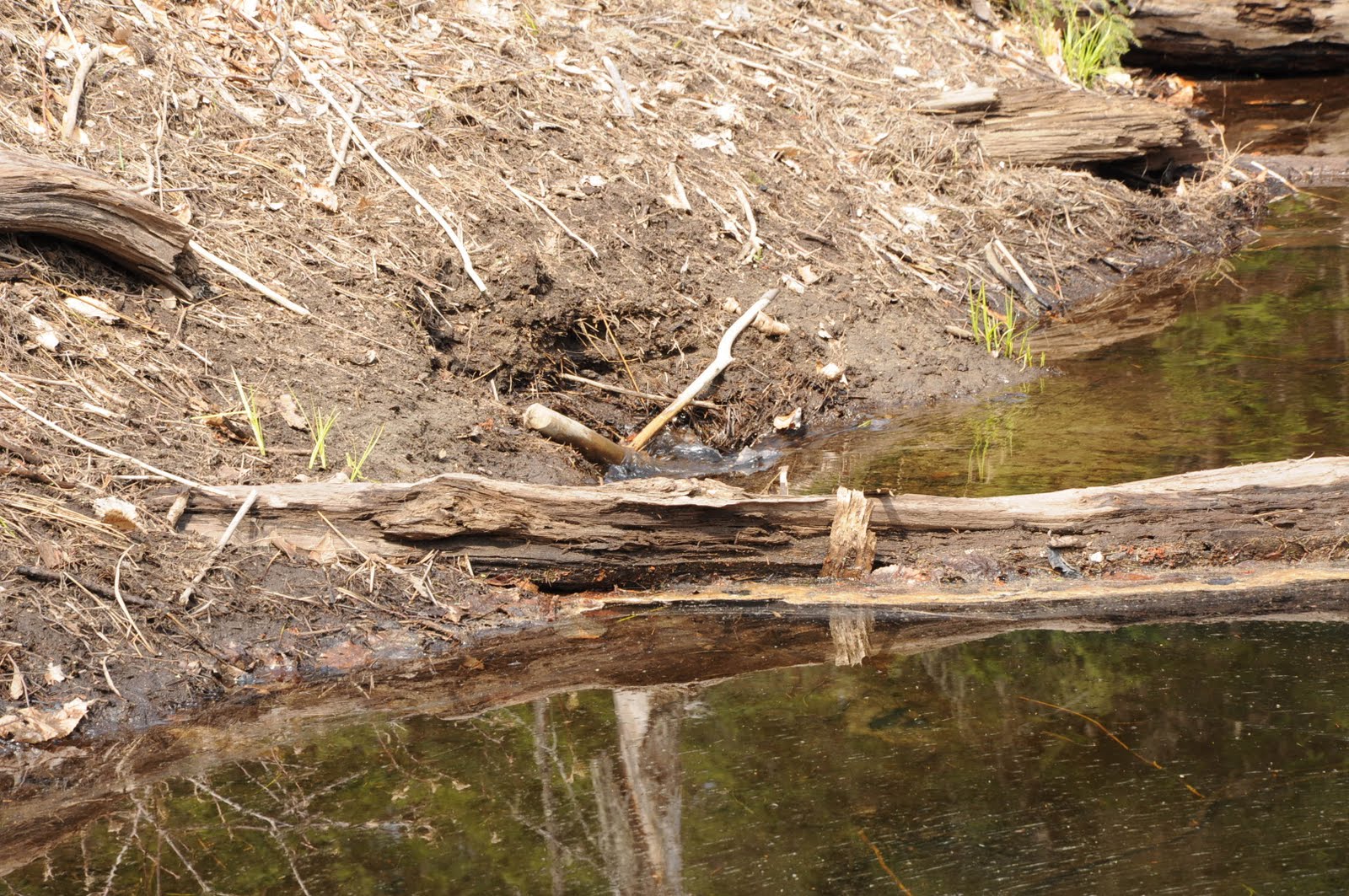
My walk took me past the beaver complex, and I was very surprised by what I saw. The water level was waaaay down. As in several feet. In this shot you can see the lodge, complete with formerly underwater entryway and the winter's food remains (all the sticks).


The dam was high and dry.


I followed the sound of gurgling water and about at the center of the dam I found this rushing leak. HM. Is this Mother Nature's work? I wonder if the beavers have moved on, for even the lower dam next to the bridge was draining from three breaches. I'd think that if the beavers were still here, they'd be patching things up. This pond bears watching over the next few months.


I was surprised to see this lone myrtle (or periwinkle) growing on the trail. We have a healthy crop of this non-native plant growing on the slope right at the entrance to the VIC. Did this one travel courtesy of some animal?


While I'm not a big fan of witchhobble/hobblebush (it reminds me of hydrangeas, and I'm not terribly keen on them), I do love the leaves, especially when they are young and full of pleats.


The young flower buds are still quite green,


while the fully-opened flowers are completely white.


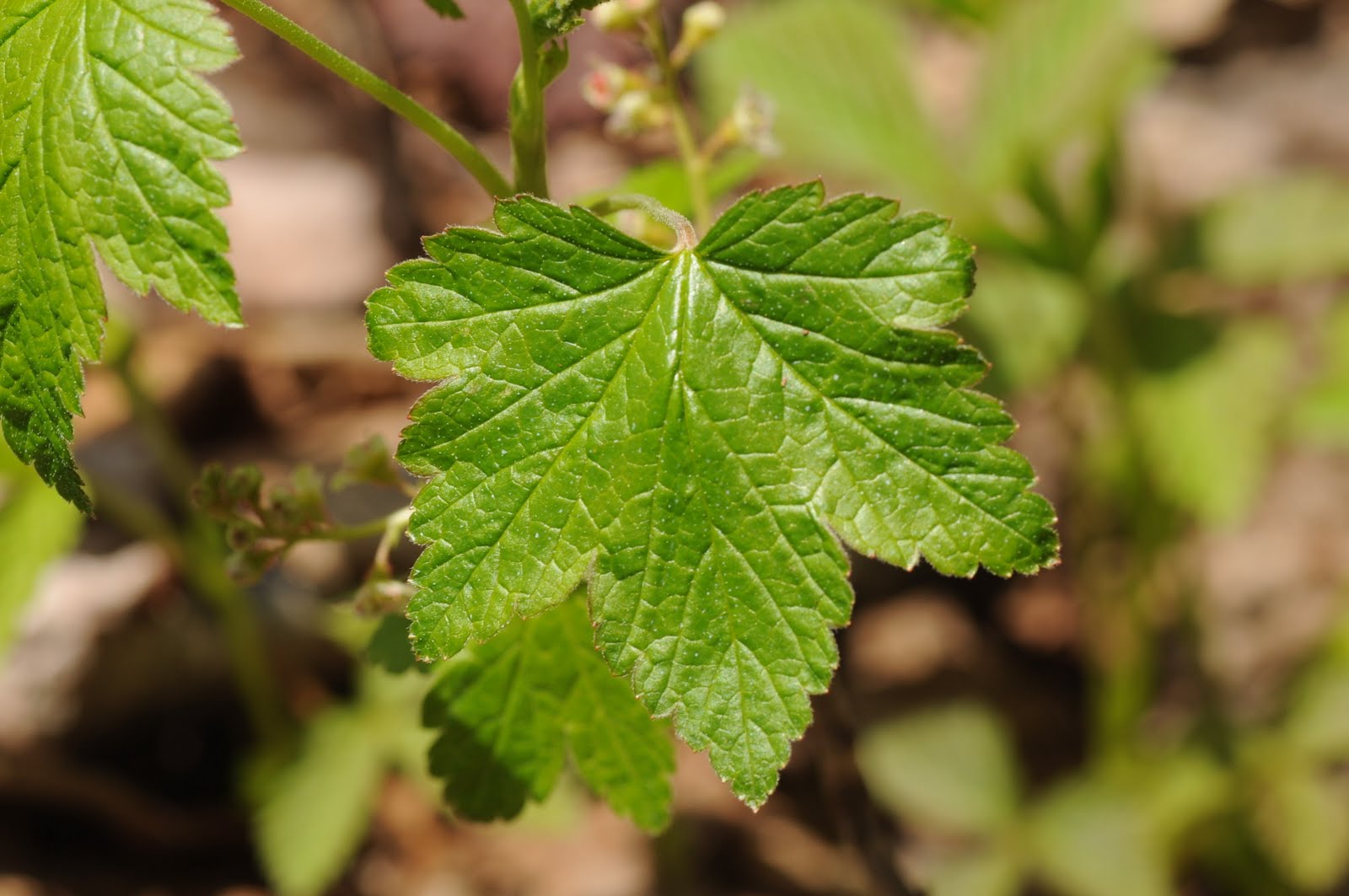
This plant was a new one for me. I had no idea what it was.


The tiny flowers were stunning up close. Note the little red pollen packets,


which are missing in this particular blossom. Keying it out when I got back to the office, I discovered this was skunk current, Ribes glandulosum. Or at least I'm pretty sure it is. If I had crushed part of the plant and sniffed, I'd know for sure, for apparently it smells like its namesake. I'll have to do the scratch and sniff test the next time I'm out there.


And, as mentioned yesterday, the shad have started to bloom. In my book, a blooming shadtree is as nice, if not nicer than, a cherry tree. It's delicate, it's wispy, and just the epitome of springtime beauty.


At first I was confounded by this spike of tiny buds/flowers. After careful consideration and investigation, I finally determined that it was a foamflower not yet in bloom. I imagine in a week or so the flowers will be out.


This was another plant that threw me. As soon as I saw it I knew I must know it, but for the life of me I couldn't remember. Back in the office I tried keying it out - not easily done without the flowers actually blooming. Even my boss took a look and said "I know I know it." I paged through a picture guide to wildflowers and just as I said "duh!", she said "baneberry." Yes, it is red baneberry.


And here is the reason I wanted to go out on the trails today: spring beauty. It is a flower that is so well-named. I've rarely seen it since living up here, so it is a special treat to have it along the Sage Trail.


And right close by the spring beauty, is our other early bloomer: trout lily.

I think the back of the flower is as lovely as the front.

Do you see something hiding behind the petals?


These beetles were all over the trout lilies. Apparently they are false blister beetles, genus Asclera. There are two species in the east and one of these is widespread (according to my Kaufman's Insect Guide). Adults, like this fellow, can be seen on early spring wildflowers, like this trout lily. Update: these are red-necked false blister beetles (Asclera ruficollis). These beetles, like the real blister beetles, produce a protective chemical (cantharidin) that can raise blisters on your skin if you handle them.

This red-eyed fly was another great find. It was hanging out on the skunk current. I'm still trying to get an ID on ths one. Update: While a great photo, this doesn't provide enough information (like a good view of the insect's abdomen) for an ID. Pity. Still, I do like the red eyes and think it's a nifty shot.
And here we have yet another fly, this time visiting a spring beauty. Again, I'm awaiting ID confirmation. Update: The good folks at BugGuide have decided this is a Tachinid fly, of the genus Siphona. My photo just doesn't have enough information to provide a more detailed ID, but I'm happy with what I got.

All-in-all, a great day on the trails!