Tuesday, August 14, 2012

Olden Times

My folks were visiting for a day this weekend, so we took advantage of the break between rain storms Sunday to visit the Waterloo Farm Museum which was having an antique tractor and engine "show."  It was glorious weather to be out at a "fair."


They had a number of old engines there, sputtering and phutting along,either just making noise, running a fan, or pumping water, as seen here. 


They had a gentleman doing flint napping - and for a small fee folks could try to make their own points.  I was very tempted, but in the end just settled for a couple photographs.


The woman with the antique sock-knitting machine was also there - I saw here here last winter when I was out for the Victorian Christmas festival they had.  It was much easier to see the machine in action out in the daylight under a tent, rather than in a small dark room in the house.


It's a fascinating machine, and if she wasn't having to talk to folks who were full of questions about her contraption, she could probably whip up a sock in less than half an hour.  It really does zip right along.


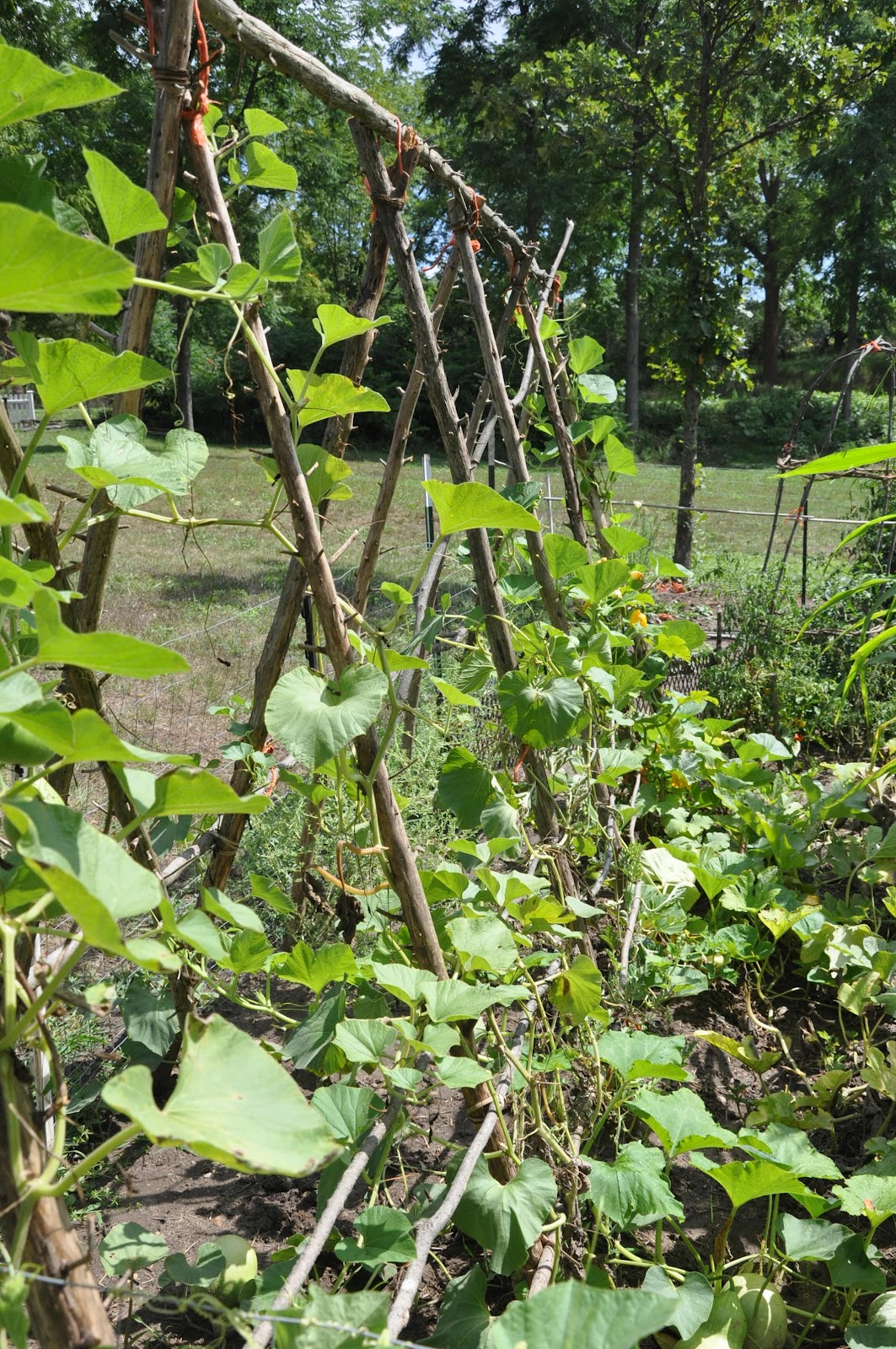
Part of the museum grounds feature a small garden with the "three sisters" growing:  corn, beans and squash.


In this case much of the squash was actually gourds.  I may give gourds a try next year - they seem like fun things to grow.


Sadly, they didn't have as many of the buildings open (like the spring house), and the old cabin, instead of having interpreters inside showing how life was lived back 150 years ago, featured two young boys and their guitars.  Not quite the same thing.


A very popular exhibit was Steve Hopkins and his wood turning machine.


For a very modest fee ($5), Steve would turn a wooden mallet or rolling pin for you.  Of course, I simply had to have one, and dear ol' Dad thought it was proper as well, so he commissioned this mallet with the walnut head.


It took Steve about 15-20 minutes go from a couple blocks of wood to a finished mallet.  Here he's coating a finished mallet with linseed oil.


Et voila. 


I just love the idea of being able to make a tool with what is around in just a short amount of time.  Unlike me...if I need a hammer and I can't find one, I'm inclined to go find a rock to use.  A bit more primitive than turning on a machine and making a mallet from scraps of wood that are lying around, but equally effective.

There were also some pretty neat old tractors on hand, like this steam-engine model.  They fired this one up later in the afternoon, and with a roar and a belch of smelly black smoke, it was up and running.


All in all, it was a very pleasant way to spend part of a day.  Michigan has a rich agricultural history, and it's great to see how things used to be done "in the old days." 

The (local) World Gasps on Relief


Huzzah!

Wednesday, August 1, 2012

Tamed Natives

Along two sides of the veg garden I have planted a variety of native prairie plants.  Things are starting to come into bloom, which, considering the heat and drought, is a small miracle this year.  Last night I took the camera out to capture a few blossoms.

Slightly flattened, either due to wind or the weight of the plant itself, is the hoary vervain.  This (usually) tall, slender plant with its tufts of purple flowers has been blooming for most of July.  You can see how the flower heads have bent upwards now that the plant is lying down.


Both Culver's roots are in bloom.  Normally this prairie native stands over four feet tall.  This summer, thanks to the drought, it finally put out blossoms while still under two feet in height.  I guess it decided to forgo height in  favor of just getting some seeds made.  


The first of the green-headed coneflowers opened this week.


And just a short distance away the purple coneflowers are in full, glorious color.  Like the Culver's roots, these garden perennials are rather short this year.


The rose mallow, which seems to struggle in the garden, has one blossom already blown, and one bud waiting to burst.  


Horsemint has always been a favorite of mine.  The petals are described in Newcomb's as being yellowish with purple spots.  I've seen them with so many spots that the petals seem purple or pink in their own right.  These are definitely tending more toward the "yellowish," with colorful spots being few and far between.


I knew a girl once who told me this plant was called dragon's tears - that's what her mom called it.  So for years, this was dragon's tears to me as well.  Now I know it is actually called obedient plant - a much less dramatic name.  I was also surprised to learn it is a native wildflower - it always struck me as a genuine garden plant - one of those that folks plant because natives are "boring."  Ah...if only they knew!


This gorgeous rose-bud-ish  flower is actually giant St. Johnswort.  I have two of these plants in the garden and this is the first bud I've seen.  I can't wait for it to blossom.  


Liatris is another fairly common garden flower, but I'll bet you've rarely seen one that looks like this!  This is rough blazing star - another member of the Liatris clan, but a native of the harsh, dry prairie.  The buds are only just starting to get some color - should be starting to bloom this weekend I imagine.


And even if this flower never had any more color than it does now, I think it is just beautiful!  However, this is the flower head and it's still only sporting tight buds.  The plant is the giant yellow hyssop, and already it is approaching 3.5 feet in height.  I am looking forward to seeing the flowers.


I planted this perennial because I love the name:  compass plant.  It is supposed to get quite tall, with these large, deeply cut leaves.  The flower, when it finally produces one, is yellow, looking much like the yellow coneflowers, the tickseeds, and the rudbekias that populate the plains.  It's a Silphium, a name which I also like.  This makes it a relative of my beloved cup-plant, which is also native out here and not considered an invasive like it was in NY.  The cup-plant I planted last year is still quite small - no flowers this year, but I'm sure in a couple years it will tower over the garden.  And, just because I love factoids like this, there used to be an enormous Silphium in northern Africa that was THE plant to use for birth control back in the days of the Greeks and the Romans.  It was so popular that it was wiped out - harvested to the point that it could not keep up with demand and today it is extinct.


Meanwhile, the field that is part of my property sports not a single native wildflower (well, no, that's not quite true - there are a few small clusters of milkweed).  I hope to eventually convert it into native plants - when budgeting allows.  As it is, the native bees (and hummingbirds and moths and butterflies) are highly dependent on gardens around here - there's hardly a native flower to be seen for miles around.

Tuesday, July 17, 2012

Word to the Wise

Do not zap dried tinder conks (Fomes fomentarius) for two minutes in the microwave.  If you do, have a bucket of water handy to quench the resulting coal(s).

(The good news is that we now know we need smoke detectors in the building.)

Saturday, July 14, 2012

I give you...the Rattlesnake Master!

At last, my rattlesnake master's flowers have started to open!  I've been waiting for this for a year.  

I had never heard of this plant until I moved here to Michigan.  Around our building at work, staff and volunteers have planted several native flower gardens, and among the plants was rattlesnake master (Eryngium yuccafolium).  Unfortunately, the plant that was planted there not only wasn't thriving, it seemed to have disappeared, but I was hooked.  Anything with a name like "rattlesnake master" must be fascinating.

Last summer I purchased one from WildTypes Native Plant Nursery, and tenderly  planted in front of the house between two spice bushes.  I watered it and nurtured it, but it didn't do a whole lot.  This spring the shoots appeared again, and it grew.  

The leaves, as you might have guessed from the name, resemble those of the yucca - long silver-green triangles with spikes along the edges (ah-ha...it should be deer- and rabbit-proof), but this native tallgrass prairie plant is actually a member of the carrot family, not related to yucca at all.

Flowerheads started to form this summer and I've been waiting and waiting for a blossom to appear - checking the plant every evening when Toby and I go out for our walk.  This week I was rewarded.


Okay, it may not be the showiest of flowers, but you have to admit, it is rather interesting-looking.  It sort of reminds me of buttonbush, a wetland plant that I will never see around my house (no wetlands...and so far this summer no rain, either).

This native plant is hugely beneficial to a whole slew of native insects:  long- and short-tongued bees, wasps, flies, butterflies, skippers, moths, beetles and plant bugs.  It even has it's own associated rare insect:  the rattlesnake borer moth, whose larva burrows into hte stem and feeds on the hpith.  I haven't seen any holes in my specimen, but now I know I should keep an eye peeld, just in case!

Most of these insects are after the flower's nectar, but some bees visit it to also collect pollen, which they stuff into the brood nests they make for their young.

According to various sources, Native Americans used this plant for a variety of ills, usually in the form of a bitter tea.  Early pioneers thought the root could be used to cure rattlesnake bites (they were wrong).  Natives also used the dried seedheads for rattles.

Why the name rattlesnake master?  I suspect it was from an unsubstantiated 18th century account by the trader James Adair that the Indians with whom he traded would chew on the roots, then blow on their hands before attempting to handle rattlesnakes, which they did without sustaining any injuries to themselves.  Adair turns out to be an interesting character in his own right, having traded with the Native American all across the southeastern US for most of the 1700s.  He left the trade to work on his book, which was based on his theory that the Indians were descended from the Lost Tribes of Israel.

ANYWAY...rattlesnake master...a very interesting plant that is quite at home in wet or dry prairies/grasslands, but also does well in open woods.  It's a good plant to have around, the insects will love you, the herbivores will leave it alone, it makes an interesting accent to your garden(s), and it does well here.  What more does one need, eh?  So rip out those non-native yuccas -  despite the lack of rain we do not live in a desert here.  Go forth and plant the plants that belong here.

Friday, July 13, 2012

Cuter than a Baby Raccoon

Another evening walk sans camera.  Will I never learn?

We were headed down the road, Toby and I, when I heard a rustling in the shrubs and trees to our left.  I figured it was a rabbit or woodchuck getting off the road (see them a lot).  But then I saw some branches bobbing up and down.  I stopped, looked, and there precariously balanced on a very thin branch, was a baby opossum!  It was eating some berries that were on the shrub in which it was perched. Further investigation yielded a second baby in the tree next to it.  This sibling was much better hidden.

A baby opossum really is cute as a button.  It's silver white fur contrasts with the black tips on its ears.  The ears and tail are whole - no frostbite yet.  And they don't look all ragged and rough from age (not that 'possums live all that long in the wild, but after a year or two they are a bit scruffy-looking).

All was well, everyone foraging in peace, until Toby also spotted them (probably wondering why I had stopped walking and what I was staring at in the woods).  As you can guess, he started to bark.  The second 'possum immediately dropped from its perch (whether because it was making a hasty departure or because it fainted, I don't know), while the first one just froze.  It kept its beady eyes on us and just sat there for several minutes.

I finally got the dog quieted down, and we watched for quite a while (I'm sure passing cars were wondering what the heck this person crouched on the side of the road staring into the woods was doing).  Finally the little fella decided a departure was in order.  It turned around and headed for the trunk of the shrub.  Toby and followed suit, standing up and continuing our walk.

Did I mention we also saw an indigo bunting and another dragonfly perched in perfect silhouette on an old mullein stalk?  Yep - I should start taking the camera back out on our walks.

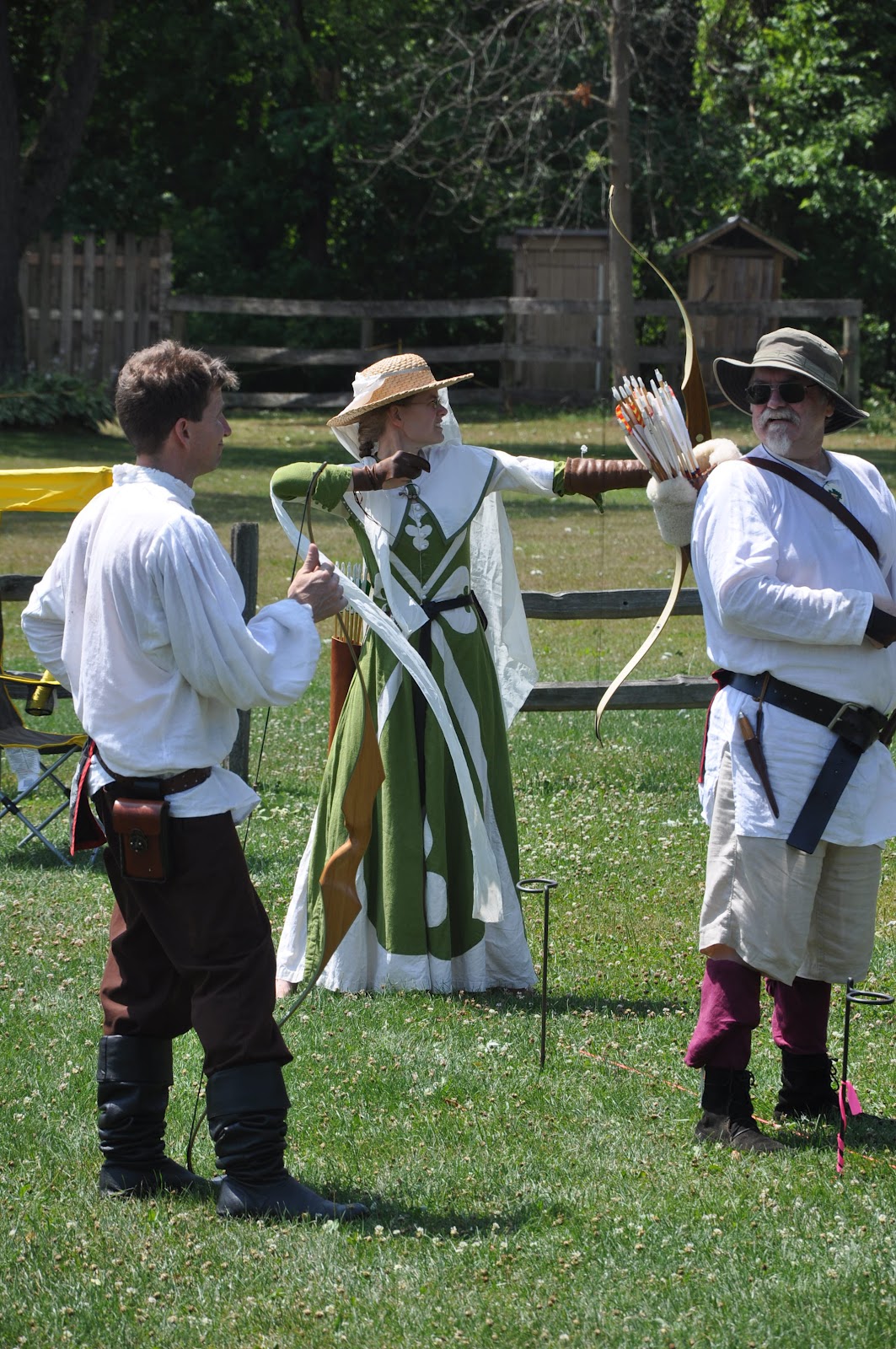
But, just so this isn't a total photoless post, here's a shot of what I did this last weekend, when it was over 100 degrees:


No, that's not me - I'm the one behind the camera.  But I was there, in full SCA garb (sweat literally pouring down my body), trying my hand at archery once more.  It's been nearly 20 years since I was in the SCA, but work (of all things) has gotten me in touch with the local groups, and the fine folks at the Barony of Cynnabar (Ann Arbor) invited me to come play with them.  I'll be off again this Sunday for an archery event with them:  Smurf Shoot.

Friday, July 6, 2012

A Little Bit of Rain

We had a whopping 1/10" of rain yesterday morning - a near flood!  On the way to work the evidence of this precipitation event was clear:  frogs by the dozens were hopping across the road (interestingly all going in the same direction).  Unfortunately, they chose to do this during the morning rush hour - there was no way to avoid them.  :(

Yesterday afternoon a "severe storm warning" was out, and the sky darkened considerably about 4:40.  There were some rumblings of thunder, and suddenly the heavens opened.  I walked out to the car in the downpour, reveling in the wet and the cooler air (it has been around 100*F).  As I drove home, I saw evidence that the rain, which had lasted maybe 10-15 minutes, had blown thru Jackson, headed eastward.  It dumped on Napoleon, but when I got to the ol' homestead, only four miles further east, not a drop had fallen.

I live in a bubble.

The heat and humidity was back on the rise, too.  (Today "they" are predicting a heat index of 110*F.)

When T and I got home from our brief evening walk (too hot and humid to stay out long), I found this lying on the front steps:


It was nearly dead, so I had a photo opportunity.  I put the dog inside and grabbed the camera.  I'd seen this insect before, but couldn't recall ever having identified it.  The red belt around the abdomen and the blue tinge to the wings were quite striking.

This morning I found it in my insect books:  Mydas clavatus, one of the Mydas flies.  Typically a southern and western family of flies, this is the only species in the family that is found in northerly regions, and it is one of the largest flies in general.

Despite its wasp-like appearance, it is harmless to people.  According to Marhsall's Insects - Their Natural History and Diversity, this species is commonly found along the Great Lakes, where it likes to nest in the sandy beaches.  That could explain why it is here - instead of real soil we have sand.

Another nifty note Marshall makes is that little is known about the lives of the adults other than they seem to be nectar feeders (although the larvae prey on beetles).  Could it be that this individual has been visiting my hummingbird feeders (there was one hanging very near where I found it)?

What caught my eye about this particular individual, besides its gigantic size and it's bluish wings, was the white "ring" around the end of the abdomen.  Upon closer examination, I discovered what looked like little seed pearls and small reddish-brown beads stuck to this area.  Could they be parasite eggs and the parasites themselves?


Not knowing the answer, I have sent a copy of this photo off to BugGuide.net to see if any of their folks are in the know. Stay tuned for updates!