Wednesday, April 7, 2010

Close Encounter with a Grouse

I was sitting at my desk putting some finishing touches on an article about fireflies, when I heard a resounding crash from the front of the building. A few seconds later, the front bell dinged, and a couple visitors came it. I figured the crash was them banging around out front. Then a man came in, rather flustered.

"Is there a ranger here?"

"You've got me," I said. "What can I do?"

"There's a bird out here. It hit the building and is injured. Can you come save it?"

We went right out. There, lying among the rocks bordering the hummingbird garden, was a ruffed grouse, and it had expired. The man was greatly saddened. As I lifted the bird, we could see its neck had been broken from its impact with the immoveable wall. A little blood glistened on its beak. I told him we'd put it in the freezer and see if anyone wanted it for a taxidermy specimen.

After they left, I took the bird back outside to get some photographs, for after all, how often does one get to see a ruffed grouse up this close?


The coloration on the neck feathers was stunning. This is where the ruff is located. When in full display, the male erects these feathers, making it look like it has a feathery version of an Elisabethan ruff around its neck. The chicks apparently find this very attractive.

When relaxed, the tail isn't much to brag about...


...but when it's fully displayed, it is a beautiful appendage.


I was surprised at the lack of coloration on the wings, though. When folded against the body, only the uppermost part is visible, and it shares the cryptic coloration of the rest of the body.


The head is topped with a small crest. Like many birds with similar decorations, these feathers are raised when the bird is excited.


I've mentioned in the past how grouse grow special scales on the sides of their toes that enable them to navigate a little better in deep snow.


Here's a close-up of the toes and those wonderful scales:


How beautiful is this? The colors are so perfectly suited for its environment, that when I went out to retrieve it, it took a few moments for me to actually see the bird, even though I was looking right at it.


Obviously, this was a tragedy for this bird, but at least it gave us an opportunity to see a grouse up close and admire it's beauty and adaptations.

Tuesday, April 6, 2010

More Insects of Early Spring

After spending a couple hours weeding four more beds of the veg garden on Sunday, I grabbed the camera and headed for the willow shrub, which was just swirling with insects. By now, thanks to three days of temps in the 80s, most of the catkins were "open" and the insects were in buggy heaven.

This little yellow dude was one of the first to catch my eye. I think it is a fly of some sort, but again, I have an ID request in at BugGuide. Will keep you posted. Update: Ken Wolgemuth at BugGuide suggested Scathophaga sp., so I looked it up in Kaufman's and found Scathophaga stercoraria, which seems like a pretty good match. This is a dung fly, which prompts the question "so why is it on the willow?". Well, it turns out that as adults, dung flies are predators; it's the larvae that feed on animal droppings. So, this adult was probably scoping out the scene for tasty morsels that were so focused on finding their own food that they weren't watching for predators. Still, it certainly looks like this one is snacking on the catkin. According to Stephen Marshall's Insects, this is also called the Pilose Yellow Dung Fly, and it usually breeds in fresh ungulate (eg: cattle) dung, where the male is known to guard the female while she lays her eggs.


I was watching the larger of this pair, contemplating whether to take a photo of it or not, when the smaller one flew it and latched on. Turns out, the big one is female and the male decided it was his job to sire her offspring. His front legs were scrabbling the entire time, while his abdomen pumped away. I took some video footage of it, but I'm having a difficult time trying to load videos on this post. It's probably just as well, because between the wind blowing the branches and my legs shaking (I was kneeling upright - not a stable position), the video needs to warn viewers to take dramamine before watching.


This enormous, and rather fierce-looking, fly came in and dominated the scene a bit. Isn't it the most bristley thing you've seen?


Here it is again, this time as seen from behind. I figure that white butt has got to be diagnostic. We'll see what BugGuide has to say. Update: Andy Calderwood over at BugGuide says it is a Tachinid fly of the genus Epalpus - the white patch diagnostic, as I suspected. Looking up Epalpus in my Kaufman's field guide, I see E. signifer as the illustrated specimen. This fly has a whitish face and thorax, which you can sort of make out in the first photo. According to the field guide, there are three species of Epalpus found in North America (the other two species are not found in the East). It's a parasitoid, laying its eggs on the caterpillars of a species of owlet moth. Reading up on this fly in my new weighty tome Insects, Their Natural History and Diversity, the very first sentence reads "We are surrounded by killer flies." The family Tachinidae is made up almost entirely of parasitoids. AND, just in case you are wondering, a parasitoid kills its host, where as a parasite does not. Anyway, the whole page about Tachinids is fascinating and gruesome. I won't violate copyrights by typing it up here, but if you really want to know some of the reproductive strategies of these flies, you'll want to find a copy of this book and turn to page 408. I don't recommend it as late night reading.


I checked out the black pussy willow, too, to see if anyone besides the flies were visiting. This small wasp was having a busy time getting a meal.


The daphne are all is full bloom. Amazingly, it is only this year that I've noticed how cloyingly sweet their scent is. It's got a kind of soapy quality about it. Ick. Still, up close the flowers are rather attractive.


Zipping about the stem of the daphne was this sweet little jumping spider. It was so fast that every time it jumped, it reminded me of Jeannie in "I Dream of Jeannie" - a blink of the eyes and she vanished from here and reappeared there. Update: this is probably the zebra jumping spider (Salticus scenicus). Jumping spiders are delightful creatures. See those big black eyes? They have fantastic vision and will actually look up at you and watch you. The males are noted for their elaborate courtship dances - make the most of that good vision, eh? And when it comes to jumping, well, these guys can out-distance even our best long-jumpers, for they can jump up to 50 times their body length! Let's see, for me that would be something like 275 feet. But they've got rather scrawny legs, so how is that possible? They use a system kind of like hydrolics. Quick contractions of the muscles in the front of the body cause an increase in blood pressure, which in turn makes the legs extend rapidly. Zooooommm! Blink and it is gone!


The place was hopping down at the vernal pool Sunday evening as Toby and I strolled by. Spring peepers and woodfrogs alike were busily singing their hearts out. I tried to get photos, I tried to call in the woodfrogs, but my efforts usually resulted in silence. So we finished our trip to the river and on the way back I gave the pond one more try. This time I just shot some video. Most of the action is behind the grasses (you can see the water roiling a bit), but at the beginning you can just make out a couple frogs as they bob near the surface. The high-pitched peeps are the peepers, and the quacking sounds are the wood frogs.


And here's what all the fuss was about - eggs!


Our final find of the evening was this bizarre-looking thing. It's like someone crossed a caddisfly larva with a pangolin. It was creeping across the road, tucking its little tush underneath as it moved, much like a crayfish does. The head, stretched out here, was moving back and forth, sometimes extended way out, other times pulled back in under its protective armor. I collected it in a vial and brought it to work today, where my boss immediately said "OH! A firefly larva!" Well, who knew!


These guys are out at night hunting for things like snails. Like their parents, the larvae have glow-in-the-dark capabilities, but it was still light enough that this fellow wasn't lit up. You will be happy to know that he's been released back into the woods.

Saturday, April 3, 2010

One More Thing

I keep adding more and more things to the previous post (like last night's frog findings), but since folks have started reading it already, I decided I'd better start a new post so they don't miss anything, like these coltsfoot flowers, which just opened today!

First Flowers & Their Friends

Would you believe we hit 80*F yesterday! In the Central Adirondacks! In Early April! Unheard of. Must be a new record.

The plants and insects are enjoying it, though. Mr. Mike reported coltsfoot in bloom at his barn, and he also saw "an orange butterfly with black spots." One of the punctuation butterflies? A Compton's tortoiseshell? I don't know.

Back at my house, though, I discovered the following signs of life:

Daphne, opening in profusion.


The giant pussy willow had three or four catkins "open"
(pollen now available), and they were drawing in the bees.


This was the giant among the hungry feeders. I think it is a type of mining bee, but I'm waiting for confirmation from BugGuide. Update: The experts say this is Adrena frigida, one of the mining bees. There are about 1200 of these solitary bees in North America. They burrow in the soil. I watched a nesting aggregation of these bees last spring, but never got any photos of them. Maybe this year.

This trio were all quite focused on the pollen and ignoring each other
as well as me. Update: the big one in the middle is another species of Adrena, but the Bugnet folks couldn't give me more than that. How different it looks from the fuzzy Adrena in the previous photo. The other two are the same species as the one in the next photo.


Here's one of the trio (and there were a lot of these - probably the dominant bee at this shrub). I think it is a species of sweat bee, but again, I'm waiting to hear from BugGuide. Update: and the experts say this is a male Nomada bella. Nomada are cleptoparasites of digger bees, specifically those in the families Andrenidae and Halictidae. Their larvae, which are laid in the bees' burrows, eat the pollen and nectar that have been put aside for the digger bees' offspring. Sometimes they kill the host larvae, too. As adults, Nomada look a lot like wasps.


The second species of the trio. I have no idea what kind it is...BugGuide is on standby. Update: Adrena sp., as noted two photos up.

Meanwhile, over at the black pussy willow, the only visitors to its catkins were flies. Hm...I wonder what that means?


Idefix was enjoying his time outside.
This is one of the few photographs I've taken of him
where he doesn't look pissed off at the world!


And there, in the "field" (the unmowed portion of my yard),
two crocuses (crocii?) had raised their cheery heads.


And then, to top it all off, last night, as Toby and I were walking the golf course, I heard them: the first frogs. First, it was a lone peeper, who, after two peeps clammed up. But then we came around a bend in the trail and in front of us a pocket wetland was full of woodfrog songs! As we approached, a chorus of coyotes started calling from the woods. Toby, of course, had to respond, which promptly made the woodfrogs close their mouths and submerge.


I perched on a rock and tried "quacking" to entice the frogs back, but after several minutes nothing happened. The rock was becoming uncomfortable, and Toby was eager to move on, so we left the frogs to themselves. Maybe I'll try again tonight.

And then, the cap it all off, we heard the first peents of the woodcocks, followed by their twittering flights.


Note: the spring peepers are about 20 days earlier than usual, and the wood frogs 10-20 days earlier.

Friday, April 2, 2010

At Last!

Thar she is! Isn't she beautiful?!?!


I rushed right out to the hazelnuts when I got home and peered at every little bud. And there, so tiny they are easy to miss, I saw my first female hazelnut flowers!
And I do mean tiny. These buds are maybe 3mm long. In their entirety!


I have four hazelnut bushes. One is a robust specimen, one rather small, and two that look like collections of dead sticks. The first has had catkins for three or so years, so I was really hoping to get nuts this year. I was surprised to find female flowers on the second as well, since it is so much smaller, but it produced catkins last fall, so I guess it felt like it was ready.


It is my understanding that hazelnuts are wind pollinated (a no-brainer) and do not pollinate themselves. So, perhaps #1 shrub has had female flowers in the past, but because there were no other male flowers nearby but its own, they were never fertilized. So here's hoping that #2 shrub, despite its runty size, will do its thing and maybe, just maybe, I'll have nuts this year...if I'm still here to enjoy them.

OH, and the daphne is ready to burst into bloom, too - will probably see flowers before the week is out.


Thursday, April 1, 2010

Spring Tidings from the Rich Lake Trail

It was in the '70s by afternoon, so I had to go out and walk a trail. I wanted to see if we had any signs of spring flowers yet (I know, I know...it's only April 1st, but hope springs eternal). Didn't find any, but I did find some nice things.


The elderberry by the birdfeeders is getting ready to burst.


All along the lake shore the ice is melting. I stared and stared at the open water in hopes of finding a defrosted newt or frog swimming about, but nada.

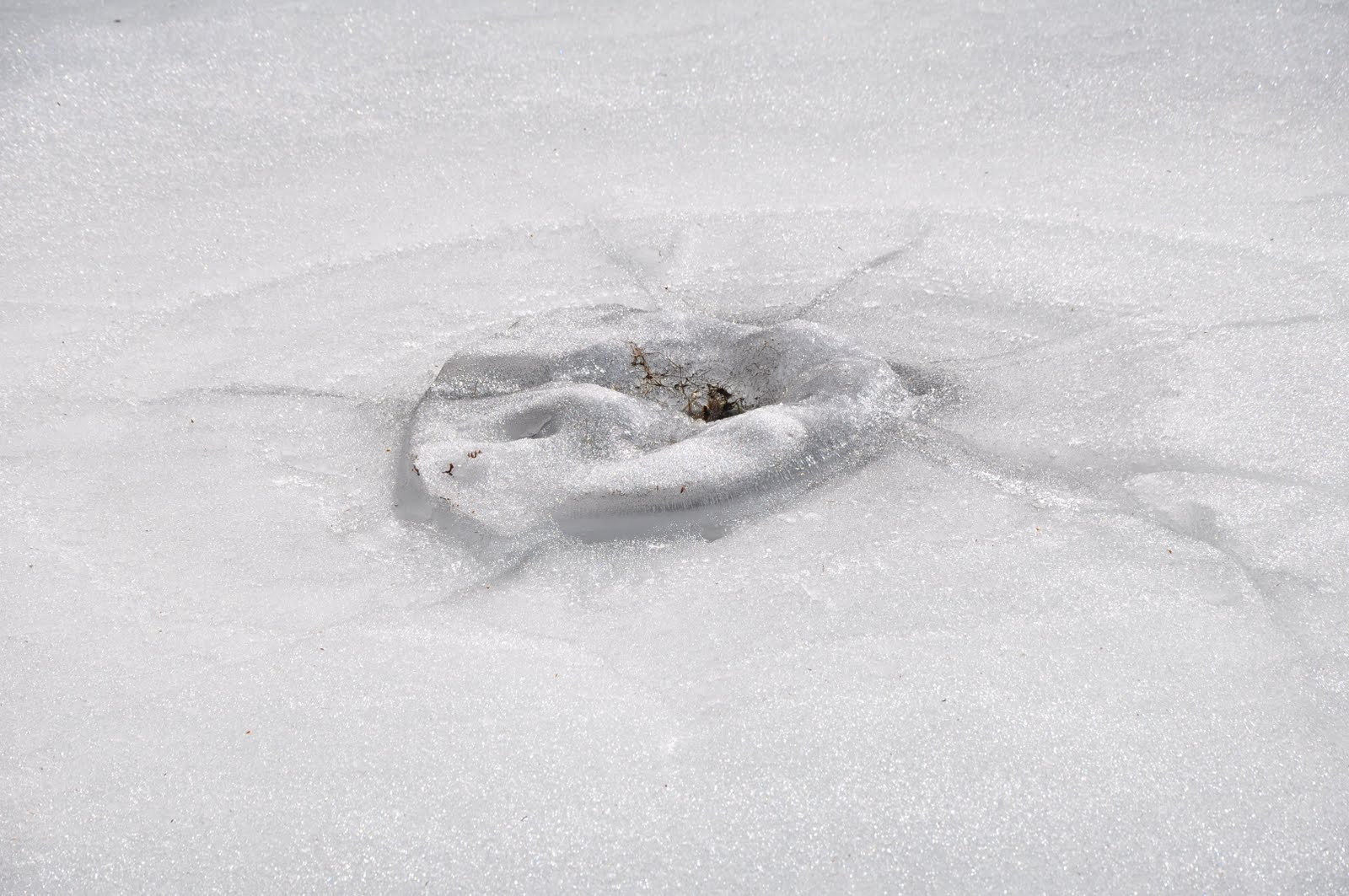
There was this interesting blemish on the ice:


Zooming in, it looks like the ice heaved around a branch or stump that is mostly submerged. I'll have to watch as the ice melts to get a confirmation on the cause.


I love this twisted bit of old cedar. It's the closest we get to drift wood.


The ol' glacial erratic came through the winter just fine...what rock wouldn't?


The far side is covered with all sorts of moss and lichens, like these enormous rock tripes (Umbilicaria mammulata). Right now they are greenish-grey and very pliable.


Towards the end of the walk, I came across this lovely scat nestled in some ice. I believe it is from a mink. Note the folded back and forth structure - like toothpaste from a tube.


And finally, this terrific artist's conk (Ganoderma applanatum) that grew partially inside a woodpecker's food hole:


Now I'll go home and see what's happening in the yard - the daphne in bloom? How about the hazelnuts? Can't wait to see who's enjoying the sun!


Waterfalls Large and Small

What a GLORIOUS day today is turning out to be! When I got up, the fog was settling in nicely. I had to drive out to North Hudson to meet my Bluebird Society County Coordinator to pick up bluebird nestboxes for this weekend's workshop (Saturday, 3 April, 1:00 PM - come on out), so I took my camera with me, just to make sure no moose stepped out of the fog and into the Jeep. It worked - no moose.

But moose aren't everything. Today's star turned out to be waterfalls.

First, I was treated to these these splendid twin waterfalls that were tumbling merrily down the rock outcroppings. I was driving eastward on the Blue Ridge Road, and they were to my left, just beyond the bison farm.

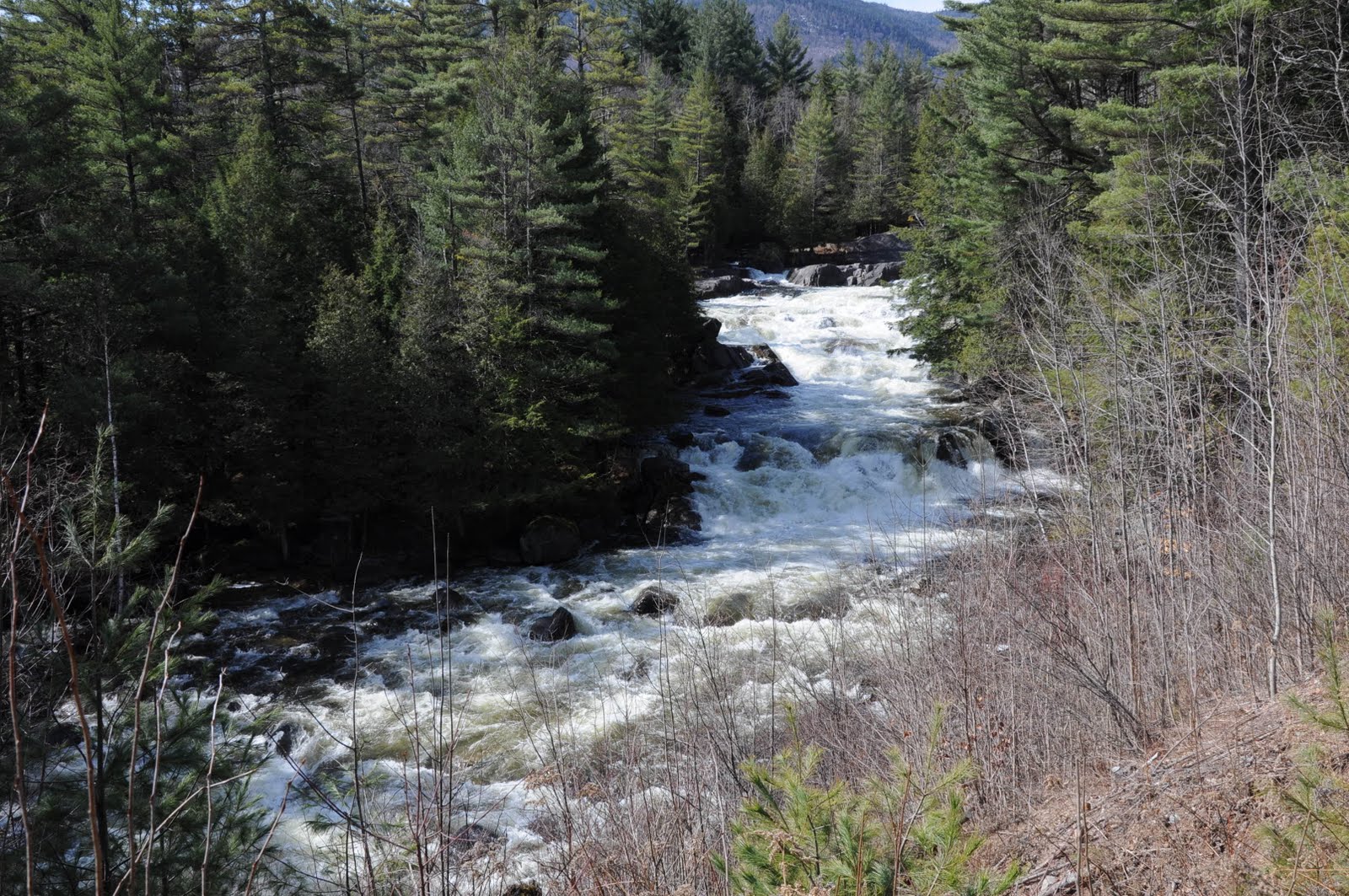
After picking up my nestboxes, I knew I had to stop and check out Schroon Falls as I headed back to the office.

If one is headed westward on the Blue Ridge Road, and if one is looking to one's left just as one drives past the Blue Ridge Campground, one will see a pull-off next to the guardrail, and way down below one will see Schroon Falls. (It's harder to see it if you are driving eastward.)

With the winter run-off and spring rains, the water is flowing very nicely right now.


And while it was oh-so-beautiful to look it, it was tough as the dickens to photograph. The sunlight was just too bright, so if I exposed for the brilliant water, everything else was black as pitch. If I exposed for the trees and rocks, the water was a glare of white. The Happy Medium was not putting in an appearance at the Falls today.

There's a footpath that runs upstream from the "parking area," which I've never taken before. Since it was such a beautiful day, and I had the camera with me, I decided to see how close I could get to the falls without killing myself.

The answer is right down to the water's edge!

There are lots of water-worn boulders along the edge that were high and dry today, so I could get pretty darn close. In fact, I could've dipped my toes in the rushing water if I'd had a mind to. I didn't...I'm smarter than that.


I really wanted to catch some of the sprays as the water pounded downstream and slammed into the rocks. Mostly I was unsuccessful, but even so, one can still feel the power of the river.


Here's a glance down-river:


Something about the sunlight, the water, and probably the geology, made this one swell of water an amazing bottle green.


I took about 900 shots of this rock with the water splashing up against it, trying to get ONE that captured the action and feel of it.


I think the monochrome shows the drama best.

Lots of summer folks stop by the VIC and ask for directions to waterfalls. If the summer is dry, even our most spectacular waterfalls can be rather non-descript. But if you come in the spring, you can almost be guaranteed a good show at Schroon Falls, and also at Buttermilk Falls over in Long Lake. These are the two waterfalls closest to Newcomb that are easily accessed by vehicle, and well-worth the show.