Thursday, March 17, 2011

It's So Close You Can Smell It

"It," of course, is Spring.

I know, I know...I keep saying that, and then it snows.  But today we snuck up really close to 70*F!  At 8 PM it was still 66*F.  Sure seems like spring to me, so let's take a look at the evidence.

One:  chipmunks on the move at the bird feeders.


Two:  ponds thawing.


Three:  things that were buried under the snow are now visible. Such as,  deceased deer...


...vole tunnels...


...and that wefty white mold?  fungus? that lurks beneath the snowbanks.


To take advantage of the balmy evening, Toby and I headed over to the Falling Waters Trail.  We weren't alone.  Older couples and good friends were out walking the trail for exercise.  A cyclist or two whizzed by.  We were even passed by a rollerblader.

The sides of the trails just beckoned, especially the ponds.  One of the naturalists at work told me today that she heard her first chorus frog of the year today, so I had to stake out the ponds for frogs (number four).


Ah-ha!  It was time to make a recording.  Now, I'm not going to win any oscars for my filming talent, so just close your eyes and listen.  Almost all the sounds of spring are there:  red-winged blackbirds, starlings, robins, and chorus frogs.  The frogs sound like the sound you get when you run your thumb nail down the teeth of a stiff plastic comb.  I haven't heard a chorus frog since I worked in New Jersey!  And later on, when it was nearly dark, I even heard a few spring peepers in the woods.


Wetlands abound in southern Michigan.  I can only try to imagine what spring was like three hundred or more years ago in this part of the state.  The cacophony of birdsongs must've been something to behold.  Even today, when mere remnants remain, the waterfowl and other birds still seek them out.  Ducks, geese, cranes...red-wings, woodcocks (I heard them tonight, too), killdeer...the air was full of songs (number five).


Much of the soil here seems quite sandy, which is perfect for turtles looking to lay their eggs.  Sadly, most turtle nests are predated by raccoons and foxes.  If they are lucky, each turtle has one egg make it to adulthood during a lifetime of egg laying.


The find of the evening, however, was a dark form that fluttered overhead as we reached the end of the trail, heading home.  At first I thought it was a woodcock sweeping in to land.  But then I saw it...a bat (number six)!  A good-sized bat with broad wings.  Best guess is a big brown bat.  And then, even better, two more bats flew over.  A few minutes later, I saw two more! 

Bats are doing much better here in Michigan than they are back east.  So far, it seems that White-nose Syndrome isn't here.  I'm sure it is only a matter of time, so I'm going to enjoy seeing bats again for as long as it lasts.

Saturday, March 12, 2011

On Snakes and Shedding

Hooray for Herps!  Here's just one more reason why I love snakes:  they shed!


This is our little garter snake, brought in this winter from someone's basement.  We've kept it in an aquarium tank, filled with bark chips, a little log to hide under, and a small "pool" to swim in.  A couple weeks ago one of our staff thought the snake's eye looked cloudy - a sure sign that it was going to shed its skin.

A couple days later, the eyes were clear and that was that.  Hm.

Then, one of the naturalists saw the snake swimming in its pool.  Now, sometimes it will go for a dip to catch one of the tiny fish we put in the water - even snakes have to eat.  And when one eats, one grows.  Unlike people, snakes' skins do not stretch as they grow, so they must be shed.

Sure enough, the shed had started.  I shot the above photo last week - the molt had started.  But here we are a week later and it has progressed no further.  HM.  What could be the cause?  We evaluated our choices.  One - reptiles often need a certain amount of humidity in order to shed.  When conditions are just right, they will shed their skins in one whole piece, like this lovely carpet python skin I have from my days working at a zoo:


This could be why the little fellow was swimming in the pool - trying to moisten the skin enough to come off.

Two - perhaps the bark chips in the tank are too lightweight to give the snake something rough to brush against.   This is the second thing snakes need to successfully rid themselves of their old skins:  rough surfaces to scrape along.  These surfaces grab the skin and help peel it off.

One of the things I love about snake skins is that they are shed inside out.  If all goes well, the snake loosens the skin first around the mouth.  Then it rubs it off, peeling it off like you would a sock.  The shed skin will look like the ghost of its previous owner.  And not only does the skin show every single scale that makes up the snake's outer covering, it also shows the scales that are over the eyes:


Amazing! 

It's a shame so many people dislike snakes; they are fascinating creatures on so many levels!  They move without feet!  They CLIMB without limbs!  They smell the air with their tongues, and they "hear" with their jaws (they don't have ears - they feel vibrations with their jaw bones)!  They can unhinge their lower jaws from the upper to more easily fit their mouths around prey - and if that wasn't cool enough, the two sides of the lower jaws can also stretch apart in the front (think "chin") to further accommodate large food.  They can go weeks without food.  Some lay eggs; some give birth to live young.  They are soft to the touch, and make great accessories (I'm thinking while alive, not as skins that are converted into handbags, belts and shoes).  And to top it all off, they are terribly important at keeping things like mice under control.

So, the next time you see a snake, instead of trying to beat it to death, consider it in all its glory and send it your thanks for helping to keep our world in balance.

Chippie TV

It was the end of a long day at work, so I passed the final minutes before we locked up gazing out The Window to see what was happening.

Something new had been added to the feeding station:  peanuts!

Now, normally, peanuts would be snarfed up faster than you could say "wha...?", but it seems that the birds and the fox squirrels needed a clue.

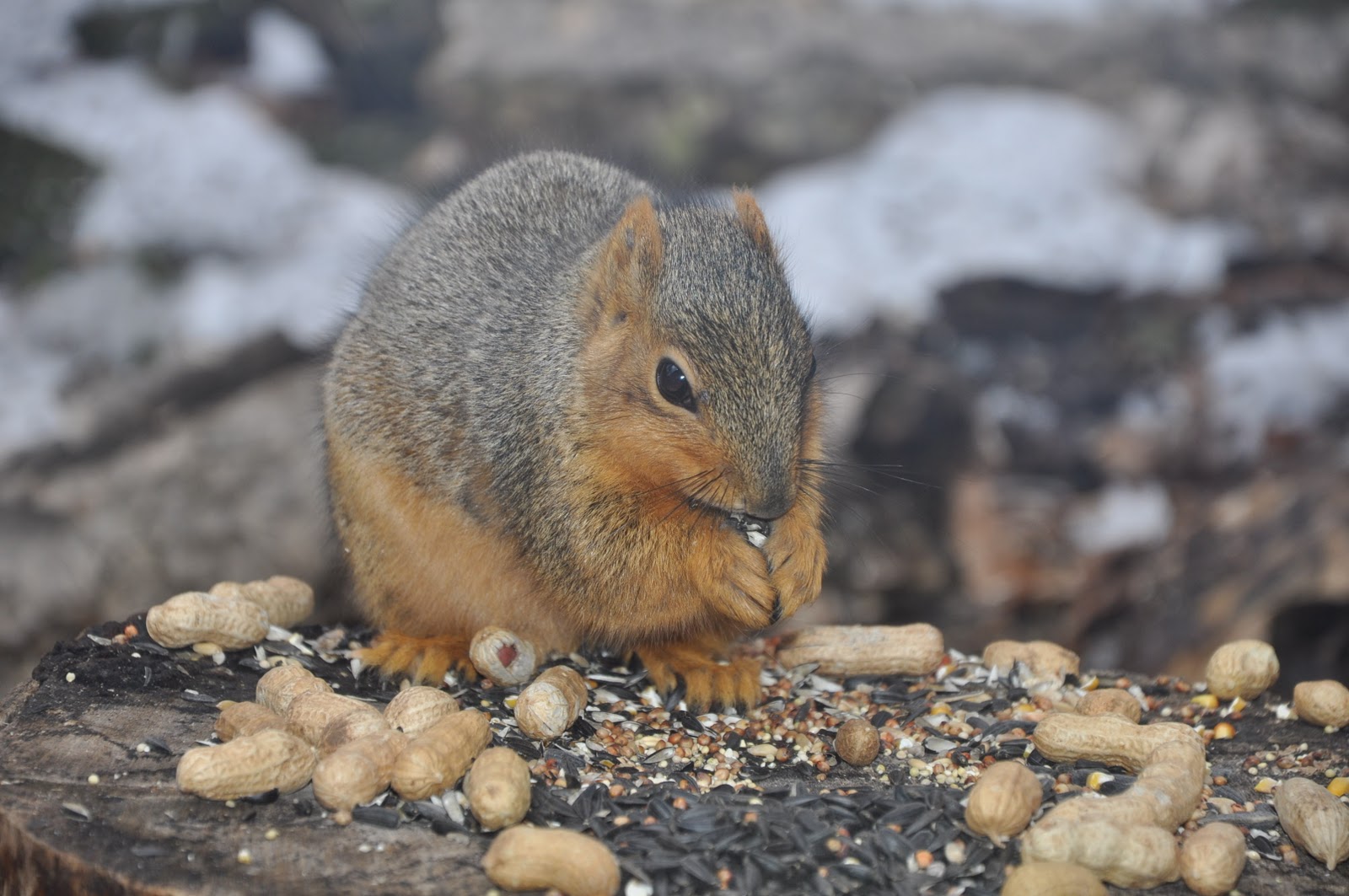
As you can see below, Pudgy the Squirrel sat among the peanuts completely oblivious to the manna from heaven that littered the stump at his feet.  (These two photos, by the way, are not enlarged - that's how close I was to the squirrel - less than three feet.  Gotta luv The Window!)


Num, num, num - sunflower seeds were what occupied his attention.  Silly squirrel!


But wait!  Who is that down on the ground?  Someone else has discovered the peanuts!


Hang on...did you see something strange about that chipmunk?  Maybe he'll come back.  Yes, indeed, there he is by the bird bath.  Let's wait and see if he comes closer.


Sure enough!  Look!  It is the rare and elusive white-tailed chipmunk (Tamisciurus odocoileus)!  What a find!  The long white hairs on this animal's tail remind me of the flowing white fur found on the backs and tails of colobus monkeys.


Tufty the Chipmunk stops for a sip at the local bar - slurping up water as it oozes through the moss and down the side of the rock.


Oops!  Caught in the act!


Once Tufty discovered the peanuts, though, nothing was going to keep him from mining this claim until all the treasure was safely stored back home...even if it had to be done one peanut at a time.


Well...one thing will keep him from his goal.  Pudgy the Fox Squirrel returned and staked his own claim on the stump.  Poor Tufty - every time he sallied forth to scale the stump and snag another peanut to spirit away to his cache, Pudgy would lunge, sending Tufty flying off the stump and dashing for cover.


Maybe eventually Pudgy will discover the treasure that Tufty so sought.  We'll see how many peanuts remain tomorrow.


******

Meanwhile, the skies are filled with sandhill cranes, mute swans, bluebirds, robins, tufted titmice, cardinals, robins, red-bellied woodpeckers - all singing their springtime songs.  The lakes, ponds, streams and fens are all starting to melt.  Vernal pools are forming in the woods during the day, only to refreeze at night.  We are just over a week away from the equinox.  Huzzah!

Wednesday, March 9, 2011

So Many Books, So Little Time

Because of requests, I'm sharing with you some of the books I purchased this weekend at the Wildflower Conference.

As I've stated before, I am an unabashed bibliophile.  New books, old books...I love 'em all.  Many (if not most) of my books are of an outdoor subject:  natural history, gardening, etc.  So, as you can imagine, books for sale at a plant conference are to me like red is to hummingbirds - I can't resist and must zoom in for a closer look!

Here are the six that came home with me. 

First up, in the Gardening and Landscaping category, we have Landscaping with Native Plants of Michigan (it's all about going native these days), Energy-wise Landscape Design (how to make your house more energy efficient with the proper landscape around your abode), and The Climate Conscious Gardener (the editor of which was one of our keynote speakers - very good).


Then, in the Natural History category, we have The Michigan Roadside Naturalist (to aid me in my explorations this summer), A Guide to Wildflowers in Winter (I have Weeds in Winter, but this looked like a good supplement to that), and the one that I think will become my favorite of this batch:  Attracting Native Pollinators.


Now, I should explain that I'm loving this book not so much because it is how to plant gardens (et al) to attract butterflies and bees, but because it has superb photographs of our native bees and terrific descriptions of them and their habits.


This is a terrific thing because a) honey bees, while important to our crops, are not native, b) honey bee populations are in a downward spiral, c) there are lots of native bees that are also very important pollinators, and d) their populations are not doing well, either, mostly because we have supplanted their preferred food sources (native plants) with horticultural varieties, non-native ornamentals, agricultural products that are genetically modified to kill insects or to not need insects for pollination, and the ever-increasing conversion of native habitats to monocultures of lawns and concrete.  Therefore, it behooves us to not only learn about our native bees, but also how to encourage their proliferation and their presence in our lives.

And this comes from someone who grew up petrified of bees.  Bees are important; native bees are even more so.  Get to know them.  Get to know how to help them.

Monday, March 7, 2011

Wildflower Association of Michigan

I spent the last two days up in Lansing, attending the Wildflower Conference put on by the Wildflower Association of Michigan (WAM). Despite 8-9 hours of straight sitting (oh, my poor aching bum), it was a very worthwhile conference.

I attended sessions about the life in soil (I always knew soil was special and full of life, but this really put it all in perspective - I'll never look at soil the same way again), the No Child Left Inside initiative, the effects of climate change on plant communities, how to manage (or remove) autumn olive from the landscape, et al.

And of course, there were the books. >sigh< Can one every really have too many books? If so, then I have yet to reach that limit. Added six more books to my collection.

I left the conference renewed, looking forward with bated breath to spring, true spring, and the bursting forth of the flowers of Michigan (and Ohio, for I've heard of this wonderful forest in northern OH that is a must for plant nuts like me).

Come on, Spring!

Thursday, March 3, 2011

Views from the Sugar Bush


We may have started the day in the double digits, but the wind was blowing cold when our first school group arrived for the 2011 sugaring season.


Most of this group was kids from France.  Teaching maple sugaring to teens who don't have a lot of English can be a challenge, even with interpreters on hand.  But our wonderful crew of volunteers sallied forth undeterred, giving these kids the benefits of their knowledge about this wholly American subject.


Trying on the yoke quickly became a hit, and many of the kids wanted to give it a try...even if they didn't completely understand what it was all about.


Although it was balmy and mild when we tapped the trees, every day since it has been quite cold.  So cold, in fact, that not only was the water in the buckets frozen, but so was the sap.  We scraped up some of the ice for the kids to taste - sort of like a sweet slushy eaten with fingers.


The bags were bulging with the weight of ice.  Fortunately, the bags are made from some pretty tough plastic, so they can take the stress.


In all the years I've done sugaring, this is the first time I've ever seen anyone plug the tapping holes after the season ends.  They use short lengths of wooden dowels, just long enough to fill the hole.  The tree then grows around them and seals them in.  Interesting.


We were all quite glad to reach the sugar shack itself.  Although the sun is shining, the wind and air were bitingly cold.


And here is why the shack was the place to be:  they'd chopped wood and built a fire for the evaporator.


We'd only actually collected about eight gallons of sap by now, so there wasn't a whole lot in the evaporator.  Here John demonstrates one of the ways the sap is tested for "doneness."


Everyone got a squirt of syrup (made last year) to taste.  Most of these kids have never had the real thing - maple sugar and syrup are not products of France.


Here are a couple views at the sugar shack:

 Syrup samples


 Sugar-steamed spider webs

After the group left, lunch time found us once more ensconced at The Window, watching a fox squirrel this time around.

 Making sure the coast is clear.


Constant vigilance!


 Never let your guard down!


And always check the window in case you can beg some more food.

Wednesday, March 2, 2011

Squirrel TV

Back at The Window for lunch today, we were entertained by the squirrels.

First up, a chipmunk peeking out of a woodpecker hole:


 But wait!  Who's that above him giving us two squirrels for the price of one?


It's a red squirrel snacking on a pine cone!


Two more chippies were running round and round on the rock pile (part of the water feature).  There's a hole in the side of this pile of snow - home sweet home.  Perhaps this pair will move in together.  Spring is definitely in the air.


The best part, though, was this:


Wheeee!  I captured the red squirrel mid-leap from the broken branch to the feeder - a common occurrence here.  I've been wanting to get this shot for weeks. It cracks me up every time.