Tuesday, December 6, 2011

A Step Back in Time

Sunday dawned chilly, grey and rainy.  Bleh.  But I wasn't about to let this keep me in.  I called my friend Carrie and off we went to the Waterloo Farm Museum to see what they had to offer for their 1880s Christmas Celebration Weekend.


It took some hunting along the backroads around Waterloo to find the place, but find it we did.  As you can see, things were a bit wet and muddy.


The fence was decorated for the season, and after we stepped into the barn, paid our $5 fee, and grabbed a homemade cookie and some cider, we went exploring.


Most of the buildings here are small.  One was the gift shop, and another had wreathes and swags for sale.  The rest, however, were set up to demonstrate their original uses.


For example, this was the bake house!  What a wonderful oven, and along the sides were shelves where no doubt various grains were kept and loaves were set to cool.


Carrie moved some props around so I could get a nice photo.


Ta-da!


The floor housed an old grind stone.  We pondered on this for a while.  Why was it put here?  Was this stone removed because it was worn out and subsequently installed here as a decorative floor?  Had the original mill gone automatic? We didn't find an answer.


We were equally fascinated by the roof of the bake house.


What a wonderful collection of mosses and lichens!


One of the buildings was the original farm cabin.  Inside they had three volunteers on hand to do some interpreting.


A toasty fire was crackling away and the lady of the house was cooking up some lunch.


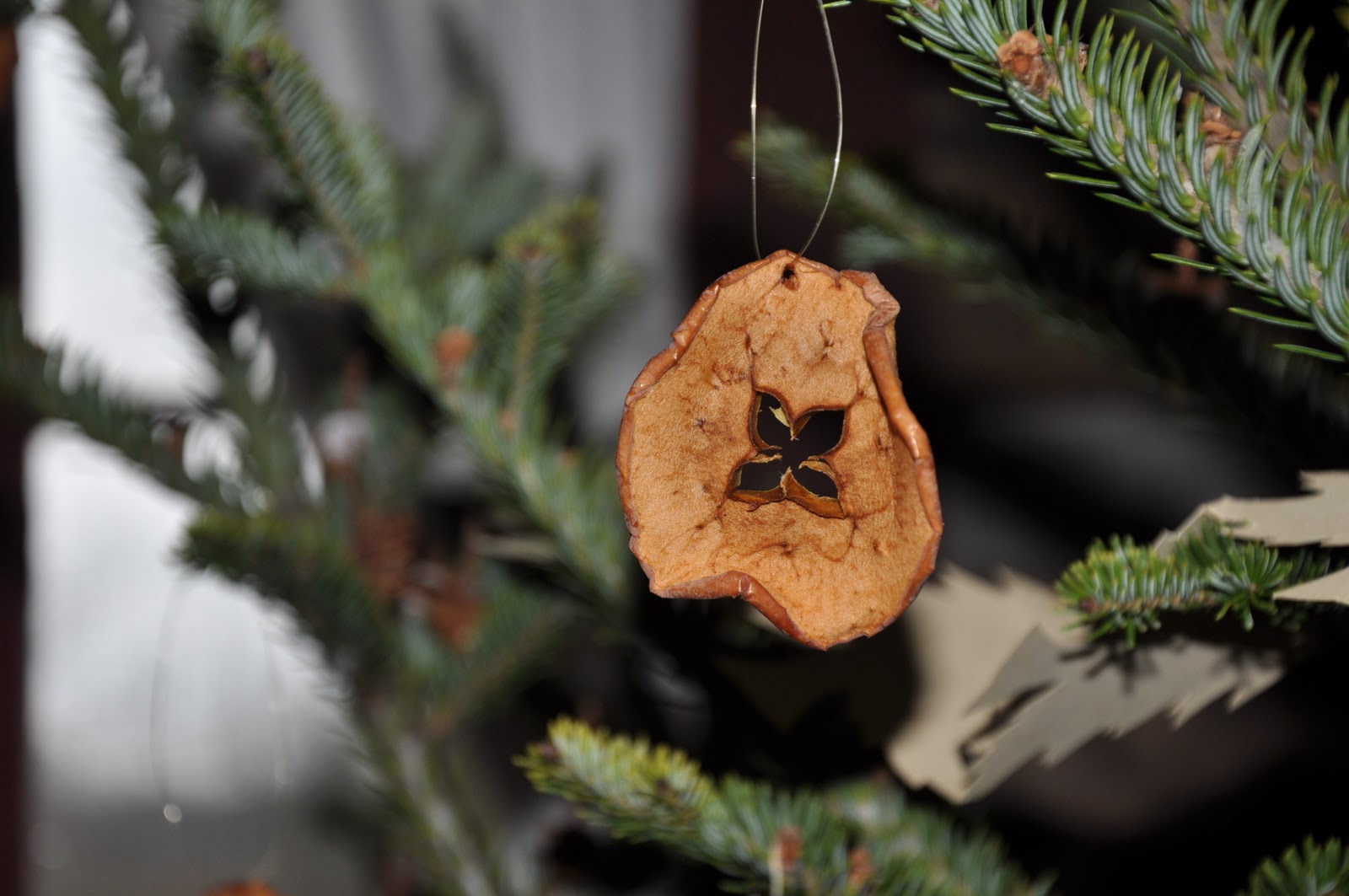
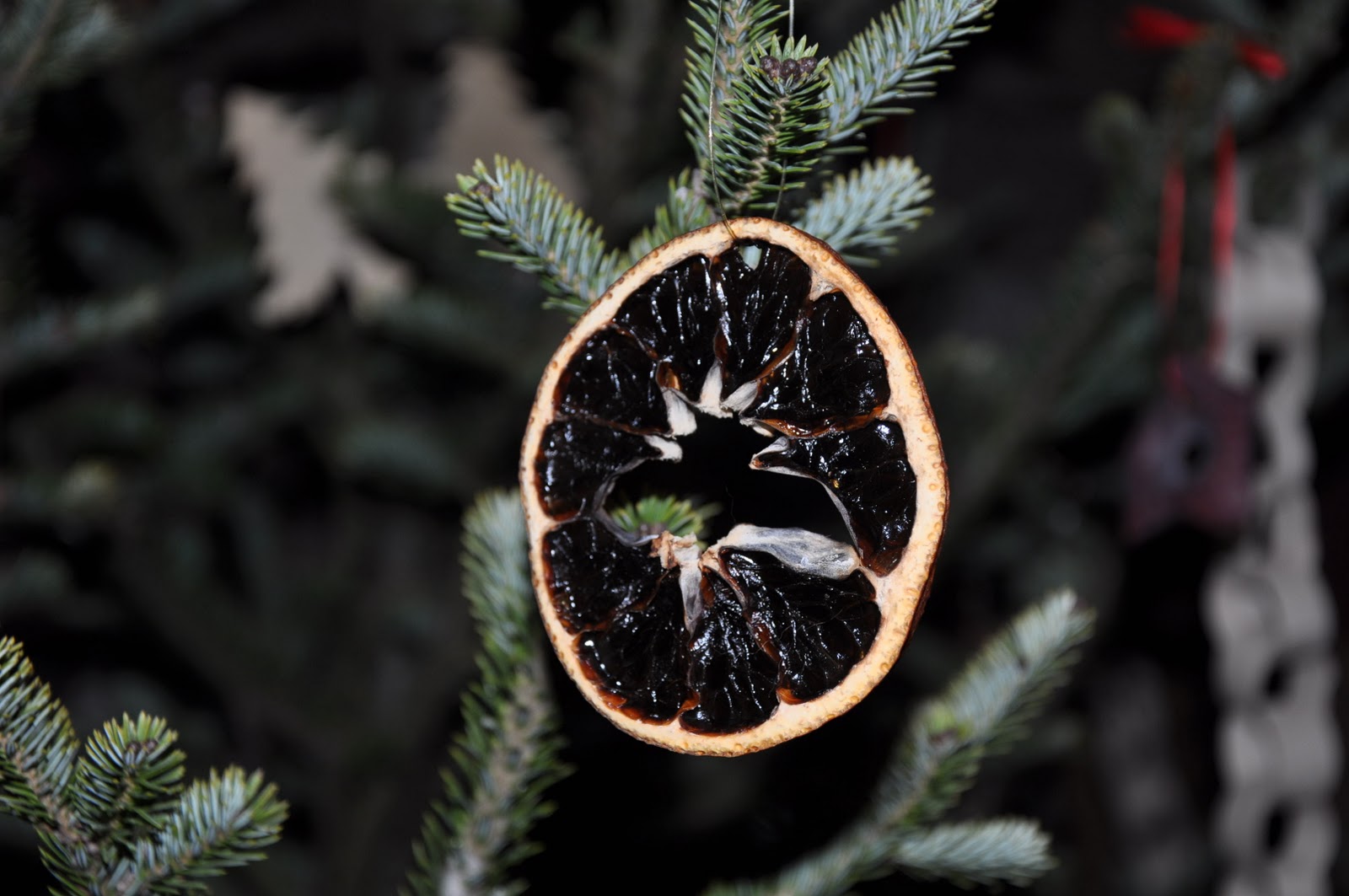
They had decked out the place for the holidays.  Their tree was decorated with various dried fruit ornaments.


I, of course, was drawn to the bed, with its three quilts! 


The tall "barrel" you see just to the right of the door is a section of hollowed out sycamore.  The story goes that one winter the folks who lived in the cabin rescued a native woman and her child from a blizzard.  The family cared for them and when their health returned, they headed back to their people.  The following year, people from the tribe returned to the cabin with this barrel, which was packed full of dried meat, to say thanks for taking care of the woman and child.  The family kept the barrel (and apparently stored flour in it).  


A few pictures up, you can see a windmill.  It is attached to the well, and was the family's source of water.


It was a looooong way down to the water.


Next to the spring house (water pump) was a very short building...mostly under ground.


This was the milk house.  Often these buildings were built on, or next to, the spring house, which provided natural cooling inside.  The family's milk and butter were stored here.  I'm thinking it might also make a pretty nice root cellar.


Next, it was on to the big house, which the family built after living in the little cabin a few years.


Before entering, we had to don blue booties over our muddy shoes - a pretty effective means for keeping the house a little bit cleaner on a wet and muddy day.


In the front parlor we were told all about the many ways folks of this era might have celebrated the holidays. I was most taken by the feather tree, a tradition brought over from Germany in the late 1800s and which became quite popular in the US by the early 1900s.


These little table-top trees are made from feathers, twisted and attached to the branches.  The stiff feathers look very much like spruce or fir needles.  Candles, of course, were the traditional way to light one's tree.  If done correctly, candles on a tree are safe.  One should just never leave the room while they are lit.  My grandmother used to put candles on her tree (she was of German descent), but I don't recall her ever lighting them.  I've only once seen a tree lit with candles, and that was at the house of the family of one of my classmates when I was a kid.  It is lovely.


We toured through the second parlor, which was the domain of the woman of the house, and one could only go in there if invited.  They had an old pump organ there and a woman played it for us as we passed through. 


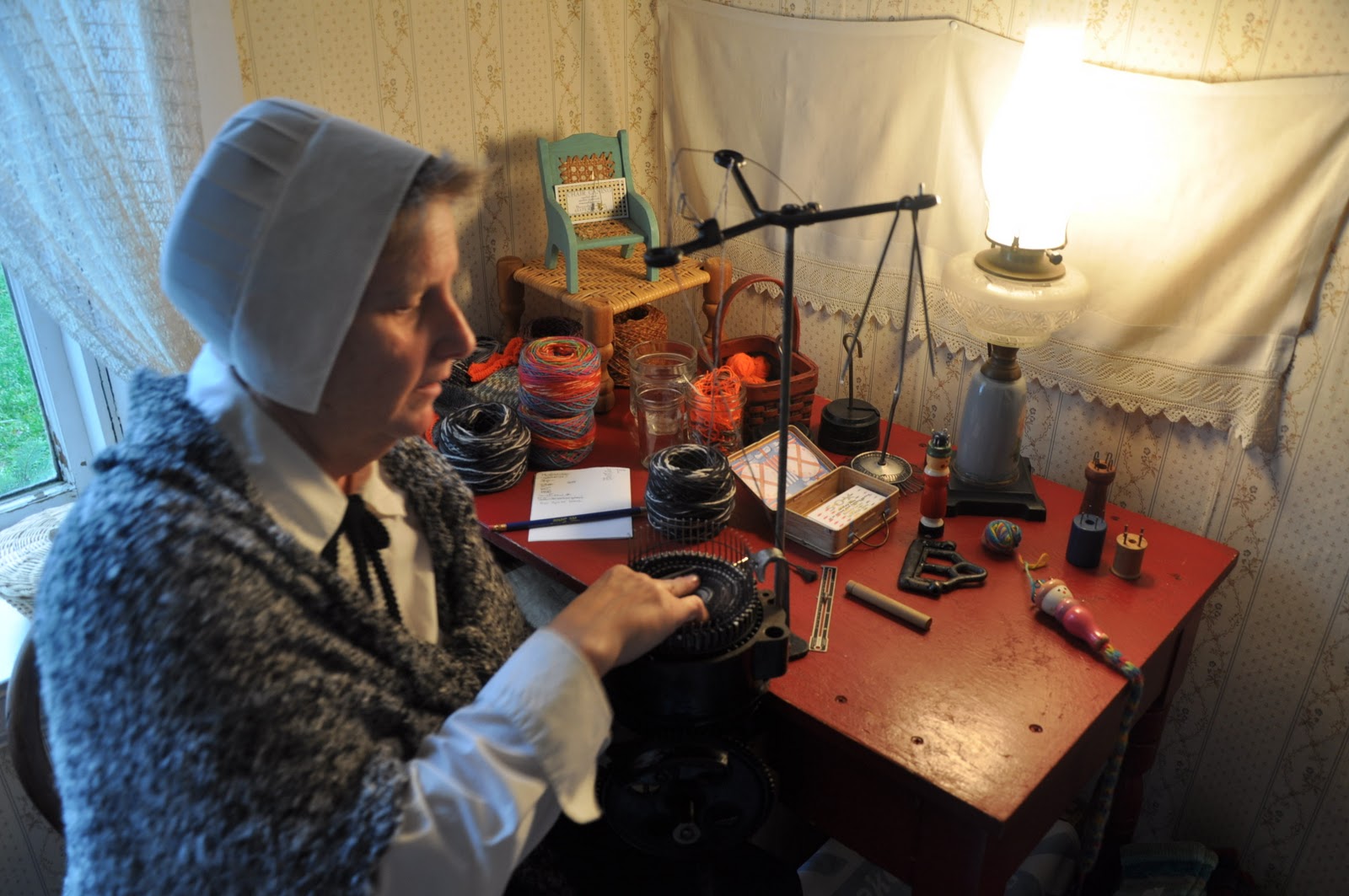
Continuing around the rooms, we came to a small one where a woman was making socks on an antique sock-knitting machine.  The story behind this machine was that there was a woman who was married to a minister.  She spent a lot of time knitting socks for her family, time that her husband would be better spent in prayer.  So, he invented this machine that turned out socks in a fraction of the time it took to knit them by hand.


While I was quite taken by her socks, and interviewed her at length about her machine, I was also enthralled with the crazy quilt that was on the bed.  It had a lot of wonderful embroidery on it, including some great phrases, like the one below ("Laugh and grow fat").


Feathers also featured in artwork upon the walls.  This lovely framed arrangement of flowers was made entirely of feathers.


Things were cooking in the kitchen.  Although it was a chilly and damp day, it was toasty warm in here.  They had bacon frying on the stove and a stew going in the Dutch oven.  Next to the stove, on the left, is the wash tub - it was bath day.  In fact, one of the women in the kitchen was telling us how that was how her family bathed when she was a kid, and she couldn't have been older than her 60s.


The gentleman in the kitchen regaled us with tales of butter-making.  They had a small table-top churn set up to make butter, and they also had this "machine" with some butter on it.  The key, he said, to making good butter was to separate the buttermilk from the butter, otherwise your butter would spoil.  This could be done in a big bowl, pressing the butter up the sides and pouring out the buttermilk, or in the machine below, which would force the butter up between the paddles, leaving the buttermilk in the pan below, from which you could easily pour it off.


By the time we got upstairs, it was after 3:00 and things were getting dark, thanks to the overcast day.  But over all, I had a great time - well worth the price of admission.  In fact, I was so taken by this place that I might even consider becoming a volunteer...after all, I love this period of history.

Friday, December 2, 2011

Raptor Musings

Two nights ago, while letting Mr. T out for one final pee before we turned in for the night, I heard a not-so-distant hooting.  It was a great-horned owl, with a not-so-great voice.  A juvenile practicing, perhaps?  It was out across the field behind the house and sounded like it was in The Tree on the far side.  I listened for a while, hooted back a couple times (just to see if I'd get a reaction) and then heard a second GHO calling from the woods to the west.  When I talked to our bird expert at work the next day, he asked if one of the birds had a higher-pitched voice than the other.  If so, he said, that one would be a female and this might be a pair of birds that might "hook up."  If not, then they might just be a couple males setting up territories.  I hadn't listened well enough to note an difference in the voices, so I went out again last night, hoping they might be calling again.  No such luck - but I will keep trying.

This morning, I had to be at one of the local schools early for a special "Forum" they were holding, with something like 20 speakers on hand to do presentations for the students.  As I walked around the building trying to find the correct door, a small hawk flew overhead:  sharp-shinned or Cooper's.  All I caught a glimpse of was the belly and wings and an edge-view of the tail as it sped away.  Not enough for me to make a definitive ID. 

After the school program I stopped back home to let the dog out, since I will be late getting home tonight, and after doing my duty as a responsible pet-owner, I headed in to work to do my duty as a responsible employee.  Just as I was leaving the driveway, I saw a bird struggling up to the utility pole across the street.  Something was "wrong" with its shape.  When it landed, the tail bobbed up and down - it was a kestrel, and it didn't perch for very long.  As it took off, I saw what had made its shape so odd:  it had a mouse clutched in one foot! 

About fifteen minutes later, another hawk flew across the road in front of my car!  I'm fairly sure this one was a Cooper's, just because of its size.  Again, I didn't see enough of it to tell for sure; it's hard to see the shape of the head and such when a) one is driving and should be watching the road, b) the bird is flying rapidly away from one, and c) the sun is in one's eyes.

But it's been an amazing couple of days for raptors:  owls, hawks and a falcon!  Gee - that's almost a grand slam in my book.

Thursday, December 1, 2011

Snow & Frost

Tuesday it rained.  And rained, and rained.  The wind blew.  And blew, and blew.  The roof leaked.  And dripped and dripped.  And then it turned to snow.  (Well, the precipitation turned to snow, not the roof.)

This is what the world looked like Wednesday morning:


This morning while walking Toby, I noticed all these wonderful long ice crystals on the plants - and the early morning sun hit them just so.  I had to grab the camera and snap some shots before dashing in to work.  Enjoy.


Happy December to All.

Wednesday, November 16, 2011

11-11-11 and Attacking the Alien Invaders

On 11-11-11, we woke to a snowy world.


Okay, so it wasn't terribly snowy, but snowy enough to make things white.  Toby always has to sample the snow.  I keep telling him it's not really good until February, but he insists on forming his own opinion.


By afternoon the snow had melted away, but it was lovely while it lasted.


By the weekend the temps had soared back into the 60s.  I have some time off coming to me at work, so I stayed home Saturday to take advantage of the balmy weather and attack the remaining woody invasives in my yard:  honeysuckles.


Armed with a bowsaw, a set of loppers, a bottle of concentrated RoundUp and a paintbrush, I sallied forth and had at it.


Before long I was left with several piles of trunks and branches, and had my fingers crossed that the freshly painted stumps would not sprout come spring 2012.


This morning I was very pleased to find that juncos and sparrows (I don't know which ones) had already taken possession of the new brush piles (you can just see a junco to the left of center in the photo below - they all flew away when I came back out with my camera). Brush piles are highly underrated by homeowners.  I suspect it is because most people are rather obsessed with The Perfect Tidy Lawn.  Not me - give me a messy yard any day.  I let the grass grow, I plant trees and shrubs in random locations, and I will probably leave these piles of brush lying about.  They make terrific cover for small birds, who will flitter and flutter in and out of them in search of food and shelter.  I may even move a pile over near the birdfeeders.  I just hope the branches don't resprout (like the honeysuckle branches did back at my house in Newcomb).


As I was sawing and lopping my way thru the tangle, I discovered some stout stems growing among the shrubbery and trees.  One thing stood out on these stems:  the large, white leaf scars.


I knew this leaf scar.  It was familiar.  I wracked my brain trying to remember which species it belonged to. Ash?  Walnut?   The phrase "monkey faced leaf scar" kept teasing me.  It was one we used in my dendrology class, oh these many years ago, to remember the species.  Grrrr!  It was dancing around the edges of my memory and I just couldn't come up with a definite answer, although I was leaning towards the walnuts.

There were two reasons for this.  One:  there are a LOT of black walnuts around.  A LOT.  And two:  the ashes have been pretty much wiped out by the emerald ash borer here in Michigan.

I grabbed my copy of Harlow's Fruit and Twig Key and thumbed through it. No luck.

As I sit here at my desk, now, with various books littering the surface around me, I find myself still stumped.  The one clue I need I don't have - a sample of the pith!  This requires cutting off a twig and splitting it open to see the middle.  The stems don't have any branches, so I am reluctant to cut, for I'd have to take the terminal end of the entire plant, and I don't want to do that.

Moving on, we next look at the bundle scars - the bits/spots inside the leaf scar.  If this were one of the walnuts, there would be three bundle scars, one in each lobe of the leaf scar, and they would be rather horseshoe-shaped (making the scar look like a monkey's face).  These are not - they dot the leaf scar all around the curved edge.  Therefore, not a walnut. 

Frustration sets in.

Finally, as a last resort, I Google "walnut leaf scar" and look at images.  There it is!  I open the image and take a closer look.  Alianthus altissima - tree-of-heaven.  Invasive species!  I've never seen one of these.  The leaf scar is the right shape, the bundle scars are in the right locations, and it sports a solitary bud at the top of each leaf scar. 

So now I have to know what this tree looks like.  I Google it and there it is.  It looks like a sumac.  Could it be that all these trees along the roadside that I thought were sumacs are actually Alianthus?  Knowing how invasive this species is, it wouldn't surprise me. 

I just popped over to Gary's office and we looked it up in his handbook of invasive plants, and there it is - a perfect match for my photo above.  Looks like I've got a few more stems to cut and dab when I get home.

Thursday, November 10, 2011

First Snow


It's been a strange day weather-wise.

Burn, Baby, Burn!

As I sit here this afternoon and watch the snow fall in great big flakes that are only just starting to turn the grass white, I think back to this weekend, when it was sunny and warm.  I was putting up the last of the harvest (sweet potatoes, carrots), getting the garden ready for winter, and hanging out laundry, when the call came:  they were going to do a burn at Haehnle Sanctuary - be there at 12:15.  I still had a load of laundry in the washer, but as soon as it was hung, I grabbed my camera and drove north.


The burn was done by the same crew that did the burn last spring at work.  Because of this, there was a chance that I might get to help out again.


However, because I was running a little late, the burn had already started.  This was fine - I was able to kick back and just take photos.


There were two burns scheduled for this day.  The first was this patch of prairie.  The wind was quite strong all day, so the burn was started on the downwind side.  Gary had been out the day before and mowed the firebreak, which served not only as a path for us to walk, but also as a barrier to help keep the fire under control.


There's nothing quite like watching a burn.  The crackle of the flames when they hit of patch of fuel is really quite something. 


This fire moved along quite quickly, leaving a smoking, charred field in its wake.


Next year, the native flowers and grasses should be great here.


Once all the smokers were put out and the site deemed safe, the crew loaded up and headed for the second burn site along the western edge of the sanctuary.


This site was a bit different.  It started off along the edge of a wetland, where reed canary grass is invading the marshland.  Fire won't do much to remove this invasive, but it will help keep it in check.  High water levels are much more effective in controlling it.


As the fire burned southward, it entered a small patch of woods, bordered on one side by the road and on the other side by a small pond.


It was interesting to see just what didn't burn, like this pile of trash,


and the matted plants of this deer trail.


Occasionally the wind would gust and send billows of smoke across the road.  This didn't slow down the traffic, though.  It was such a glorious day that many folks were out for a Sunday drive.  Lots of shiny, clean sports cars passed us, no doubt wondering what in the world we were doing.


As the fire passed through the woods, it gobbled up the ground cover.


A couple trees also caught fire.  These were old snags, trees that were long dead and whose hollow centers acted like chimneys.  The fire crew had to put these out.


Once on the other side of the woods, the fire came to another open field.  Several lines of fire were set here to speed the burn along.


Prescribed burns are an important tool in maintaining open grasslands.  They help rejuvenate fields and prairies, stimulating new growth in the spring and summer, and they can help keep some invasive species in check.  Fire is one more tool in the arsenal of land stewards, and its one I never get tired of watching.