We had a whopping 1/10" of rain yesterday morning - a near flood! On the way to work the evidence of this precipitation event was clear: frogs by the dozens were hopping across the road (interestingly all going in the same direction). Unfortunately, they chose to do this during the morning rush hour - there was no way to avoid them. :(
Yesterday afternoon a "severe storm warning" was out, and the sky darkened considerably about 4:40. There were some rumblings of thunder, and suddenly the heavens opened. I walked out to the car in the downpour, reveling in the wet and the cooler air (it has been around 100*F). As I drove home, I saw evidence that the rain, which had lasted maybe 10-15 minutes, had blown thru Jackson, headed eastward. It dumped on Napoleon, but when I got to the ol' homestead, only four miles further east, not a drop had fallen.
I live in a bubble.
The heat and humidity was back on the rise, too. (Today "they" are predicting a heat index of 110*F.)
When T and I got home from our brief evening walk (too hot and humid to stay out long), I found this lying on the front steps:
It was nearly dead, so I had a photo opportunity. I put the dog inside and grabbed the camera. I'd seen this insect before, but couldn't recall ever having identified it. The red belt around the abdomen and the blue tinge to the wings were quite striking.
This morning I found it in my insect books: Mydas clavatus, one of the Mydas flies. Typically a southern and western family of flies, this is the only species in the family that is found in northerly regions, and it is one of the largest flies in general.
Despite its wasp-like appearance, it is harmless to people. According to Marhsall's Insects - Their Natural History and Diversity, this species is commonly found along the Great Lakes, where it likes to nest in the sandy beaches. That could explain why it is here - instead of real soil we have sand.
Another nifty note Marshall makes is that little is known about the lives of the adults other than they seem to be nectar feeders (although the larvae prey on beetles). Could it be that this individual has been visiting my hummingbird feeders (there was one hanging very near where I found it)?
What caught my eye about this particular individual, besides its gigantic size and it's bluish wings, was the white "ring" around the end of the abdomen. Upon closer examination, I discovered what looked like little seed pearls and small reddish-brown beads stuck to this area. Could they be parasite eggs and the parasites themselves?
Not knowing the answer, I have sent a copy of this photo off to BugGuide.net to see if any of their folks are in the know. Stay tuned for updates!
Friday, July 6, 2012
Thursday, June 28, 2012
A Well-done Look at WNS
I have a bat program to do tomorrow night up at the Henrietta Library, and while doing some research to be sure I have the current info about Michigan's bats, I came across this great "documentary" by Garrit Vyn about White-nosed Syndrome.
I know I've posted about this disease several times, but there remain folks out there, especially here in Michigan, who have no idea what it is. The images Vyn captures here really hit home - this is the tragedy that is wiping out our bats.
Today the fungus has been confirmed as the cause of the deaths of all these bats.
White-nose Syndrome from Gerrit Vyn on Vimeo. I am grateful that WNS is not here in Michigan yet, and every bat I see at night I greet with a warm welcome. I am happy to see these bats - they have dodged the bullet so far, but WNS is now confirmed in the Midwest, so it is only a matter of time before it makes its way to Michigan.
I know I've posted about this disease several times, but there remain folks out there, especially here in Michigan, who have no idea what it is. The images Vyn captures here really hit home - this is the tragedy that is wiping out our bats.
Today the fungus has been confirmed as the cause of the deaths of all these bats.
White-nose Syndrome from Gerrit Vyn on Vimeo. I am grateful that WNS is not here in Michigan yet, and every bat I see at night I greet with a warm welcome. I am happy to see these bats - they have dodged the bullet so far, but WNS is now confirmed in the Midwest, so it is only a matter of time before it makes its way to Michigan.
Sunday, June 24, 2012
A Walk Thru the Land
The native plants are starting to blossom! I was very excited to see that my rattlesnake master is doing so well, especially since we can't seem to get it to stay alive in the native gardens at work. Rattlesnake master is a great native alternative to yucca, which isn't native to Michigan (and grows all over, and right now is in prolific bloom, no doubt enjoying the drought). The spiky leaves help keep the deer (and rabbits) from eating this native plant.
I can't wait to see the flowers open!
Watched the spicebush swallowtail caterpillar cruise along the spicebush branch last night. So, I thought I'd let you see the difference between the native spicebush...
and the Korean:
Do you see the difference? The native is all chewed up, while the Korean is blemish-free. In other words, the Korean has no (zero, zip, nada) wildlife value - no insects eat it, so it likewise doesn't feed any birds. I should rip it out and plant more native spicebush!
The St. John's wort has come into bloom in the last week or so...right on time for the summer solstice.
The invasive thistles have been going strong all month, too. I've finally started eliminating them (Round Up) in the yard...nasty, prickly things. Good riddance, although the flowers are rather nice-looking and the bees do seem to enjoy it.
The little bit of rain we did manage to get sent this mullein shooting upwards. It was about 10" tall before the rain, and the day after it was pushing three feet!
Although the last couple of days have turned quite hot, the humidity has been down, and the nights have been gloriously sleepable!
I decided to take our evening stroll thru the field - I've been avoiding it because of the ticks, but it just called to me this evening, so off we went.
There are several areas where the ground is bare. My first thought was "deer lays," but it seems pretty exposed for a deer to be snoozing here.
A pile of rabbit droppings is a clue. We have LOTS of rabbits. Cottontails, all. I do miss snowshoe hares - a "rabbit" of decent size. Cottontails seem so runty by comparison.
Now, this is suspicious: an open bluebird box. How in the world did it get open, for it's held shut with a screw?!?!
Yep, it was pulled open alright. Must've been a raccoon - the screw was barely in.
Down on the ground was the torn-apart remains of the nest. House sparrows...no great loss.
But the other box, that one had bluebirds in it earlier this spring. I found the nestlings dead, with the parents still "taking care of" them. I emptied the box and put in a man-made nest of grass to encourage the bluebirds to try again. Did they?
The feathery nest suggests that someone made use of it, but not a bluebird.
There were two nestlings inside. Species? House sparrow. By rights, I should've "dispatched" them - nasty invasive species. But I'm too gentle-spirited to do that. It's one thing to keep ripping out starling nests and to chuck starling eggs out into the field, but to actually suffocate or drown a bird...well...I don't think I can do it.
Here is the entire patch of native milkweed on my property. Three whole plants.
And the flowers were covered with Japanese beetles. Argh!
More bare spots. These are just too big to be rabbits, right? The squishiness of the ground suggested to me that this is mole damage. Just like in my native plant bed, the subterranean mole tunnels must've kills the plants, drying them out from below.
This hummock is the only bit of "elevation" on my property (not counting the roadside ditch). A tree root had been toppled over here years ago. What's growing here now?
Plenty of pokeweed!
And this brings us to the abrupt edge between my land and the field next door.
This year he is growing hay. It was harvested earlier this month, and this pile remains. Several of the fields have lone piles of unrolled hay. Is it the leftover cleanings of the equipment? I'm sorely tempted to sneak a few loads of it over to my gardens for mulch!!!
Along the edge day lilies thrive.
I know they are rather invasive, but they are a cheery spot of color on the otherwise rather dull brown and green landscape.
Soon the raspberries will be ripe. Pity I don't like them - there's a few good batches of jam here. The birds will get to enjoy them, though.
This year I finally got a shot of the everlasting sweet peas. They are a stunning splash of pink in the tangle along the edge of the property. Native? No, but there's only a handful, so I leave them. If they start to take over, well, then I'll reconsider.
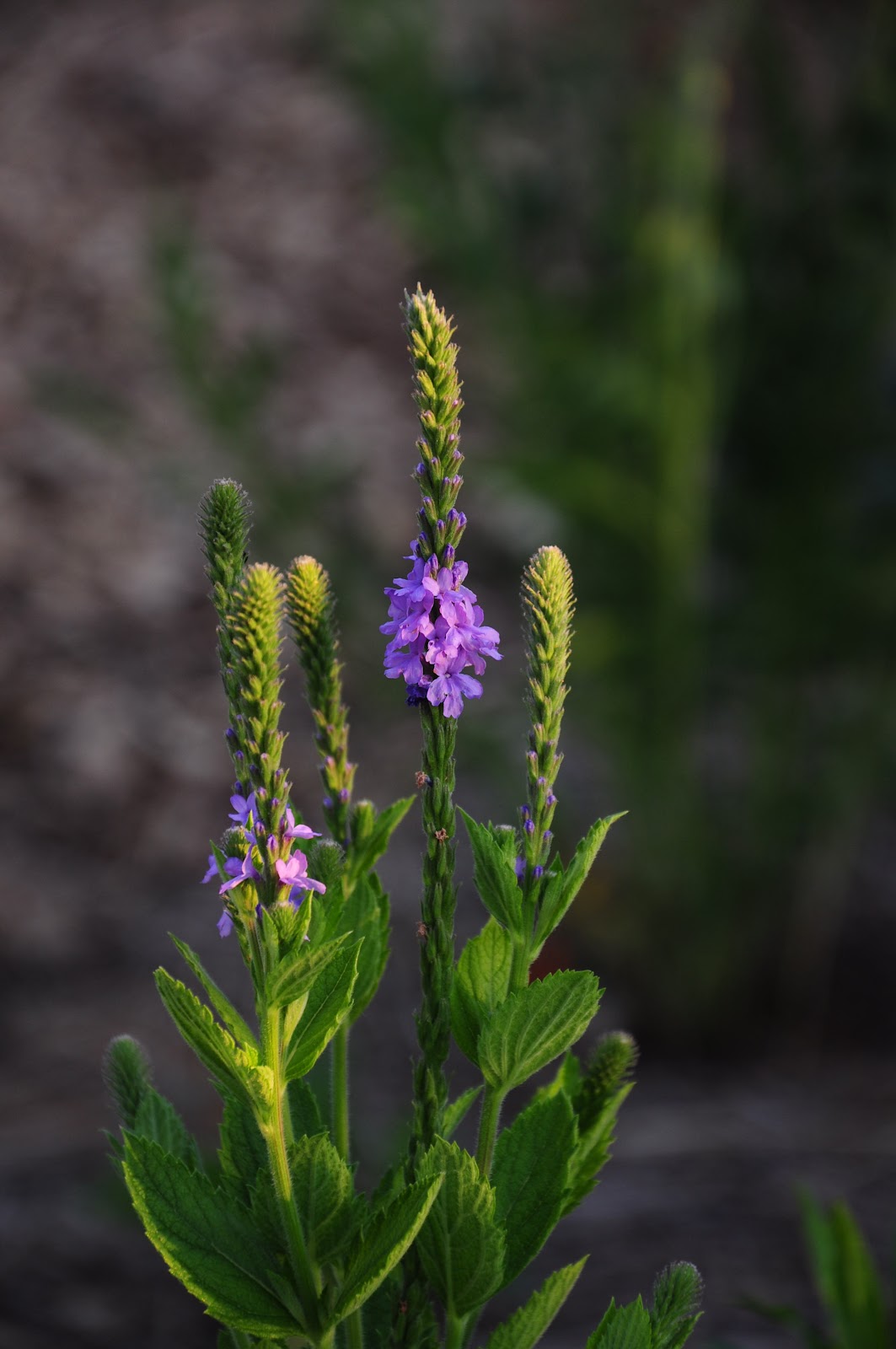
The native plant border I planted around the veg garden is starting to bloom - it's very exciting. I didn't have blossoms last year - it was only planted in August. First to blossom is the hoary vervain. This is a terrific pollinator plant, and I have three!
And right next to it is thimbleweed. A member of the buttercup family, I learned about this lovely plant about four years ago while botanizing along the Hudson (at the Ice Meadows) with my friend Jackie. It always makes me think of her.
The trees are still going strong. Lost some of the white pines, but that was expected...they were looking poorly when I got them. The dogwoods were a bust. I kept hoping, since the folks from the conservation district insisted there were enough roots to take, but I had my doubts and it looks like I was right. But the oaks and ninebark are looking great. I'll give 'em time to get a good root system going, and then I'll go and plant them. Maybe this fall.
The native bed by the house is starting to recover. As long as I keep on top of the mole activity (literally), it looks like some of the plants may recover. Others are a lost cause. I think I should've chosen all "full sun" plants - the partial sun/shade plants are not doing well at all (like the green dragon). Maybe I should transplant them to a shadier spot.
Next year perhaps the natives will take off here like they did around the veg - and I'll have lots of glorious flowers to share. And maybe by then I'll be able to tackle turning that field into a native plant haven...starting with fire.
Friday, June 15, 2012
Ramblings Around the Neighborhood
Despite the drought, things are happening all around. One of the things is the death of many of the native plants I planted last month near the back deck. They just weren't thriving, and against my better judgement, I kept watering them (it's been hot and dry after all, and the leaves were all curling up). This didn't seem to help. Then last night, while watering again, I noticed one of the monkey flowers looked like it's root ball had been pushed up out of the ground...and so did another (they were both dead - over night). I took a step into the garden and sank. Moles. The #*&^$#( things have tunneled under the garden and have exposed the roots to air rather than soil - they dried out from below!!! I am not a happy camper. I've often had warm feelings for moles, but this could be the end of that.
Meanwhile, on a more cheerful note, I've been watching and listening to many of the birds, especially while Toby and I do our evening walk. The dicksissels are back! It took me a while, but this unusual bird call caught in my mind and eventually I saw and identified the bird - the dicksissel, which I saw for the first time last year. This year I tried photographing it - I think it is an extremely camera-shy bird, but I persevered, and finally got a few shots that are okay. Ta-da!
And here is what it sounds like. It is the rough "dick dick dick sissel", not the sweet floating song you hear first.
Let's see...what else. Oh - I found two spicebush swallowtail butterfly caterpillars on my spice bushes! Very exciting - this is why I planted them! The first is the younger - when very young they look like bird poop.
The older instar looks like a green worm with huge eye spots - all the better for scaring off predators, my dear. Like all good spicebush swallowtail larvae, it was rolled up in a leaf for the night.
I found this beautiful egg under the maple tree where my feeders are. I brought it in and looked it up in my guide to nests, nestlings and eggs; it's an oriole egg. The big hole in the side suggests another bird broke it open and probably ate the contents - Gary suggested the likely candidate was a grackle.
The little beggers bolted up the fenceline, in the wrong direction! (Can you find them both?)
I tried heading the trapped one off at the pass, but it only turned and made little growly noises at me - it wouldn't turn away from me and move toward the opening.
But how cute is that? Is there anything cuter than a baby raccoon?
After it decided to come toward me (see above video), I decided to find a Plan B. My fence is not the sturdiest thing, but it is sturdy enough that just raising up one section is not easy. I was able to pull it up about three inches and the little one scooted underneath, the two happy to be reunited in the tall grasses.
I waited a few minutes and then let Toby out. Oops!
Look at that fur stand on end!
He was simply beside himself.
I thought the babies would've moved on, but they stayed in the grasses - waiting for mom? I finally had to put T back inside while I did my chores. By 2:30 AM they had moved on.
Meanwhile, on a more cheerful note, I've been watching and listening to many of the birds, especially while Toby and I do our evening walk. The dicksissels are back! It took me a while, but this unusual bird call caught in my mind and eventually I saw and identified the bird - the dicksissel, which I saw for the first time last year. This year I tried photographing it - I think it is an extremely camera-shy bird, but I persevered, and finally got a few shots that are okay. Ta-da!
And here is what it sounds like. It is the rough "dick dick dick sissel", not the sweet floating song you hear first.
Let's see...what else. Oh - I found two spicebush swallowtail butterfly caterpillars on my spice bushes! Very exciting - this is why I planted them! The first is the younger - when very young they look like bird poop.
The older instar looks like a green worm with huge eye spots - all the better for scaring off predators, my dear. Like all good spicebush swallowtail larvae, it was rolled up in a leaf for the night.
I found this beautiful egg under the maple tree where my feeders are. I brought it in and looked it up in my guide to nests, nestlings and eggs; it's an oriole egg. The big hole in the side suggests another bird broke it open and probably ate the contents - Gary suggested the likely candidate was a grackle.
Then last night, an indigo bunting (my first of the year in the neighborhood) was singing down at the edge of the woods, and it flew to the ground not 20 feet from me - and sat there! Did I have the camera? No, of course not.
When we returned home and cut across the yard, a low brown movement near the fence caught my eye. I thought it was a woodchuck, but it was TWO baby raccoons!!! One was inside the fence, the other outside, and they were desperate to get to each other. I dragged T around the house and put him inside, grabbed my camera and went out the back door, intending to get a photo or two and then shoo the trapped raccoon out through the "gate" I opened in the fence. Here's what happened:
The little beggers bolted up the fenceline, in the wrong direction! (Can you find them both?)
I tried heading the trapped one off at the pass, but it only turned and made little growly noises at me - it wouldn't turn away from me and move toward the opening.
But how cute is that? Is there anything cuter than a baby raccoon?
It's sibling was in the tall grasses on the far side of the fence (far being relative - it was only about 4 inches away, but with the fence it might as well have been four miles).
After it decided to come toward me (see above video), I decided to find a Plan B. My fence is not the sturdiest thing, but it is sturdy enough that just raising up one section is not easy. I was able to pull it up about three inches and the little one scooted underneath, the two happy to be reunited in the tall grasses.
I waited a few minutes and then let Toby out. Oops!
Look at that fur stand on end!
He was simply beside himself.
I thought the babies would've moved on, but they stayed in the grasses - waiting for mom? I finally had to put T back inside while I did my chores. By 2:30 AM they had moved on.
Saturday, June 9, 2012
Mole Holes
I've become quite curious about the mole activity around here. There are plenty of moles in the Adirondacks, and I even had them tunneling through my yard there, but I've never seen mole activity on the scale I've seen it here in Michigan. When they talk about mole hills and tunnels here, they mean massive structures (by comparison to those I saw in the 'dacks). Why, you almost need an oxygen mask to scale the things, they are so large! (Okay, that's a bit of an exaggeration, but to see a pile of dirt that's over a foot across and 8+ inches high - that's pretty darn impressive.)
So, a couple nights ago when I saw a mole hole along the road, I knew I had to go back and take a photo of it, preferably with a measuring tape. I figured that with some data I might be able to determine just which moles were making these impressive structures.
So, we went out, I found the hole, I photographed it, I measured it, and I've now looked it up in my tracking book. And I'm no further along than I was before. Grrr!
According to Mammal Tracks and Signs (Mark Elbroch), mole holes measure 1-1 3/8" across. HM. This one was 2-2.5" across. Maybe Michigan moles are bigger?
Combing through available literature, and personal experience, I know that star-nosed moles prefer wet areas - swamps and the like. My yard is not wet. The road is not wet. And this is not just because it hasn't rained in forever - I am just not in a wetland. Therefore, the odds of these mole holes/tunnels/hills being made by a star-nosed mole are pretty slim.
There are four species of moles that are found along the western coast (broad foot, Townsend, shrew-mole and coast moles). I'm not likely to have one of those here, either.
This leaves the eastern mole and the hairy-tailed mole. I used to find dead hairy-taileds quite often in the Adirondacks. Don't know if I've ever seen an eastern.
If you believe the Michigan DNR website, we only have eastern moles here, but I've seen a range map for star-nosed moles that puts them here, too, plus I've heard native Michiganders talk about star-nosed moles, so I think they are here, too. Still, they prefer wet areas, so by process of elimination the culprit in my yard, along the road, and all around, has got to be the eastern mole (Scalopus aquaticus).
Case closed? I think I still want to see one of the critters up close - that will be the only way to know for sure.
FYI: mole hills are pushed up to become ventilation shafts - gotta get air into those tunnels (some of which can be quite deep). Mole hills might be used for a hasty escape route, but they are primarily there to bring oxygen into the home.
Wednesday, June 6, 2012
Another Bird
These are bird days - lots of activity! I was simply tickled pink to have an oriole come to my feeders!
First it was trying to feed from the hummingbird feeder, but this wasn't designed for orioles.
So I quickly refilled the oriole feeder, which has larger feeding ports and perches set at oriole distance from the holes. It also has little dips around the edges for grape jelly, which supposedly orioles love. I have yet to have an oriole ever eat the jelly, but I've heard other people say it works.
Between the oriole(s) and the hummingbirds, I have run out of sugar! I must get a bag today so I can make some more nectar.
Nectar is very easy to make, and so much cheaper than buying it: boil four cups water and add one cup sugar. Cool and serve. No red food coloring is needed.
Four cups of nectar used to last me a month...if the weather was cool and the nectar didn't mold. Now, however, I'm going thru four cups in a couple days!
And then there are the barn swallows...
First it was trying to feed from the hummingbird feeder, but this wasn't designed for orioles.
So I quickly refilled the oriole feeder, which has larger feeding ports and perches set at oriole distance from the holes. It also has little dips around the edges for grape jelly, which supposedly orioles love. I have yet to have an oriole ever eat the jelly, but I've heard other people say it works.
Between the oriole(s) and the hummingbirds, I have run out of sugar! I must get a bag today so I can make some more nectar.
Nectar is very easy to make, and so much cheaper than buying it: boil four cups water and add one cup sugar. Cool and serve. No red food coloring is needed.
Four cups of nectar used to last me a month...if the weather was cool and the nectar didn't mold. Now, however, I'm going thru four cups in a couple days!
And then there are the barn swallows...
Little Brown Bird
I know...it looks like any other little brown bird, probably a sparrow. And indeed it is. But it's more than that - it's a Henslow's sparrow, a bird that many a birder will travel many a mile to see in person. Yesterday I got to see several, thanks to the birding expertise of a coworker and the regular Tuesday Morning Group programs he leads. We went out for a morning stroll near Waterloo to look for these sparrows, bobolinks, and other field birds. I was there for the bobolinks (didn't see one), but I got to add two new birds to my life list: the Henslow's and swamp sparrows.
You can read about the trip here.
Subscribe to:
Posts (Atom)