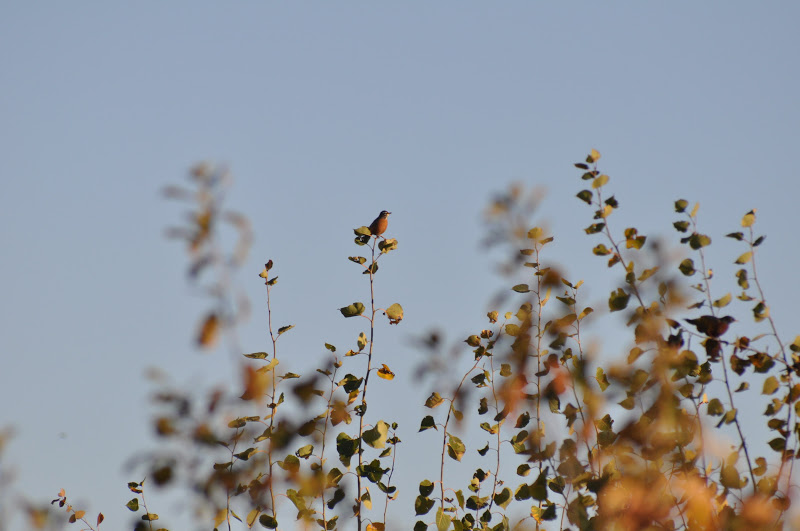
Tuesday, October 16, 2012

Noggles Road

Monday was completely unscripted.  I had to make a trip to Saline, and on the way back home I stopped at the shooting range just up the road from the house.  Do they do archery, or is it only firearms?  Turns out, not only do they have a dinky little archery spot, but they are in the process of building a full-fledged archery range a distance from the firing range.  Huzzah!  

So, I have my loaner bow and loaner arrows...all I needed was a bow stringer and ear protection (archery may be silent, but the firing range is RIGHT THERE and it is best to be safe than sorry).  Where to go?  Cabelas, down in Dundee.  

I turned the car around and headed to Manchester.  Lots of road work going on there - Route 52 has been under construction for about a year now.  I didn't want to deal with all that, so I decided to hit the back roads.

Now, I didn't really end up lost...I just wasn't completely sure where I was.


I discovered some really, truly lovely land, though.  Noggles Road - you've gotta love the name!  It is a dirt road, and seems to go on forever.  Both sides were lined with lovely autumnal woodland.  There were even some little pocket wetlands along the way.


 The camera was lurking in the back of the car.  I should've taken it out sooner, for I came around the bend at one point to find a half-dozen full-grown turkeys, beards and all, in the road.


Mostly the drive was wooded, but a few fields zipped by (well, "zipped" is what it looks like in the blurry photo, but in truth I was rarely above 20 mph - bumpy dirt roads do not lend themselves well to speed).


The highlight, after the turkeys, was this hawk coming in for a landing.


I sort of pulled over to take some shots, but of course suddenly it was Grand Central Station!  I moved the car further off to the side to avoid getting grazed along the side.  The final vehicle to pass was a large, noisy truck, and the bird flew off.  Still, I got enough shots to say I think this is a juvenile red-tailed hawk.  The dark belly band is the biggest clue.  The tail was banded, not a solid russet like we expect on an adult red-tail, which made me think it might be a Cooper's or sharpie, the bird was just too big for either of those.  Looking through the field guide later, I confirmed what I suspected:  juveniles have banded tails.  


I eventually found my way out of the woods and onto a highway.  But I had such a good time driving Noggles Road that I was sorely tempted to do it again on the way home from Cabela's.  In the end, I stuck to 52 and got caught up in all the constructions...should've followed my whim and headed back into the woods.

I'll be returning to Noggles Road another day - it warrants visits in all seasons.

Wednesday, October 10, 2012

Crane Counting

Monday was breezy and lovely - a day to get chores done outside.  But last week I promised a co-worker that I would come out to Haehnle Sanctuary to help with the weekly crane count.  So, after doing laundry, taking a cat to the vet, digging spuds and shucking dried beans, I showered and drove up to Waterloo.  By 5:00 it was still sunny and lovely, but the breeze was chilly - and it would only get colder as the sun set. 


A handful of watchers were already on The Hill, and it turned out that the folks for whom I was the stand-in counter arrived after all.


So, I was able to go down the hill and do some late afternoon photography instead!


Not too much was still blooming.  This delicate little aster, which is rather prolific around these parts, was still putting on a show.


And of course the milkweed was in full fluff.


Sweet everlasting is also in bloom right now.  A relative of the pearly everlasting I knew back east, this plant has a trait the other lacks:  it smells like maple syrup.  No kidding. 


Robins by the dozens (dare I say hundreds?) flitted back and forth across the sky, coming in to the to sanctuary for the night. 


The main event, though, was the nightly return-to-the-roost of the greater sandhill cranes.  When conditions are just right (water levels and mudflats), the sanctuary fills up every evening in the fall with cranes who are making their way southward for the winter.  Two years ago they had record numbers of over 5000 birds.  Last year water levels were too high and only a fraction of that number used the sanctuary for roosting.  This year, however, conditions are looking promising.


There were a number of gashawks making tracks across the sky, too.


I left the sanctuary about 7:00 - a bit chilled.  Crane watchers were starting to fill the parking lot, and apparently after I left the large flocks started to arrive.  Final count for the night:  1,855.

Tuesday, October 9, 2012

Reign of Arrows

Welcome to a cold and blustery day in central Michigan.  It was Saturday, and we were just outside Flint, where one of the members of the Barony of Cynnabar Shire of Stormvale was hosting an archery shoot:  Reign of Arrows.  We arrived about 10:00 AM and the clouds arrived with us...never quite departing.

Early arrivals kept warm by the fire.


But it was time to get warmed up to shoot.  Bows had to be strung...


the range had to be set up...


and soon we were on the line, stretching our strings and sending arrows down-range into targets (and the grass).


At these shoots, there are targets at 20, 30 and 40 yards, the usual fare.  Additional targets can be almost anything else.  In this case, about, oh, 75 or more yards down range was a "clout shoot" - which today was a large bear behind some bales of hay.


Anyone who can get their arrows within the boundaries of the hay bales is doing well.  To actually hit the bear is either blind luck or very good shooting!

 
After sufficient warm-up time, we shot a Royal Round.  This involves six arrows shot at each of the targets (20, 30 & 40 yards), and then a timed shoot at the 20-yard target (however many arrows you can loose at it in 30 seconds).  I never do as well at the Royal Round as I do in practice.

Then it was lunch time; hot soup was very welcome on this chilly day!


And after lunch the fun shoots began.  First up was a...well...I'm not sure what to call it.  It involved four separate shoots.  First, we had these small targets attached to hay bales that were only 5-15 feet away from us.  You'd be surprised just how difficult it is to shoot at a target that is so close.


For the second round, we had to shoot at the Black Knight.  Points were only awarded if we got our arrows in his arms or legs.

This was followed by round three:  Friend or Foe.  One of the small targets was placed on a pile of bales in front of the Knight.  If we hit the small target (Friend), it was not good.  But we got points if we hit any part of the Knight (Foe).

The final round was the clout shoot, but the bear was replaced by a large drawing of a pumpkin (see above shot, in distance).  We shot from the 75 (ish) yard line, then the 50 (ish) yard line, then sort of 30-ish...sneaking up on the pumpkin.  Various points were awarded depending where your arrow(s) landed on the target.

All points were added up and the winner was:  Forrester Dillon!


Next up was a "Stuffy Shoot."  An assortment of stuffed toys were scattered across the range.


Now you might think this was only for kids,


 but we are all kids at heart.  You got to keep what you shot:


It was a hoot.

Of course, every shoot requires that all arrows not lodged in targets are located.  Sometimes this is easy - they are sitting on top of the ground or poke into the earth at a great angle.  Other times, well, we have to hunt for them.  The group affectionately calls this QUASAR:  Quarrel and Arrow Search and Rescue.


Sometimes you have to bring out ye olde metal detector.  But bare feet are often just as effective...they just don't beep.


Despite the less-than-optimal weather,


a good time was had by all.  And why not?  Good food, good friends, and target shooting with traditional bows - how could it be anything but fun?

Thursday, September 20, 2012

It's a Beautiful Thing

My dad forwarded this video to me. I thought I'd share with it with you. There are good folks in the world.

Please - if you are a fisherman, please be sure to take care of your gear when it gets fouled in trees, rocks, bridges, etc. You may not save a whale from certain death, but you could prevent the death of birds, turtles, or other wildlife. And if you see tangled line while out paddling, swimming, hiking...collect it. You, too, could save a life.

Tuesday, September 18, 2012

The Yellow Flowers of Fall

While touring the native flowers around my yard, I came to the conclusion that there are an awful lot of yellow flowers out this time of year...and they all look the same!

Cup Plant (Silphium perfoliatum)

Green-headed Coneflower (Rudbeckia laciniata)

Rosinweed (Silphium Trifoliatum)

Sneezeweed (Helenium sp.)

Unknown, but probably yellow

 Ooops!  Not a yellow flower!

Now, in all fairness, not everything is yellow (although I did leave out the woodland sunflowers and the western sunflowers, which are also yellow, rayed flowers).  A few other colors are lingering:

 Rough Blazing Star (Liatris aspera)

Hoary Vervain (Verbena stricta)

                                          Prairie Heart-leaved Aster (Aster oolentangiensis)

Purple Giant Hyssop (Agastache scrophulariaefolia)

Yellow Giant Hyssop (A. nepetoides)

Horsemint (Monarda punctata)


The Rosinweed is one I've been waiting to bloom - love the name, the rabbits kept eating the plant, so I have been chomping at the bit to see what this wonderful plant would look like.  Here it is:

I do like the form of the plant - it's compact, solid, growing quite tall all of a sudden, and the whole of the plant is riddled with flowers and buds.  Had I looked at the scientific name, however, I probably could've guessed it would be a rayed, yellow flower - it is a Silphium, after all. 

The prairie heart-leaved aster was another I was eager to see in bloom.  Asters as a whole can be very confusing flowers to ID, especially since they readily hybridize (scandalous!) and I was looking forward to seeing one with such a delightful name, although I must admit I haven't seen a single heart-shaped leaf on the three plants I put into the native flower bed.


 Also known as Sky-blue Aster, this is one of the last asters to bloom in the fall.  The flowers, as you can see, are a delicate pale purple.  I'm guessing the bees are gonna be lovin' this plant now that many of the others have given up the ghost for the season. 

And out in the fields all around the house?  What is blooming there?  Assorted grasses and knapweed.  In other words, they are pretty barren - even the knapweed is Spartan this year.  The field behind my house is brown...90% brown.  Not a spot of color to be seen anywhere.  Hopefully I will be taking care of this in the years to come:  big plans to burn it and plant native flower seeds...and shrubs...and trees.  We shall see what the budget can support!

Wednesday, September 5, 2012

BB in the BB

I love my "bird TV".  How delightful it is to sit on the sofa and look out the window at the antics of the birds (and other wildlife).

I admit, I don't always keep the bird bath cleaned and filled...I go in fits and spurts on that.  I filled it about a week ago, and then a week of hot, hot weather evaporated most of the water, and what was left had become quite slimy (algae?  bird schmezz?).  So, a couple days ago I schlepped the hose over to the bird bath and gave it a good scrubbing, after which I filled it right up with cool, clean water, and then headed off to water the shrubs and wildflowers I recently planted as part of my on-going effort to naturalize the landscape.

Soon the birds had found the newly watered plants and the clean bath.  They went to town.  Not only were there easily a dozen or two sparrows flitting around in the grass, but a family of bluebirds decided it was bath time.


And, just for laughs and giggles, here they are in action:


(The background sounds are either traffic on the road, Dr. Who on the computer behind me, or the dog.) 

It's amazing how just a small bit of water can bring so much life to a yard.